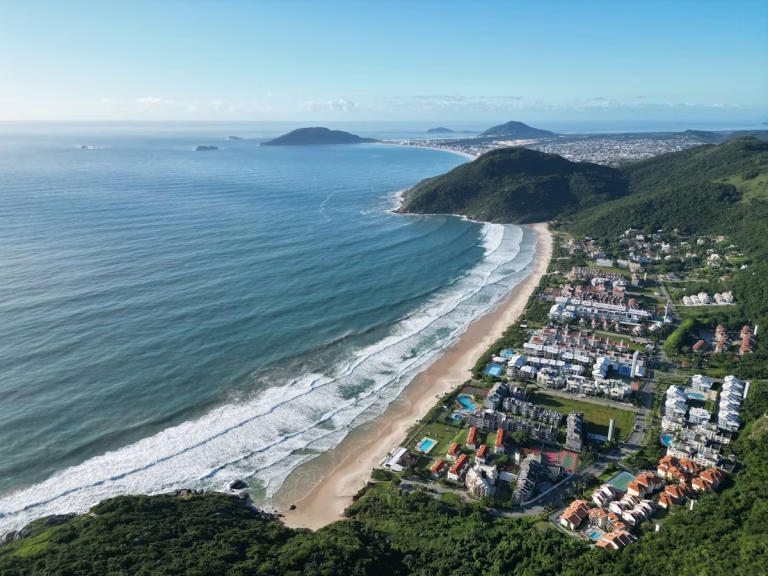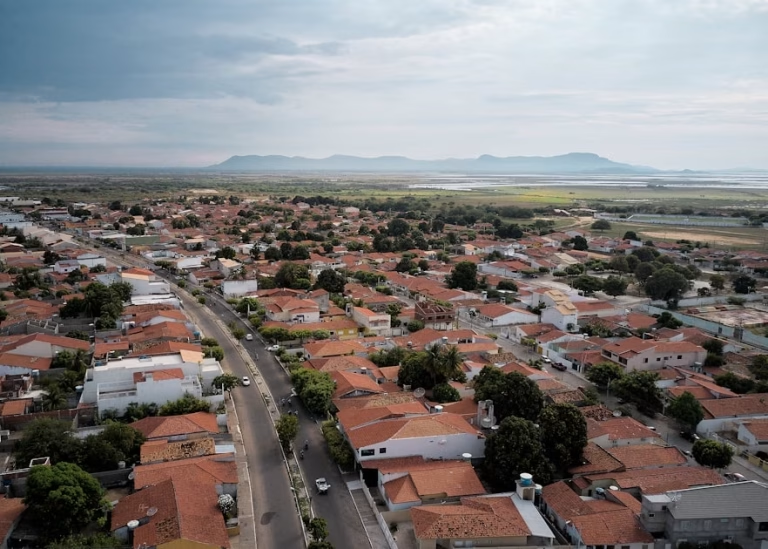
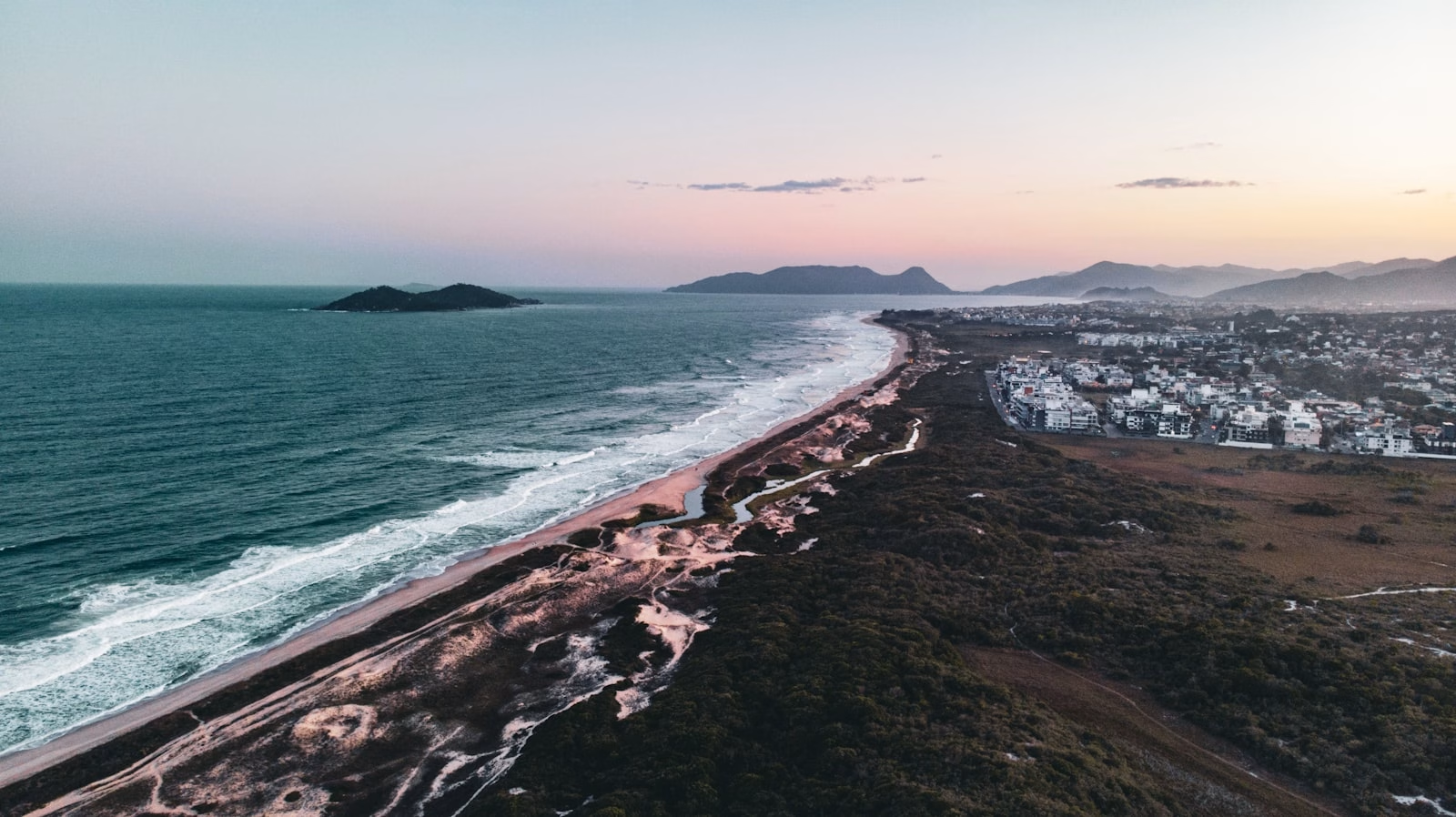
The history of Florianópolis does not begin in 1748, with the arrival of the Azoreans. Nor in 1673, when the bandeirante (a colonial-era Portuguese-Brazilian frontiersman) Francisco Dias Velho founded the settlement of Nossa Senhora do Desterro. It begins much earlier, when the island did not yet carry that name.
The first inhabitants called this land by another name. And each layer that followed — the Indigenous, the Azorean, the successive waves of immigration — left a mark that almost never shows up on the postcard. The rock of the hills is around half a billion years old (a story of its own, told in our guide to the archipelago’s geological formation); human history is far more recent, and that is what concerns us here.
This is a guide to the island in layers, from its first name to its nickname today, separating fact from legend.
Meiembipe: Before the Europeans
Before it was Florianópolis, before it was Desterro, the Island of Santa Catarina had a Guaraní name: Meiembipe, roughly “the rise of mountains along the sea.” It was used by the Carijó, a coastal Guaraní people the Europeans encountered on arrival.
But the Carijó were not the first either. Millennia before them, this land was home to the sambaqui peoples, fishers and gatherers who raised mounds of shells over generations. Greater Florianópolis has more than 80 mapped sambaquis (shell mounds). For a long time they were treated as mere refuse heaps. Modern archaeology has shown the opposite: they are funerary monuments, built shell by shell, with burials inside.
From the same era, carvings in the stone remain. Campeche Island (Ilha do Campeche), a few kilometers off one of the city’s most photographed beaches, holds the largest concentration of petroglyphs on the Brazilian coast — more than a hundred markings still undeciphered. The site is protected by IPHAN (Brazil’s national heritage institute) and open to controlled visitation. They are not “woodcuts,” as is sometimes said, but carvings made directly into the rock.
The Island’s Enigmas: What Is Speculated and What Science Confirms
The island attracts theories. Some describe “megalithic observatories” at Morro da Galheta and “energies” around Campeche. An honest distinction is worth making.
The rocks of Morro da Galheta are natural granite outcrops, hundreds of millions of years old, and the site is protected as a Natural Monument, not an archaeological one. At Campeche there is indeed a point of magnetic anomaly, documented as a geological phenomenon; the mystical narratives around it are not. And the authorship of the rock carvings remains an open scientific debate, which is different from esoteric mystery.
In short: there is plenty to admire in the island’s prehistory without inventing lost civilizations.
Nossa Senhora do Desterro
European settlement begins around 1673, when Francisco Dias Velho founds the settlement of Nossa Senhora do Desterro. It becomes a town in 1726. The turning point comes from 1748 onward, with the mass arrival of Azorean and Madeiran immigrants — somewhere between four and six thousand people over the years that followed.
It was these people who shaped the culture now known as manezinha (the local islander culture of Florianópolis): the parishes of Ribeirão da Ilha and Santo Antônio de Lisboa, the rows of colorful houses, the cassava flour, the bobbin lace. The Portuguese Crown also fortified the mouth of the bay with a defensive system designed by the engineer Silva Paes: the fortresses of Anhatomirim, Ponta Grossa, Ratones, and Araçatuba, some still open to visitors today.
The Sea as Backbone
For nearly two centuries, island life revolved around the sea. The colonial economy rested on cassava flour — both a currency and an export — and on whaling, with stations (armações) that processed whale oil. The port of Desterro linked the island to the rest of the country, and crossing to the mainland depended on boats and ferries.
That changed on May 13, 1926, with the opening of the Hercílio Luz Bridge, the first fixed link between the island and the mainland. It was closed for nearly 28 years and only reopened in December 2019. To this day it is the city’s foremost symbol. (The bridge’s rare engineering and its story of rising value are covered in our dedicated guides to the Hercílio Luz Bridge.)
From Desterro to Florianópolis
The city did not always bear its current name. The change came out of a harsh episode. During the Federalist Revolution (1893–1895, a Brazilian civil war), Desterro was seized by the Navy rebels, and prisoners were executed by firing squad at the Anhatomirim Fortress.
With the defeat of the Federalists, the city that had backed the losing side was renamed in 1894 as Florianópolis, “the city of Floriano,” in honor of President Floriano Peixoto — the very man who had led the crackdown. The name the city carries holds that contradiction.
The Waves of Immigration
After the Azoreans, Santa Catarina received new waves. Germans and Italians settled mainly inland and in the Itajaí Valley from the 19th century onward. And Japanese immigration came too.
An important distinction belongs here: the Japanese did not colonize the island. Japanese immigration to Brazil arrived through the port of Santos in 1908, and in Santa Catarina it concentrated inland and in the highlands from 1961 onward. On the island, the presence was more discreet and came later. Even so, it left deep marks, including one surprising detail: the first Japanese to set foot in Brazil landed at Desterro in 1803, shipwreck survivors taken in at Santana Fort, more than a century before official immigration. Decades later, in the 1950s, a fisherman from Kagoshima would transform fishing in the south of the island — a story we tell in the Memória da Ilha (Island Memory) series.
Why It Is Called the Island of Magic
Florianópolis’s best-known nickname comes from Azorean folklore. The waves of the 18th century brought an imagination peopled with witches, folk healers, boitatás (a fire-serpent of Brazilian legend), and hauntings, passed by word of mouth through generations of fishermen.
The person who turned this world into heritage was the teacher and artist Franklin Cascaes (1908–1983), who spent decades recording the island’s “tales.” His archive is held at UFSC (the Federal University of Santa Catarina). A contemporary reading adds a layer: behind the “witches” were many folk healers and curanderas — women of popular knowledge silenced over time. And the tradition lives on in the Boi de Mamão (a traditional Azorean folk pageant), recognized as intangible cultural heritage of the city, and in the Festa do Divino (Feast of the Divine Holy Spirit), celebrated in Florianópolis since 1775.
The legends are a cultural fact. They exist, they have been documented, and they are part of local identity — without that meaning the supernatural is being affirmed as real.
Frequently Asked Questions
What is the history of Florianópolis?
The Island of Santa Catarina was first inhabited by the sambaqui peoples, millennia ago, and later by the Carijó (a Guaraní people), who called it Meiembipe. The settlement of Nossa Senhora do Desterro was founded by Francisco Dias Velho around 1673, received mass Azorean immigration from 1748 onward, and was renamed Florianópolis in 1894.
Why is Florianópolis called that?
The city had been called Nossa Senhora do Desterro since its founding. In 1894, after the Federalist Revolution, it was renamed Florianópolis in honor of President Floriano Peixoto — a controversial choice, since the city had backed the side he fought against.
Who founded Florianópolis?
The bandeirante Francisco Dias Velho established the settlement of Nossa Senhora do Desterro around 1673. The local culture, however, was shaped by Azorean and Madeiran immigration from 1748 onward.
Why is Florianópolis called the Island of Magic?
Because of the Azorean imagination brought over in the 18th century: stories of witches, folk healers, and hauntings passed down orally through generations. The folklorist Franklin Cascaes was the great documenter of this world, which is cultural heritage rather than an affirmation of the supernatural.
How old is Florianópolis?
The settlement of Desterro was founded around 1673 and elevated to a town in 1726 — more than 340 years of recorded history. The name Florianópolis has existed since 1894.
To know Florianópolis from the inside is to understand that every beach, every neighborhood, and every name carries a layer of history that rarely appears on the sign. From the rock of Campeche to the old houses of Ribeirão, the island is made of time.
It is this curatorial eye that guides Regente. If you want to live on the island with people who truly know it, talk to an advisor, and follow the Memória da Ilha (Island Memory) series, about the Florianópolis that goes unnoticed.