
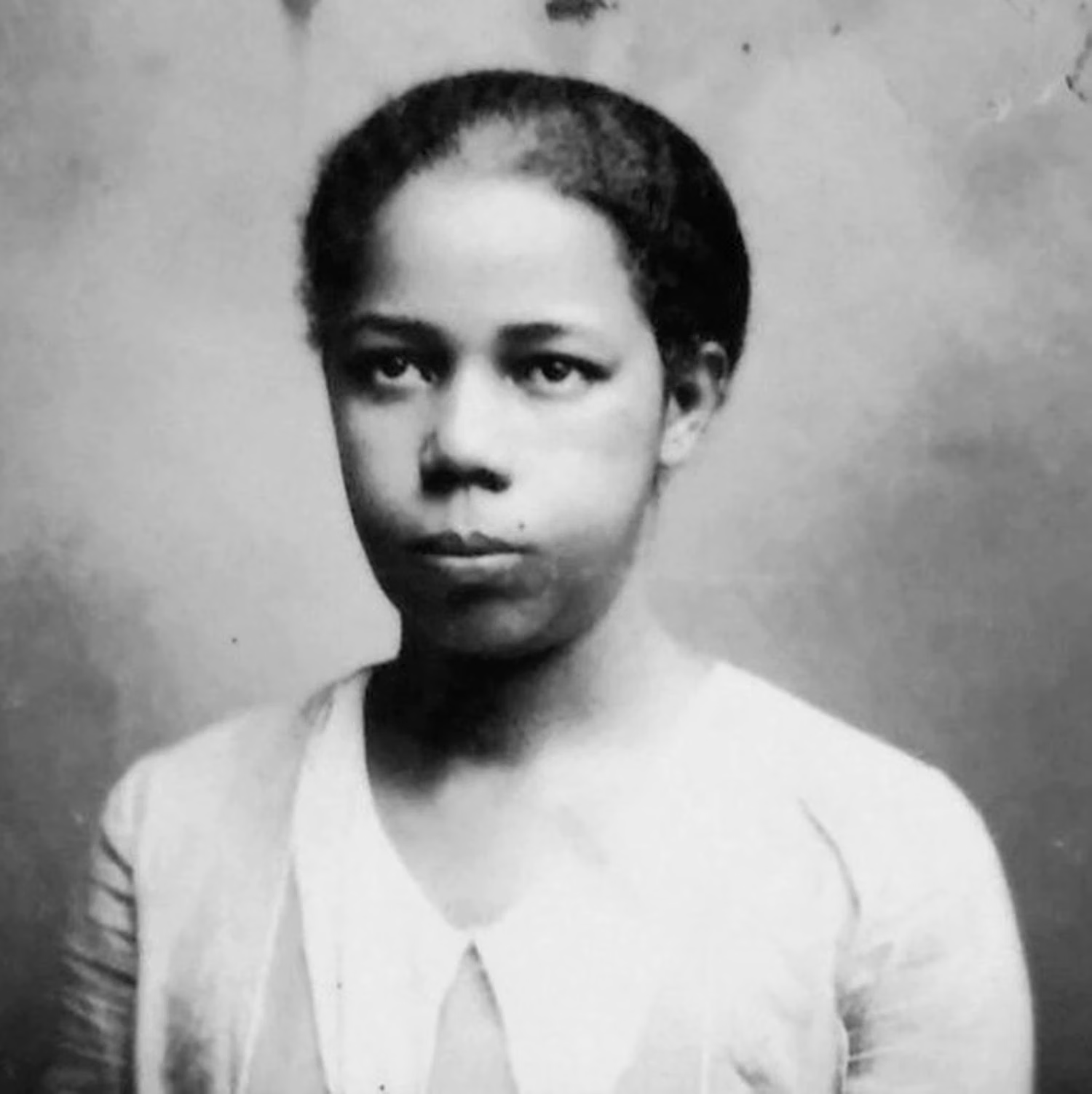
You have probably seen the name, maybe on a street sign, maybe on the front of a school. Few people can tell the whole story. Antonieta de Barros was born in Florianopolis on July 11, 1901, the daughter of a washerwoman, and while still young she chose the classroom as her territory. A daughter of the Island (the local nickname for Florianopolis, an island city) and a Black woman, she turned teaching into a cause and the written word into a craft. When it comes to the history of Santa Catarina, her name is among the most remembered, a sign that the Island recognizes the figure but does not yet know her in full.
Teacher, journalist, lawmaker
Antonieta made education the center of her life. In 1922, at the age of 21, she and her sister Leonor founded the Curso Particular Antonieta de Barros, a private school aimed at teaching literacy to those the State tended to leave out. She taught at the Escola Normal Catarinense (the state teacher-training college) and was principal of Colégio Dias Velho. Alongside teaching, she took up a second territory: the press. Under the pen name Maria da Ilha, she founded and ran the newspaper A Semana in the 1920s, and later the magazine Vida Ilhoa. She wrote, took positions, and held her era to account at a time when the public voice of a Black woman was rare anywhere in the country.
It was from that ground, the teacher who was also a journalist, that her greatest achievement came. Elected in 1934 for the Partido Liberal Catarinense (the Santa Catarina Liberal Party), Antonieta de Barros took her seat in 1935 in the Santa Catarina Legislative Assembly, in the first election in which Brazilian women could vote and run for office. She became the first Black woman to hold a parliamentary seat in Brazil. As a member of the constituent assembly, she served as rapporteur for the chapters on Education and Culture and on the Civil Service in the 1935 state constitution. Years later she would return to the Assembly for a second term.
Why she was forgotten
Stories like this tend to fade from view for a set of quiet reasons. Official memory long kept the usual names, nearly all of them men, nearly all of them white. A teacher from southern Brazil, devoted to the small, patient work of teaching people to read and shaping students, rarely became a monument. Add to that the fact that much of what Antonieta wrote was scattered across local newspapers and records, the kind of archive that time hides before a city realizes what it has lost.
You know the result. The name survives on streets, schools, and tributes, while the full story is reduced to a single line in a textbook, when it appears at all.
Why it matters today
Remembering Antonieta de Barros is not an exercise in nostalgia. It means understanding that Florianopolis produced, long before the country began debating representation, a woman who opened paths in education and politics at the same time. It was her state law that created Teacher’s Day in Brazil, on October 15, the date the country still celebrates today. In 1937 she published Farrapos de Ideias (Scraps of Ideas), the first book authored by a Black woman in Santa Catarina. Every student taught to read, every text published, every day in office was a concrete answer to a city that expected none of it from her.
Knowing this story changes the way you see the Island. Behind the postcard there is a city of people who did difficult things first, and Antonieta is among them. A city understands itself better when it knows from whom it inherited its own progress.
Knowing the Island from the inside
At Regente, curating real estate and curating memory go hand in hand. Knowing the Island from the inside means knowing that an address has a history, and that the history has a name. Antonieta de Barros’s name deserves to be told in full, not merely engraved on a plaque.
Memory of the Island, a series by Regente.
Sources: Memória Política de Santa Catarina — ALESC · Wikipedia — Antonieta de Barros · Fundação Cultural Palmares · Correio Braziliense
Read also: the history of Florianopolis.