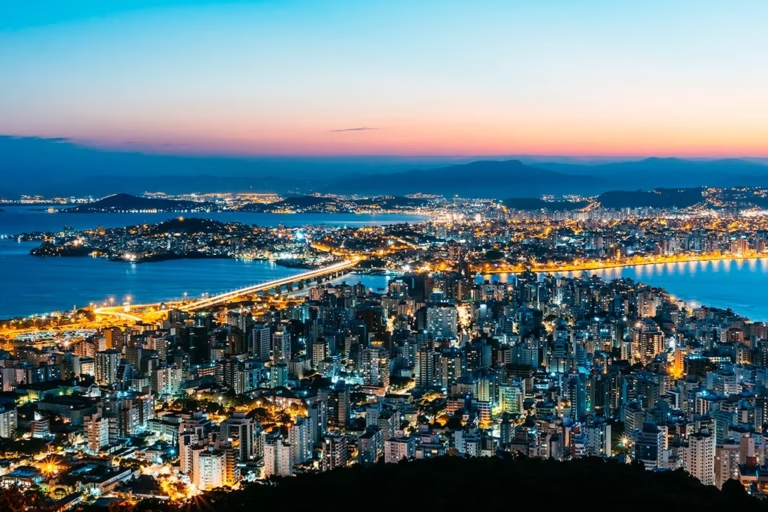

Buying, building, or developing in Trindade without consulting the Master Plan is a costly mistake. The neighborhood has zones with vastly different height limits just meters apart, two Protected Areas that restrict development, and a federal university campus with its own regulations. Understanding the zoning map before closing a deal is essential.
The legislation in force
Florianópolis’s Master Plan is based on LC 482/2014. In May 2023, the Municipal Chamber approved LC 739/2023, which updated land use and occupation rules across the entire municipality (REPLAN/PMF).
The detailed indices by zone — floor area ratio, occupancy rate, maximum height — are found in Table F01, annex to LC 739/2023, available at strapi.redeplanejamento.pmf.sc.gov.br.
To verify the zoning of a specific address, the official channel is the city’s interactive map at redeplanejamento.pmf.sc.gov.br/planodiretor.
The predominant zones in Trindade
AMC — Central Mixed-Use Zone
The AMC zone covers the neighborhood’s main commercial avenues: Lauro Linhares and Deputado Edu Vieira. It allows mixed use — residential, commercial, and services — on the same lot or building.
Maximum height varies by subzone. In the most permissive subzones along Lauro Linhares, it is possible to reach up to 12 stories. This flexibility explains the concentration of vertical development launches along this corridor in the 2020s.
ARM — Residential Mixed-Use Zone
The ARM zone covers the internal areas of the neighborhood, set back from main commercial streets. The predominant use is residential, with greater restrictions on commerce and services. Heights are lower than in the AMC.
Those who buy or build in ARM should consider that rapid verticalization is less likely. The character of internal streets will tend to remain more horizontal for longer.
University and institutional use area
The UFSC campus has its own regime. The municipal Master Plan recognizes this special status, but rules for use and expansion within the university perimeter follow UFSC’s Campus Master Plan, managed by DPAE/UFSC. References are the institutional repository (repositorio.ufsc.br/handle/123456789/200222) and the DPAE portal (dpae.ufsc.br/planos-diretores/).
Campus expansions do not depend on municipal zoning. For those evaluating properties nearby: UFSC’s institutional growth can alter traffic flows and demand without going through the Master Plan.
Protected Areas: where soil cannot be occupied
Itacorubi Mangrove
The Itacorubi mangrove forms Trindade’s eastern boundary. This entire area is a Permanent Protected Area (APP) with a prohibition on building — no construction is allowed. Any intervention nearby requires joint licensing with FLORAM and IBAMA.
For investors, properties bordering the mangrove have two opposing effects: restrictions on verticalization in the immediate surroundings and added value premium from proximity to preserved green space.
Morro da Cruz slopes
Trindade’s western boundary meets the slopes of Morro da Cruz, also classified as APP in portions with steeper grades. Restrictions apply to steeper slopes and vary based on terrain inclination.
Properties near slopes with inclination within legal limits can be built on, but require case-by-case analysis with the city government.
The BRT and its market impact
The TICEN–TITRI Structural Transport Corridor, Florianópolis’s BRT, runs through the Pantanal area with terminus at TITRI — a terminal that directly serves Trindade.
The project has federal funding through the PAC program of R$ 159 million, with construction expected to begin in 2026 (ND+; Agora Floripa). Improved travel time to downtown and other parts of the city is expected to increase property values near the corridor and terminal.
TITRI already functions as a major transit hub. The project expands and formalizes this centrality. For those evaluating investment in Trindade, the BRT is a medium-term value driver to consider.
Basic sanitation
Water supply and sewage collection in Trindade are CASAN’s responsibility. The neighborhood is established and has complete urban infrastructure. The exact coverage percentage has not been confirmed by an updated public source — for reports and specific projects, verification should be done directly with CASAN.
Verticalization and densification: what has already happened and what’s coming
Condomínio Itambé is the largest example of densification already consolidated in Trindade: 27 buildings, 405 apartments, and approximately 1,500 residents in a continuous area. It was built under rules prior to LC 739/2023.
In the 2020s, single-family homes and townhouses have been replaced by vertical buildings in AMC zones, primarily along Lauro Linhares. Launches such as Viva Trindade Residencial, Viva Trindade Apart Studios, and Hout Bay Residence are part of this cycle.
On internal streets in ARM, the process is slower and subject to greater restrictions.
Mobility infrastructure: bike lanes, sidewalks, and the Trindade Terminal
Trindade has an expanding active mobility network that complements the already-established public transportation system.
Trindade Terminal (TITRI). TITRI is one of Florianópolis’s main bus terminals. It connects Trindade to downtown (TICEN), to UFSC, to Conceiçãozinha Lagoon, and to neighborhoods in the north and south of the island. Frequency is high during peak hours — reducing reliance on personal vehicles for daily commuting. For residents and renters without vehicles, this is a real quality-of-life advantage.
Bike lanes and cyclist infrastructure. Avenida Madre Benvenuta has a bike lane section connecting Trindade to the Agronômica neighborhood and downtown. Avenida Deputado Edu Vieira also has bike infrastructure in sections. The neighborhood is part of the active mobility axis planned for the island’s mainland region.
The arrival of the BRT should reinforce this infrastructure. The project envisions wider sidewalks along the corridor, integration with shared bike stations, and improved boarding and alighting conditions at TITRI.
Sidewalks and pedestrian access. The interior of the neighborhood — internal ARM streets — has variable sidewalk quality. The main commercial streets, Lauro Linhares and Deputado Edu Vieira, have regular pavement with level transitions for reduced mobility access in sections. For residents relying on walking, proximity to UFSC (up to 15 minutes on foot from most residential addresses) is a relevant selling point.
This mobility infrastructure directly impacts property values available in Trindade — especially for university renters and young professionals who prioritize car-free living.
What to verify before buying or building
Four points require verification before any construction decision:
Exact zone of the lot. AMC and ARM have distinct parameters. The difference can be three to eight stories of height allowance in the same neighborhood.
Proximity to Protected Area. The influence radius of the mangrove and slopes affects both construction licensing and the verticalization potential of neighboring lots.
Subzone within the AMC. Maximum height varies by subzone. Two lots on the same avenue may have different limits.
Table F01. Floor area ratio, setbacks, and permeability rates are in this annex. It is the technical reference document for projects.
Frequently asked questions
What is the maximum height allowed for construction in Trindade?
It depends on the zone and subzone. In the AMC, on main avenues such as Lauro Linhares, height can reach 12 stories in specific subzones. In the ARM, limits are lower. The city’s interactive map (redeplanejamento.pmf.sc.gov.br/planodiretor) shows zoning address by address.
Can I build near the Itacorubi mangrove?
Not within the Protected Area. In the immediate surroundings, restrictions vary based on distance and type of intervention. Any project within the Protected Area influence zone requires environmental licensing with FLORAM and IBAMA before any municipal approval.
Has the BRT already changed prices in Trindade?
The BRT is still in pre-construction phase (expected to begin in 2026). Properties near TITRI and the corridor already incorporate some of this expectation into listing prices. The concrete effect on transactions will be measurable after construction begins.
Can the UFSC campus expand into neighborhood areas?
UFSC has federal property status. Expansions into adjacent areas depend on federal expropriation or acquisition, not on the municipal Master Plan. This is a long-term scenario with no concrete indication at this time.
Did LC 739/2023 change much compared to the previous law?
The 2023 revision updated occupation parameters and created new subzones in some regions. For Trindade, the main impact was confirmation of verticalization potential in AMC zones along commercial streets. Comparing the two versions requires reading Table F01 in both editions — a technical task for an architect or specialized lawyer.
Next steps
Understanding zoning is the first step. The second is finding a property within the right parameters for your goal — whether residence, rental income, or development. Regente has a track record of actual transactions in Trindade and can recommend which properties best fit each strategy.
See properties in Trindade
Sources: LC 482/2014 and LC 739/2023 (LeisMunicipais/PMF); REPLAN/PMF — redeplanejamento.pmf.sc.gov.br; DPAE/UFSC — dpae.ufsc.br; ND+ (Florianópolis BRT); Agora Floripa (BRT PAC).