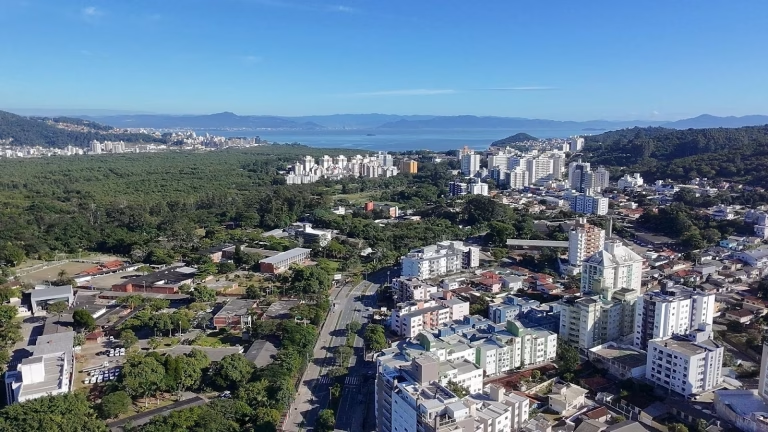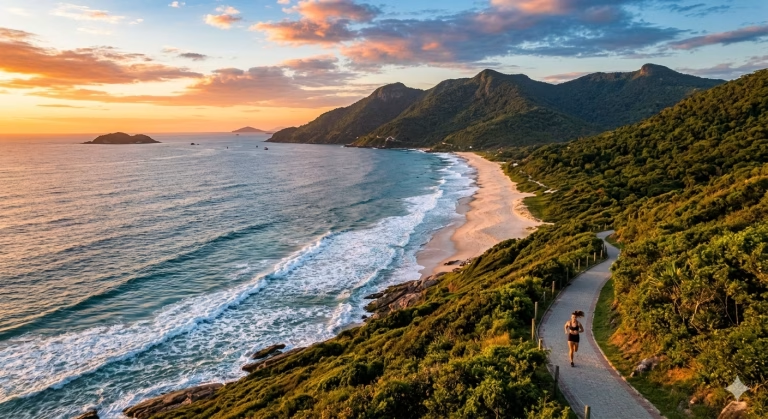
You’ve reached 50 in São Paulo or Rio with your career at its peak, wealth built, and a question that haunts every morning commute: is it worth paying this price for the city. Many of your generation answered by looking south.
Florianópolis is typically sold for its beaches. The beaches exist, but it’s the weakest argument. What sustains a high-income professional’s decision to leave a major capital after 50 are less photogenic data points: physician density, human development index, cost-of-living breakdown, and property appreciation trajectory.
This guide compares before and after with dated sources. The before is your life in São Paulo or Rio today. The after is what the numbers say about living on the island. There are no promises, and honest caveats about what doesn’t improve.
The Before: What a Major Capital Costs You After 50
The bill of a major capital doesn’t show up just in your bank account. It shows up on the clock.
A Florianópolis resident saves roughly 500 hours per year in commuting compared to São Paulo (cost-of-living estimate, to verify against primary source). That’s more than twenty full days, every year, that return to you. At 50, that’s an asset you can’t rebuild.
Absolute cost weighs too. São Paulo has Brazil’s highest basic food basket at R$ 852.87, followed by Rio de Janeiro at R$ 826.98 (NDMais (2026)). Average individual cost in SP runs around R$ 8,750 per month (NDMais (2026)).
None of this is news if you live there. The news is that after 50, your tolerance for this cost drops. You’ve already proven what you needed to prove in the big city. The bill now weighs less on what you earn and more on what you burn through in the course of a life.
The After: Florianópolis in Numbers
HDI: Highest Among All Brazilian Capitals
Florianópolis has an HDI of 0.847, the highest among all state capitals in Brazil (Human Development Atlas, UNDP/Ipea/FJP (2022)).
There are two municipalities with higher scores in the country—São Caetano do Sul and Águas de São Pedro—but both are in the interior of São Paulo state and aren’t state capitals. Among capitals, Florianópolis ranks first across all three dimensions: income (0.827), education (0.752), and longevity (0.869) (Human Development Atlas, UNDP/Ipea/FJP (2022)).
For someone coming from a Southeast capital, this is a floor of public services, healthcare, and education that requires no standard downgrade.
Healthcare: Third-Highest Physician Density Among Capitals
This is the metric that matters most after 50, and Florianópolis delivers.
The city has 10.30 physicians per thousand residents, the third-highest density among Brazilian capitals, behind only Vitória and Porto Alegre (CFM, Medical Demographics (2023)). The average among capitals is 6.81 physicians per thousand, so the island sits well above standard.
The network backs the numbers. UFSC University Hospital is the only federal hospital in Santa Catarina and offers more than twenty specialties. Hospital Governador Celso Ramos is a state reference for neurology, orthopedics, and oncology. The private network includes SOS Cardio, Hospital Baia Sul, and Hospital Unimed, among others, with ICUs and surgical centers (NDMais (2026)).
Liver transplant, kidney transplant, and high-complexity cardiac surgery are performed in the city. Leaving the state for specialized treatment is a rare exception, per the local medical network (NDMais (2026)).
Higher physician density typically means shorter waits for appointments and exams than in larger capitals. Individual health insurance runs around R$ 450 per month, roughly 10% below São Paulo (NDMais (2026)).
Cost of Living: Cheaper in Almost Everything, With One Honest Caveat
Florianópolis isn’t a cheap city in absolute terms, and it would be dishonest to sell it that way. By some measures, it’s the capital with the highest individual cost in the country. What tips the scale is the spending breakdown, not the total figure.
Average individual cost sits at R$ 8,272 per month, roughly 5% below São Paulo. For a family of four, the gap widens to near 10% (NDMais (2026)).
The savings concentrate where high-income earners feel it most:
- Private school: roughly 25% cheaper than in SP.
- Health insurance: roughly 10% lower.
- Public transport: roughly 20% cheaper.
- Recreation: beaches, trails, and parks cost zero.
The caveat: Florianópolis’s basic food basket is the third-most expensive in Brazil, at R$ 797.53, because of island logistics (NDMais (2026)). Still, it sits below SP and Rio. Gasoline also runs slightly higher than in SP.
For someone arriving with established income who wants to maintain their standard, the net reduction exists, especially in healthcare and education.
Active and Cultural Life: UFSC’s NETI, Brazil’s Pioneer Program
Active retirement assumes having something to do with recovered time. Florianópolis has formal structure for that.
The NETI, UFSC’s Center for Studies of the Third Age, has operated since 1982 and is the first Brazilian program in this open-university model for older adults. It offers 719 openings for those age 50 and above, in physical and artistic practices, health, cognitive activities, and languages (NETI/UFSC (institutional)).
The city is also UNESCO Creative City in Gastronomy since 2014, the first in Brazil to receive this designation (FloripAmanhã / Floripa Creative City (2014)). That translates to festivals, fairs, and a cultural ecosystem that extends beyond the waterfront.
For outdoor lifestyle, there are 42 accessible beaches, trails in conservation areas, motorless sports on Lagoa da Conceição, and cycling on the Agronômica Linear Park. The temperate subtropical climate enables physical activity nearly year-round.
What Doesn’t Improve: Mobility
Honesty to the persona demands naming where the city falls short.
Mobility is the weakest point. The bridges connecting the island to the mainland create genuine bottlenecks during peak hours and high season, and public transit doesn’t match São Paulo’s frequency.
The good news for retirees: without a fixed work schedule, you dodge the peaks. Neighborhoods like Agronômica and Lagoa da Conceição have good walkability. A car remains recommended for island residents outside the downtown core.
Your Wealth: What Happens to Your Money in the Trade
Why the Island Appreciates Structurally
Florianópolis has more than half its territory protected by environmental law, combining permanent preservation areas and conservation units (PMF/FLORAM (2026)). Practically, the island has nowhere to expand horizontally.
Finite buildable land supply, paired with growing demand from high-income migrants from the Southeast and South, anchors an appreciation that doesn’t depend on trends. The m² averaged R$ 11,331 in June 2024 and rose to R$ 13,288 in May 2026, a 17.3% gain in two years (FipeZAP (2024–2026)).
Over the last 12 months, appreciation held at roughly 7.86%, above the period’s general inflation. The city ranks fourth on FipeZAP among the 56 tracked (FipeZAP (2026)).
Selling in SP and Buying on the Island: The Real Math
Here, honesty is mandatory. The m² in Florianópolis, at roughly R$ 13,288, sits about 15% above São Paulo’s average of around R$ 11,500 (FipeZAP (2026)). Square meter for square meter, you get less space.
The trade’s logic lies in the package, not the acquisition price: structural appreciation above inflation, a more favorable cost-of-living composition over time, and immediate quality of life. There’s also rental liquidity, with potential returns around 1% per month in well-positioned properties, per the local market (to verify via own survey).
What Comfortable Retirement Costs
For a 2-bedroom, 55–75 m² apartment in consolidated island neighborhoods like Agronômica, Coqueiros, or Campeche, the ticket runs between R$ 600,000 and R$ 900,000 (market range, to verify via own survey).
Reference ranges (May 2026):
- 2 bedrooms, superior standard (João Paulo, Trindade): R$ 900,000 to R$ 1.4 million.
- 3 bedrooms with recreation area (Jurerê, Cacupé): from R$ 1.5 million.
- Studio or 1 bedroom on the mainland (Coqueiros, Estreito): R$ 300,000 to R$ 500,000.
On the mainland in São José, rent drops 30% to 40% versus the island, with equivalent access to hospitals and commerce (market range, to verify).
Frequently Asked Questions
Why is Florianópolis good for retirement?
Florianópolis brings together indicators that rarely appear together in a capital. It has the highest HDI among Brazilian capitals, with an HDI of 0.847 (Human Development Atlas, UNDP, 2022 data). It has the third-highest physician density among capitals, at 10.30 physicians per thousand residents (CFM, 2023). It boasts 42 accessible beaches, a pioneering university program for the third age—NETI at UFSC, active since 1982—and the title of UNESCO Creative City in Gastronomy since 2014. For someone coming from São Paulo or Rio after 50, the most-felt difference rarely lives in the rankings. It lives in roughly 500 annual commuting hours that no longer exist (estimate to verify), time that returns to your life.
What’s the cost of living in Florianópolis compared to São Paulo?
For an individual, Florianópolis costs roughly 5% less than São Paulo, with averages near R$ 8,272 versus R$ 8,750 per month in 2026 (NDMais, 2026). For a family, the gap reaches near 10%. Savings concentrate in private school, roughly 25% cheaper; health insurance, roughly 10% lower; and recreation, since beaches, trails, and parks cost zero. Where Florianópolis runs higher is the food basket, the third-most expensive in Brazil at R$ 797.53, due to island logistics (NDMais, 2026), though it still sits below SP. Florianópolis isn’t absolutely cheap. The advantage lies in a different spending shape.
Does Florianópolis have good healthcare infrastructure?
Yes, with data to back it. The city has 10.30 physicians per thousand residents, the third-highest density among Brazilian capitals, trailing only Vitória and Porto Alegre (CFM, 2023). The average among capitals is 6.81 per thousand. The network includes UFSC University Hospital, the only federal hospital in the state, with more than twenty specialties; Hospital Governador Celso Ramos, a reference in neurology, orthopedics, and oncology; and a solid private network featuring SOS Cardio, Hospital Baia Sul, and Hospital Unimed (NDMais, 2026). Liver and kidney transplants and high-complexity cardiac surgery are performed in the city, and leaving the state for specialized care is a rare exception. High physician density also tends to cut wait times for appointments and exams.
Which neighborhoods in Florianópolis are best for retirees?
It depends on lifestyle preference. For those who want everything within walking distance and medical and commercial access, Agronômica is the practical choice: quiet, close to downtown, with parks for walking. For those preferring nature and active life without sacrificing restaurants and culture, Lagoa da Conceição offers kayaking, trails, and good dining. Those seeking top-tier infrastructure with calm beaches often choose Jurerê. Coqueiros, on the mainland, delivers beachfront and easier island access with lower cost. For those willing to live in São José in Greater Florianópolis, rent drops 30% to 40% with equivalent hospital and commercial access (market range, to verify).
How much does an apartment cost in Florianópolis for comfortable retirement?
For a 2-bedroom, 55–75 m² apartment in consolidated island neighborhoods, the ticket runs between R$ 600,000 and R$ 900,000 (market range, to verify), with the average m² at R$ 13,288 in May 2026 (FipeZAP, 2026). Those wanting more space or neighborhoods like João Paulo and Trindade enter the R$ 900,000 to R$ 1.4 million range. Three bedrooms with recreation area in Jurerê or Cacupé start at R$ 1.5 million. On the mainland, a studio or 1-bedroom in Coqueiros or Estreito runs R$ 300,000 to R$ 500,000. The m² rose roughly 7.86% over the last 12 months, and the city ranks fourth on FipeZAP among the 56 tracked.
Is it worth selling your apartment in SP and buying in Florianópolis?
Yes, provided you’re clear on what changes. The m² in Florianópolis, at roughly R$ 13,288, sits about 15% above São Paulo’s average of around R$ 11,500 (FipeZAP, 2026), so square meter for square meter you get less space. The trade’s logic sits in the full picture, not the purchase price. Florianópolis has appreciated roughly 7.86% over the last 12 months, above general inflation, and the scarcity of land—more than half the territory is protected by environmental law—supports long-term appreciation. Those buying to live and eventually rent can see potential returns around 1% per month in well-positioned properties, per the local market (to verify). The strongest argument is qualitative: trading traffic for beach, your health plan for a dense medical network, and urban wear for roughly 500 hours of life per year.
Does Florianópolis have intellectual and cultural options for retirees?
Yes, with university structure backing it. NETI at UFSC, the Center for Studies of the Third Age, is Brazil’s pioneering program in this model, active since 1982, and offers 719 openings for those age 50 and above in physical and artistic practices, health, cognitive activities, and languages (NETI/UFSC). Beyond it, UFSC and UDESC have libraries, cultural events, and programming open to the community. The city’s UNESCO Creative City title in Gastronomy, held since 2014, sparked festivals and fairs and helped build a cultural ecosystem that reaches beyond the beaches.
What’s mobility like in Florianópolis for retirees?
It’s the city’s weakest point, and worth knowing before the move. Florianópolis has real traffic bottlenecks, especially on the bridges connecting the island to the mainland during peak hours and high season. Public transit covers the city, but lacks São Paulo’s frequency. For those retiring and leaving a fixed work schedule, the impact falls sharply, since you can dodge the peaks. Neighborhoods like Agronômica and Lagoa da Conceição have good walkability, but a car remains recommended for island residents outside downtown. It’s the kind of weakness that weighs much less in a retiree’s life than in someone who needs to be at the office at nine.
Before You Buy, Rent
The decision to trade a major capital for the island after 50 shouldn’t be made in the heat of a summer vacation. Florianópolis’s summer is the worst month to evaluate the city, because that’s when traffic, prices, and crowds hit extremes.
That’s why we recommend a direct strategy: rent before you buy. Spend six to twelve months living in the city, ideally crossing a winter, before locking up wealth. You test the neighborhood, your medical routine, the actual distance to what matters for you, and only then decide where and how much to invest.
Regente walks both phases. In real estate consulting, we help you pick the right neighborhood for a test rental and, when the decision matures, buy the property that makes sense for your wealth and lifestyle, with market reading behind every choice.
Talk with Regente’s consulting team through the form and receive neighborhood and price-range analysis tailored to your income profile and timing.