On December 15, 1967, the Silver Bridge collapsed over the Ohio River in 46 seconds. Forty-six people died. The bridge used the same structural typology as the Hercílio Luz Bridge—cast eye-bar links under constant tension, without adequate preventive maintenance.
This disaster in the United States is why Florianópolis still has its centennial bridge standing. And it is part of the reason why the square meter here is worth today R$ 13,208.
The history of the Hercílio Luz Bridge is not an engineering record for a museum. It is the roadmap of how an island city became the most valued real estate capital in Southern Brazil—and why each chapter of this history has a direct parallel in the market you see today.
10 historic facts about the Hercílio Luz Bridge—and the lessons that remain
1. The bridge was born from a threat—not from a growth plan
Before 1926, the debate was real: transfer the capital of Santa Catarina to a city in the interior. Florianópolis, on an island, was expensive to access and difficult to govern. There was growing political pressure to abandon it as the seat of government.
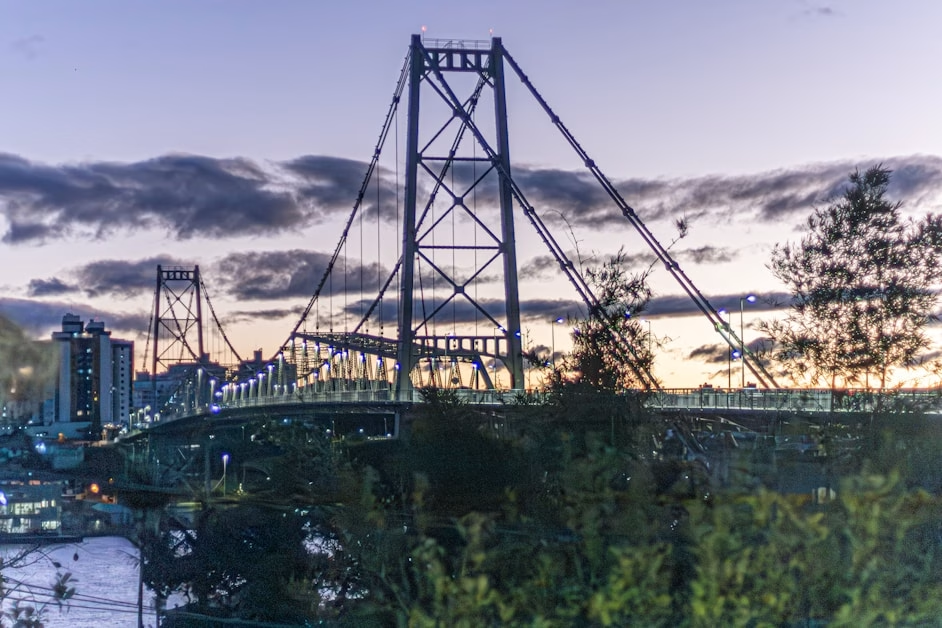
Governor Hercílio Luz responded with the only bet that could change the game—an 821-meter bridge that cost US$ 10 million and took four years to build.
Market lesson: Florianópolis is not capital by geographic accident. It is capital by a long-term political decision that others wanted to reverse. Whoever understands this history understands why the city has structural demand that does not disappear in bad economic cycles.
2. The governor signed the contract and died before the work was finished
Hercílio Luz was weakened by cancer when he signed the contracts in September 1922. In October 1924, he crossed a wooden replica in a symbolic ceremony—the actual work was still not finished. Twelve days later, he died.
The bridge opened 570 days later, on a Thursday with heavy rain. Without him.
Market lesson: Some of the best real estate investments require patience beyond the comfortable timeframe. The horizon of those who built Florianópolis was decades, not quarters. The return came—but not for those who could not wait.
3. The loan to build the bridge took 52 years to pay off
Santa Catarina took two loans from New York bankers—US$ 5 million from Imbrie & Co. in 1919 and another US$ 5 million from Halsey Stuart & Co. in 1922, with a 30-year term. Final payment occurred in 1978, 52 years after inauguration.
But no financial analysis from 1926 could calculate the accumulated value that Florianópolis generated in the period. The city is worth today, by any metric, incomparably more.
Market lesson: Long-term financing for real assets generates value that exceeds the cost of credit. The state paid for decades—and Florianópolis repaid with interest that no market rate measures.
4. An American engineer created a structural typology that received the city’s name
Engineer David Steinman reformulated the original design to use eye-bar links integrated into the stiffening truss—a configuration that saved material without losing strength. This typology became known internationally as “Florianópolis Type Bridge”.
After this project, Steinman designed more than 400 bridges on five continents.
Market lesson: Solutions created for the specificities of Florianópolis—its geography, its climate, its condition as an island—generate advantages that do not replicate in other markets. Whoever knows these specificities makes better decisions than those who treat the city as just another location.
5. The toll froze growth for 9 years after inauguration
The bridge opened in May 1926. The government implemented toll immediately—100 réis per crossing, including pedestrians. For almost nine years, the infrastructure existed without generating its full integration potential. The Estreito remained virtually deserted.
In 1935, the toll was eliminated. The flow changed scale. The market responded.
Market lesson: Infrastructure without accessibility does not generate full appreciation. The cost of entry—toll, ITBIITBI (Imposto sobre Transmissão de Bens Imóveis)Imposto municipal sobre transferência onerosa de imóvel entre vivos. Em Florianópolis: alíquota de 2% sobre o valor declarado (STJ Tema 1.113).Ver tudo →, deed, brokerage—matters as much as location. An opportunity blocked by friction of access is no opportunity at all.
6. A 60 cm crack changed the real estate map of Florianópolis
It was January 22, 1982. During an inspection, an inspector heard a sharp crack at the top of the central tower. The team found a 60 centimeter crack in one of the suspension bars. The bridge was closed that same day.
It carried 27,000 vehicles daily—43.8% of all of Florianópolis’ traffic.
Market lesson: Deferred maintenance creates crises. Properties without proper management lose value silently until the problem becomes a closure. The cost of preventive maintenance is always less than the cost of emergency correction—in bridges and in apartments.
7. The closure for 28 years reorganized the entire market—and created fortunes for those who saw it
With the Center-Estreito axis compromised between 1982 and 2019, the city grew in new directions. The North Side of the Island—Jurerê Internacional, Ingleses, Canasvieiras—expanded rapidly. The market found alternatives where the bridge did not reach.
Whoever identified this growth vector in the 1990s—when the Hercílio Luz axis was dead—captured entire decades of appreciation.
Market lesson: Restrictions on mobility redirect real estate demand. Crisis in one axis opens opportunity in another. The investor’s question is not “where is it growing now”—it is “where will mobility push demand over the next ten years”.
8. The heritage listing saved the bridge from demolition—and protected the surrounding real estate
During the 1990s, demolishing the bridge was a real option in political debate. Municipal listing (1992), state listing (1997), and federal listing by IPHAN (1998) ended this possibility legally. Legal protection gave time for the narrative to shift from “how to demolish” to “how to restore”.
Without the listing, the Center-Estreito axis would lose its most visible identity marker.
Market lesson: Historic heritage with legal listing protection has legal safeguards that preserve and increase value in the surrounding area. Properties near listed heritage assets tend to have controlled densification—which limits supply and sustains value over time.
9. The restoration replaced 40% of the structure—and was delivered 6 months ahead of schedule
Portuguese contractor Teixeira Duarte applied 210,000 new rivets using the same method as the original design—temperature above 1,100°C, required by IPHAN. It replaced 360 eye-bar links, 28 suspension cables, and more than 5,500 m³ of suspended platform.
It was delivered six months ahead of schedule. The Silver Bridge, the sister bridge in the United States, did not have the same fortune—it collapsed in 1967 from lack of adequate inspection of the same eye-bar links.
Market lesson: Construction quality with technique appropriate to the asset ensures longevity beyond expectation. A well-built and maintained property with the right materials outperforms in value and durability any construction shortcut—at any scale.
10. The reopening in 2019 reactivated an entire real estate axis—and the market still absorbs this cycle
On December 30, 2019, 200,000 people went to the streets to see the reopening. The Estreito returned to the radar of investors who prefer consolidated neighborhoods. The historic Center gained more fluidity. The Estreito neighborhood registered 12% appreciation in 2025 (FipeZAP)—among the highest in the city.
The cycle has not ended. Infrastructure reopening generates appreciation that matures slowly. The market still processes what happened in 2019.
Market lesson: Getting in before the recognition curve is the long-term investor’s strategy. When 200,000 people go to the streets to celebrate an infrastructure, the market already knows—but full pricing takes years.
What do these 10 facts say about Florianópolis as a real estate destination?
The Hercílio Luz Bridge is 100 years old. The real estate market of Florianópolis that it helped build shows today appreciation of 9.44% per year—against 5.2% of the national average (FipeZAP 2025).
This difference is not luck. It is the sum of 100 years of infrastructure decisions, urban identity, and geographic scarcity. Each fact from the bridge’s history left a mark on the price of the square meter—and the map still carries these marks.
For personalized analysis of where and how to position your wealth in Florianópolis, the Regente Imóveis team is available.
FAQ
When was the Hercílio Luz Bridge built?
The Hercílio Luz Bridge was built between November 1922 and May 1926. Official inauguration took place on May 13, 1926, on a Thursday with heavy rain. Construction lasted approximately 3 and a half years, with a peak of 400 simultaneous workers at the job site.
Why was the Hercílio Luz Bridge closed for so long?
The bridge was closed in January 1982 after the discovery of a crack in a suspension bar. It was completely closed until 1988, when it reopened for pedestrians and cyclists. Permanent closure came in 1991 and lasted until December 30, 2019—total of 28 years—due to the technical and bureaucratic complexity of the restoration.
Is the Hercílio Luz Bridge unique in the world?
Yes. The Hercílio Luz is the only operational bridge in the world that uses the “Florianópolis Type Bridge” typology—eye-bar links integrated into the stiffening truss. The other two bridges of the same design, the Silver Bridge (USA) and the Fort Steuben Bridge (USA), were destroyed. The candidacy for UNESCO World Heritage Site is under analysis by IPHAN-SC.