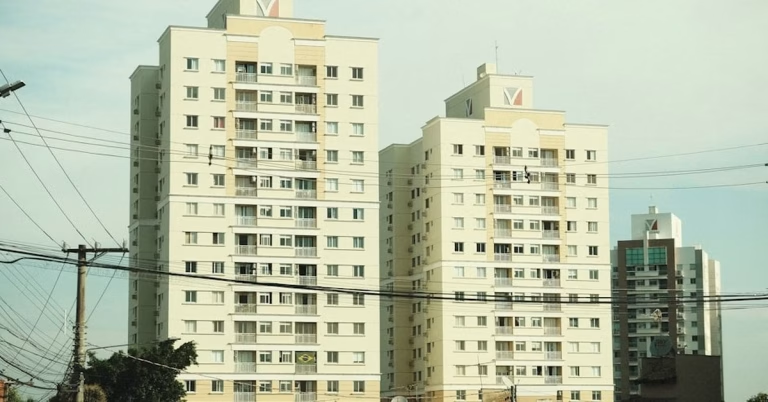

The Lar Legal program of the Court of Justice of Santa Catarina has delivered more than 45,000 property deeds in more than two decades of operation. It is one of the longest-running land title regularization initiatives in Brazil and serves residents of Florianópolis and throughout the state.
The program was created in 1999 and became permanent in 2019. It operates through a partnership between the TJSC (Court of Justice), municipal governments, and real estate registry offices. Processing occurs in the Judiciary’s electronic system, and costs can be divided into installments of up to 30 payments.
Lar Legal Santa Catarina Regularization: How the Program Works
Lar Legal Santa Catarina regularization operates within the Santa Catarina Judiciary. The program coordinates land title regularization of informal urban and rural communities through a simplified judicial procedure.
The logic is straightforward: the municipality identifies areas with established occupation and no formal registration — many in irregular neighborhoods of each municipality — presents the demand to the Judiciary, and the TJSC conducts the collective regularization procedure. Residents receive a registered property deed from the registry office.
Provision 37/1999: The Origin of the Program
Provision 37/1999 of the Corregedoria-Geral de Justiça (Chief Justice Administration) of Santa Catarina created Lar Legal. The regulation established a specific judicial procedure for regularization of subdivisions and urban lot divisions implemented without registration (Source: tjsc.jus.br).
The model was innovative by allowing judges to order the opening of individual property registration records (matrículas) for lots in consolidated areas, even without the participation of the original subdivider. This unlocked thousands of cases where the person responsible for the subdivision had died, disappeared, or refused to cooperate.
Resolution CM 4/2019: Permanent Status
In 2019, the Magistracy Council of the TJSC issued Resolution CM 4/2019, which made Lar Legal a permanent program of the Santa Catarina Judiciary (Source: tjsc.jus.br). Previously, the program operated through temporary projects tied to specific judicial districts (comarcas).
The resolution expanded the scope:
- Regularization of urban and rural properties
- Coverage in all judicial districts of Santa Catarina
- Processing entirely through the eproc system (electronic process)
- Formal coordination with partner municipalities and registry offices
Who Can Participate in Lar Legal?
The program serves any possessor or occupant of a property located in an informal urban or rural community. There is no income restriction — Lar Legal serves both low-income families and middle-class property owners.
Urban and Rural Properties
Lar Legal regularizes situations that can also be resolved by REURB or adverse possession (usucapião):
- Urban subdivisions implemented without registration
- Lot divisions conducted without municipal approval
- Consolidated occupations in urban and rural areas
- Housing developments with registration issues
The property must be in a consolidated informal community, meaning stable occupation with minimum infrastructure and no geotechnical risk.
Documentation Requirements
The participant must submit:
- Identity document and CPF (tax ID)
- Proof of residency in the property
- Purchase and sale contract, transfer of possession, or declaration of occupation
- Proof of payment of IPTUIPTUVer tudo → (property tax) or ITR (rural land tax)
- Property survey plan (when available)
The municipality completes the process with:
- Topographic survey of the community
- Descriptive report of the lots
- Certificate of urban conformity
- Urbanistic regularization project
How Lar Legal Proceeds in Practice
The procedure follows an organized flow among three actors: municipality, Judiciary, and registry office.
Processing via eproc
The case proceeds entirely in eproc, the electronic process system of the TJSC. The main steps:
- The municipality identifies the informal community and prepares the regularization project
- The municipality requests the judge of the judicial district to initiate the procedure
- The judge orders notification of interested parties and any neighboring property owners
- Residents submit individual documentation
- The Public Ministry issues an opinion
- The judge issues the regularization judgment
- The Real Estate Registry Office opens individual registration records for each lot
- Residents receive their own property registration certificate
The average timeframe between case initiation and judgment ranges from 6 to 18 months, depending on the complexity of the community and documentation available.
Role of Municipalities and Registry Offices
The municipality acts as petitioner and provides the technical foundation (topographic survey, urban project). The registry office executes the registration acts ordered by the judge. The TJSC coordinates and supervises the program.
This three-way partnership distinguishes Lar Legal from individual regularization processes, such as other paths to regularize property in Florianópolis. The collective scale reduces costs and timelines for all involved.
Costs and Installment Plans: Up to 30 Payments
The cost of Lar Legal for residents is significantly lower than individual proceedings. Resolution CM 4/2019 provides for:
- Installment plans for judicial costs and registry fees of up to 30 installments
- Free access to justice for those who qualify (proof of financial hardship)
- Reduced registry fees through agreements between TJSC and partner registry offices
In practice, many Lar Legal beneficiaries pay between R$ 1,500 and R$ 5,000 for complete registration — an amount lower than most other paths. Compare to the general costs of regularization in Florianópolis, a figure that includes judicial costs and registry fees. With installment plans divided into 30 payments, installments range from R$ 50 to R$ 170 per month.
For low-income families with free access to justice, the cost can reach zero.
Program Results Over More Than 20 Years
Lar Legal has accumulated more than two decades of concrete results in Santa Catarina.
Numbers and Coverage
- Over 45,000 property deeds issued since 1999 (Source: TJSC, Lar Legal Program Report)
- Operation in dozens of Santa Catarina judicial districts
- Regularization of subdivisions with 20, 50, and up to 200+ lots at once
- Average time of 12 months between case initiation and registration
In Florianópolis, Lar Legal has already worked in communities of:
- Maciço do Morro da Cruz
- Saco Grande
- Rio Vermelho
- Ingleses
The program remains open to new communities. The municipal government can request the inclusion of any consolidated informal area. The appreciation of properties regularized through the program follows the same pattern of 30% to 50%.
Frequently Asked Questions About Lar Legal SC
Do I need a lawyer to participate in Lar Legal?
The procedure is conducted by the municipality with the Judiciary and does not require a private lawyer for the resident to participate. However, guidance from a lawyer specialized in land regularization helps gather the correct documentation and follow the case in eproc.
Does Lar Legal work for rural properties?
Yes. Since Resolution CM 4/2019, the program covers urban and rural properties throughout Santa Catarina.
My neighborhood is not in the program. How do I get it included?
The municipal government must identify the informal community and request the initiation of the procedure from the judge of the judicial district. Residents can pressure the Housing Department to include their area in the program. In the meantime, it is possible to regularize property individually through other paths.
Does Lar Legal replace adverse possession (usucapião)?
They are complementary paths. Lar Legal regularizes subdivisions and informal communities as a whole, similar to collective regularization. Adverse possession (usucapião) resolves the individual occupant’s situation. In many cases, Lar Legal is faster and cheaper than individual adverse possession.
How long does it take to receive the deed?
The average timeframe is 6 to 18 months between case initiation and issuance of the individual registration record (matrícula) by the registry office. Simple cases with complete documentation can be concluded in less than 12 months.
Check if Your Area Can Join Lar Legal
Find out how to regularize your property. Fill out the form and receive a free analysis from a lawyer specializing in land title regularization in Florianópolis.
[RD STATION FORM]
- Tag: regularização-imobiliária
- Fields: Name | Email | Phone | Property Location
| Slug | programa-lar-legal-sc-regularizacao-gratuita |
|---|---|
| Title | Programa Lar Legal SC: regularização gratuita pelo Judiciário catarinense |
| Description | Lar Legal Santa Catarina regularização: programa do TJSC já emitiu 45 mil títulos com custas parceladas em até 30x. Saiba como participar. |
| Categoria | Regularização Fundiária · Programas Habitacionais |