For those who think of Florianópolis only as a beach destination and vacation spot, there is a side of the island that goes largely unnoticed: a section officially recognized as an extension of the Camino de Santiago de Compostela. This is not a generic religious tourism legend—it is formal recognition, with documented date and origin.
What is the Camino de Santiago in Florianópolis
Florianópolis is famous as a beach destination. But the island holds a route that rarely appears in traditional vacation guides: an official section of the Camino de Santiago de Compostela, more than ten thousand kilometers from the original route in Spain.
The so-called Brazilian Camino de Santiago de Compostela is a path of approximately 21 km between Canasvieiras and the Sanctuary of the Sacred Heart of Jesus, in Ingleses do Rio Vermelho. Along the route, pilgrims pass four churches Source (2026).
On February 7, 2017, the Cathedral of Santiago de Compostela, in Spain, formally recognized this section as an extension of the historic itinerary of the Camino Source (2026). This recognition, coming directly from the Cathedral, is what gives this section its special status. It is not a symbolic tribute nor a commercial name given by local tourism operators: it is a formal link to the institution that has administered the original Camino for centuries.
The Exact Verdict: Unique in Latin America, Not Outside Spain
It is worth correcting a common error before proceeding. It is easy to find the claim that Florianópolis has “the only Camino de Santiago outside Spain.” This is false.
There are Camino routes fully established outside Spain for centuries. The Camino Francés, which departs from Saint-Jean-Pied-de-Port, in France, is in fact the most traditional and most traveled route of the entire itinerary. There is also the Chemin du Puy, in France, and the Portuguese Way, which passes through Lisbon, Porto, and Tui, accounting for approximately 29% of pilgrims in 2025.
In 1987, the collection of routes between Spain, France, and Portugal was declared the first Cultural Route of the Council of Europe. The French Route and the Northern Routes of Spain are UNESCO World Heritage Sites.
What is true, and already notable enough, is more specific: the Florianópolis section is the only one in Latin America officially integrated and recognized by the Cathedral of Santiago de Compostela as an extension of the historic itinerary. This recognition came from the Cathedral itself, not from the Council of Europe or UNESCO, and this distinction matters so as not to overstate the fact beyond what it proves.
Swapping “unique in Latin America” for “unique outside Spain” may seem like a small detail, but it changes what is being claimed. The first is a verifiable and specific fact. The second ignores centuries of Camino tradition in French and Portuguese territory, and any European pilgrim would immediately identify the error.
The Route’s Path
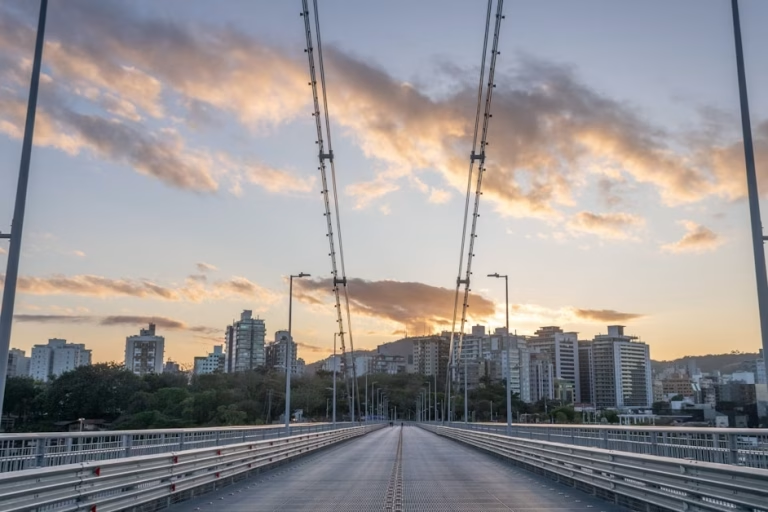
The route connects two well-known regions in the north of the island: Canasvieiras and Ingleses do Rio Vermelho. Over the 21 km, pilgrims cross the typical coastal landscape of this part of Florianópolis and visit four churches before reaching the Sanctuary of the Sacred Heart of Jesus, in Ingleses Source (2026).
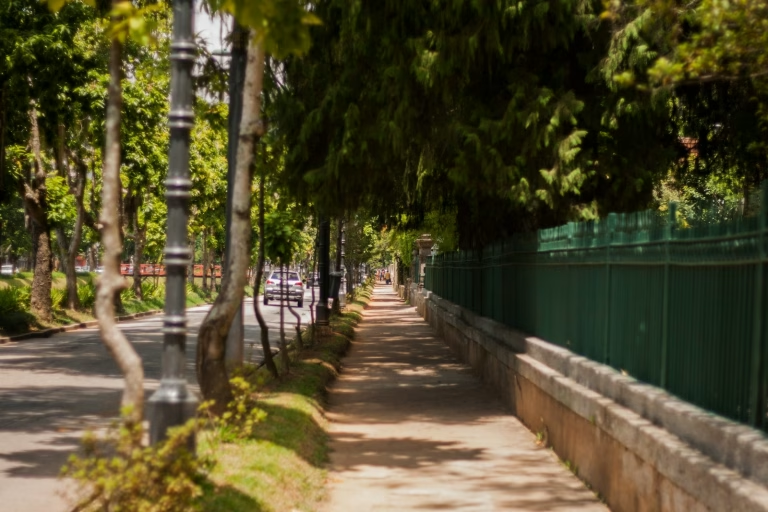
It is an urban-coastal path, quite different from the image of a rural trail normally associated with the Camino in Spain. This also explains why it functions as an option for faith and walking for those already on the island, without needing to travel to Europe.
Canasvieiras and Ingleses are neighborhoods already consolidated in the island’s tourism imagination, but almost always associated only with beaches and summer vacation. The Camino offers a different layer for these same two locations: walking, contemplation, and visiting churches, on a route that can be done at any time of year, including outside the high beach season.
The Other Side of Religious Tourism on the Island
The Camino de Santiago is not the only religious tourism site in Florianópolis. Azorean colonization left historic parishes that remain active today.
The Parish of Santíssima Trindade, in the Trindade neighborhood, began construction in 1830 and annually promotes the Festival of Santíssima Trindade. The Parish of Santo Antônio de Lisboa brings together historic Azorean fishing communities, such as Cacupé, Sambaqui, and Barra do Sambaqui Source (2026).
Regarding the presence of international Christian movements in the city, such as networks linked to Bethel Church or Hope Church, [verification needed]: there is confirmed national presence of these networks in Brazil, but no unit specifically geolocated in Florianópolis was confirmed in this research. It is worth confirming directly with local churches before asserting institutional presence in the city.
International recognition on one side and century-old Azorean tradition on the other show that religious tourism in Florianópolis is not limited to an isolated curiosity. It is a layer of the island’s identity, alongside beach tourism, business, and gastronomy tourism that are already better known.
Why This Matters for Those Considering Moving to Florianópolis
Florianópolis attracts people for very different reasons: business, sports, gastronomy, nature, and, for a real portion of the public, faith. Those who connect with the city through one of these axes tend to seek to live near what motivated that connection, whether the northern coastline near the Camino, or neighborhoods with Azorean tradition and older parish heritage.
Understanding this plurality, including the religious dimension, helps better understand who seeks to live on the island, and why.
To learn about the other tourism profiles that shape Florianópolis beyond the beach, see the complete guide: learn more
Frequently Asked Questions
Is it true that Florianópolis has the only Camino de Santiago de Compostela outside Spain?
Not exactly. There are well-established Camino de Santiago routes in France and Portugal dating back centuries, including the Camino Francés, the most traditional route of the entire itinerary. What is true is more specific: since 2017, the Florianópolis section, 21 km between Canasvieiras and Ingleses, passing through 4 churches, is the only one in Latin America officially recognized by the Cathedral of Santiago de Compostela as an extension of the historic itinerary.
When was the Florianópolis section recognized by the Cathedral of Santiago de Compostela?
The formal recognition occurred on February 7, 2017, granted by the Cathedral of Santiago de Compostela itself, in Spain.
What is the Florianópolis Camino route?
It is approximately 21 km between Canasvieiras and the Sanctuary of the Sacred Heart of Jesus, in Ingleses do Rio Vermelho, passing through four churches along the route.
Is there religious tourism in Florianópolis beyond the Camino de Santiago?
Yes. The city has historic parishes linked to Azorean colonization, such as the Parish of Santíssima Trindade, with construction begun in 1830, and the Parish of Santo Antônio de Lisboa, linked to Azorean fishing communities such as Cacupé and Sambaqui.
Did the recognition come from UNESCO or the Council of Europe?
Neither. The recognition of the Florianópolis section came directly from the Cathedral of Santiago de Compostela. UNESCO and the Council of Europe recognize other Camino routes, in Europe, but not this Brazilian section.