
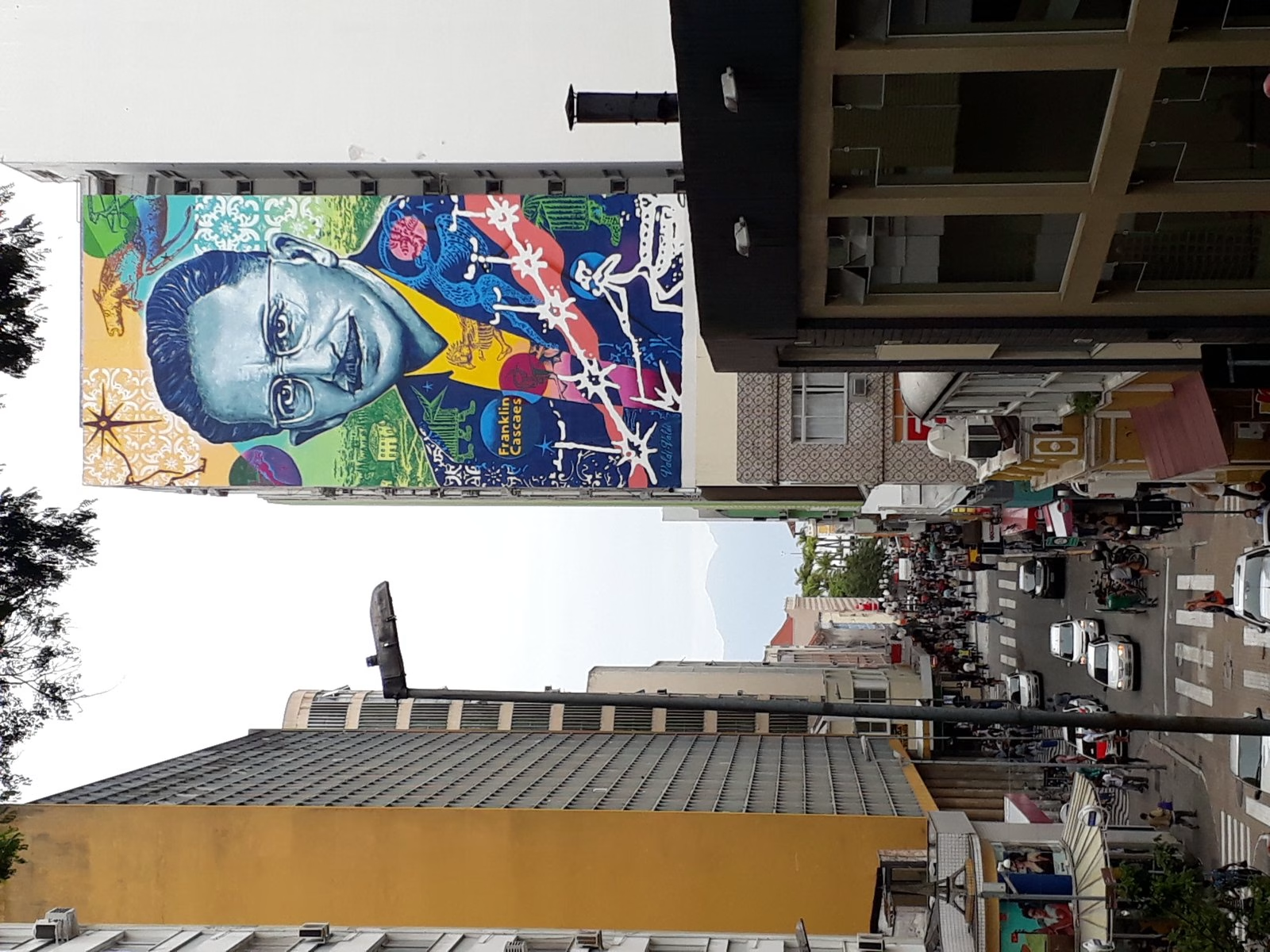
Many people arrive in Florianopolis for the beaches and leave without ever learning that the Island has a mythology of its own, and that much of it survived because a drawing teacher spent four decades writing down the tales he heard from local fishermen.
That teacher was Franklin Joaquim Cascaes (1908–1983). A folklorist, sculptor, and engraver, he turned the oral Azorean tradition of Santa Catarina Island into a documented collection. The witches that today appear in walking tours, on bar signs, and in craft pieces trace back, in large part, to his fieldwork.
This guide explains who Cascaes was, what he recorded, where to see his legacy today, and why the “witch,” in the sense he documented, is folklore rather than a claim about the supernatural. If you want to understand the Island from the inside, and not only from the shoreline, it is a good place to start.
Who Franklin Cascaes Was
Franklin Cascaes was born in 1908 in Itaguaçu, then a fishing district of the municipality of São José and today a neighborhood on the mainland side of Florianopolis. He trained and worked as a drawing teacher, but his work reached far beyond the classroom.
From the 1940s onward, he began systematically traveling through the Island’s communities (parishes, beaches, cassava-flour mills), collecting legends, beliefs, prayers, and stories passed by word of mouth among the descendants of Azorean immigrants.
One distinction matters here: the arrival of the Azoreans on the Island, in the 18th century, was a process of immigration and settlement directed by the Portuguese Crown. Cascaes documented the culture this population built over generations: its language, its fears, its popular religiosity, and the imagination of the “manezinho da Ilha” (the native Islander of Azorean descent).
The Fieldwork: Traveling the Island in Search of Its Tales
Cascaes worked like an ethnographer, though he never used the label. He went out to the communities, talked with fishermen and lacemakers, listened to the “causos bruxólicos” (witch tales), and recorded them.
One detail makes this collection singular: Cascaes wrote down speech in phonetic spelling, trying to reproduce on paper the way people spoke in the Island’s interior: the accent, the contractions, the vocabulary of the manezinho. The record thus preserves not only the story, but the voice of the person telling it.
From this material came drawings, sculptures, and the book “O Fantástico na Ilha de Santa Catarina” (The Fantastic on Santa Catarina Island), published in 1979 with narratives collected between 1946 and 1976. It is the source to which many of the modern versions of these legends still trace back.
The Island’s Witches: Folklore, Not Sorcery
The “witch” is the central figure of the world Cascaes documented. In the tales he gathered, they haunt everyday life: they tangle horses’ manes, sour the milk, torment children, and stir up storms.
What Cascaes documented is an ethnographic fact: the legend exists, it was told, it was believed by generations. That is not the same as claiming that witches or the supernatural are real. The value of the collection lies in preserving a people’s belief, not in proving it true.
These stories served a social function. In a time without accessible scientific explanations for illness, the sudden death of animals, or misfortune with no apparent cause, “witchcraft” gave a name to the inexplicable and organized collective fear.
The Witches’ Ball of Itaguaçu and the Rocks of Coqueiros
One of the best-known legends Cascaes recorded is the Witches’ Ball of Itaguaçu, on the mainland shore.
According to the story, the witches gathered to dance at the water’s edge. Caught by the light of dawn, which in the folklore is fatal to them, they were turned to stone. The rock formations along the Coqueiros and Itaguaçu shoreline are, in the popular reading, these witches turned to stone.
It is a mythical explanation for the landscape: the legend gives meaning to the rocks that any resident sees every day. Geologically, they are ordinary coastal formations. Culturally, they are one of the most frequently cited cases of the folk imagination that Cascaes helped to fix in memory.
The Collection: Roughly 3,000 Pieces at MArquE/UFSC
Cascaes’s work was not lost: he donated the collection to the Federal University of Santa Catarina (UFSC) during his lifetime, in 1981. Gathered under the name Coleção Professora Elizabeth Pavan Cascaes (a tribute to his wife and working partner), it is today in the care of MArquE, the UFSC Museum of Archaeology and Ethnology.
It comprises roughly 3,000 pieces, including sculptures, drawings, engravings, objects, and the handwritten records of the legends. It is one of the most important ethnographic collections in Santa Catarina and the main primary source on the Island’s folk imagination.
For anyone who lives in the region, or plans to, the museum works as a gateway to understanding local culture through documentation rather than a tourist brochure. Confirm hours and visiting conditions directly with MArquE before you go.
A Contemporary Reading: Witches, Faith Healers, and Folk Healers
More recent studies propose a rereading of the “witch” figure in the Island’s folklore. The contemporary reading observes that many of the women associated with witchcraft were, in practice, benzedeiras and curandeiras (blessing women and folk healers): figures who held knowledge of herbs, childbirth, and healing prayers in a society with no access to doctors.
In this light, the “witch” label appears less as a description of magical power and more as a social mechanism of suspicion directed at women who occupied a place of knowledge and autonomy outside their expected roles.
This rereading does not contradict Cascaes. It engages with the material he preserved. It is precisely because the collection exists, with the spoken accounts recorded, that researchers today can reinterpret who these women were and what an accusation of witchcraft meant.
Where Cascaes’s Legacy Shows Up Today
The folk imagination that Cascaes documented left the manuscripts and entered the life of the city. You find it in the little-witch figurines sold in local shops, in cultural itineraries that pass through Itaguaçu and Coqueiros, and in the very identity Florianopolis has built around the figure of the witch.
Recognizing the origin, a teacher’s fieldwork rather than a tourism marketing invention, changes the way you read the Island. Azorean culture sustains a living layer beneath the contemporary city, not a backdrop for the tourist.
Frequently Asked Questions
Who was Franklin Cascaes?
Franklin Joaquim Cascaes (1908–1983) was a drawing teacher, folklorist, sculptor, and engraver born in Itaguaçu, then a fishing district of the municipality of São José and today part of Florianopolis. He is recognized as the leading documenter of Azorean culture and of the witch folklore of Santa Catarina Island, which he recorded through fieldwork from the 1940s onward.
Did the witches of Florianopolis really exist?
The witch legend is a documented folkloric fact: the stories were told and believed by generations of Island residents. That does not mean claiming that witches or the supernatural are real. The value of Cascaes’s work lies in preserving a cultural belief, not in proving it true. Contemporary readings associate many of the “witches” with the benzedeiras and curandeiras (folk healers) of the time.
Where is Franklin Cascaes’s collection?
The collection (roughly 3,000 pieces gathered in the Coleção Professora Elizabeth Pavan Cascaes) is in the care of MArquE, the UFSC Museum of Archaeology and Ethnology, in Florianopolis. It includes sculptures, drawings, engravings, and the handwritten records of the legends. Confirm visiting hours directly with the museum.
What is the legend of the Witches’ Ball of Itaguaçu?
It is one of the legends recorded by Cascaes. It tells how witches danced at the water’s edge and were turned to stone by the light of dawn. The rock formations along the Coqueiros and Itaguaçu shoreline are, in the popular narrative, these witches turned to stone: a mythical explanation for the local landscape.
What is Franklin Cascaes’s most important book?
“O Fantástico na Ilha de Santa Catarina” (The Fantastic on Santa Catarina Island), published in 1979, brings together part of the narratives Cascaes collected in the field between 1946 and 1976, many transcribed in the phonetic spelling of manezinho speech. It is the leading published reference on the Island’s folk imagination and the source of many of the modern versions of these legends.
Getting to Know the Island from the Inside
Understanding Florianopolis goes beyond square meters and ocean views. Azorean culture, the witch folklore, and the work of people like Franklin Cascaes are part of what gives depth to each neighborhood of the Island, from Itaguaçu to Coqueiros, from downtown to the outer parishes.
At Regente, real estate curation begins with knowing the territory in depth: its history, its imagination, and what makes each address distinct. If you want to know the Island from the inside and find the right property within it, talk to our team.
Read also: the history of Florianopolis