
Chinese citizens can buy property in Brazil without any legal restrictions — Brazilian law treats foreign buyers equally. The real challenge is not legal: it’s financial. Capital control imposed by the Chinese government limits overseas remittances to USD 50,000 per natural person per year — and this limit defines the payment strategy for any real estate acquisition.
This guide presents the two most important updates for the Chinese buyer in 2026: China’s accession to the Hague Convention (November 2023), which simplified documentation, and the new foreign exchange control rules in effect since January 2026, which made financial planning even more relevant. With the correct structures, the purchase is viable — and Florianópolis, with its quality of life and supply of high-end properties, is a growing target on the radar of the Chinese investor.
Can Chinese citizens buy property in Florianópolis? What does Brazilian law say
Yes. The Federal Constitution guarantees the right to property without distinction based on nationality (art. 5, XXII). The Migration Law (13.445/2017) ensures foreigners’ access to urban property. China is not on any FATF or OFAC sanctions list — due diligence by the real estate agency follows standard procedure.
The only barrier for urban properties in Florianópolis is operational, not legal: the ability to transfer funds from China to Brazil within SAFE (State Administration of Foreign Exchange) rules.
Migration status and access to financing:
- Chinese nationals with permanent residence visa in Brazil: access to all Brazilian banks, LTV up to 80%, term up to 35 years.
- Chinese nationals without residence in Brazil: cash purchase, financing via fintechs/SCDs, or direct financing from developer.
- Property ≥ R$ 1 million in urban area: grants right to temporary investor visa for 4 years (RN 36/2018) — entry point for those seeking to establish residence through investment.
- Alternative via CNPJ: Chinese investor can structure the purchase through a Brazilian legal entity, circumventing the USD 50,000 limit applicable to natural persons.
Specific documentation: what the Chinese buyer needs to gather for the deed
Major update: China acceded to the Hague Convention in November 2023
Until October 2023, Chinese documents needed to pass through consular legalization — a slower and more costly process. From November 7, 2023 onwards, China acceded to the Hague Convention on Apostille. Chinese consulates and the embassy in Brazil suspended consular legalization services on that date.
What changes in practice:
– Chinese public documents (birth certificates, marriage certificates, notarial documents) can be apostilled in China for use in Brazil.
– Brazilian documents for use in China: apostilled in Brazil by an authorized notary.
– The process became faster and cheaper.
⚠️ Caution: there is frequent confusion on websites and forums claiming that China “is not a signatory” to the Hague Convention. This information is outdated. Accession is official and has been in effect since November 2023. Source: hcch.net — Status table, Convention 12.
Documents required for the deed:
- Valid passport
- CPF — obtained from the Federal Revenue Service, via consulate or in person in Brazil
- Birth or marriage certificate (if applicable), apostilled in China
- Proof of income and source of funds
- For financing: additional income documents (translated and apostilled)
Sworn translation in Santa Catarina
Documents in Mandarin require sworn translation for use at a notary office. Public sworn translators registered with JUCESC are available at: leiloeiros.jucesc.sc.gov.br/tradutores/. Verify availability for the Chinese-Portuguese pair in advance.
How to transfer money from China to Brazil
This is the central point of the feasibility analysis for the Chinese buyer. SWIFT works between China and Brazil — the problem is not the international payment system, it’s what the Chinese government allows you to send.
Chinese capital control — rules in effect (2026):
SAFE (State Administration of Foreign Exchange) limits remittances abroad for natural persons resident in China to USD 50,000 per person per year. As of January 2026, new rules made control more stringent: mandatory facial verification at bank branches for remittances above RMB 5,000 (approximately USD 700).
Direct impact on property purchase:
| Property Value | Remittance Scenario |
|---|---|
| Up to ~R$ 277,000 | One annual remittance per person (limit USD 50k) |
| R$ 500,000 – R$ 1 million | 2–4 years of annual remittances, or alternative structure |
| Above R$ 1 million | Alternative structure required |
Legal alternatives identified:
Offshore funds (Hong Kong, Singapore, Macau): accounts in these territories are not subject to the SAFE limit. Buyer with an account in Hong Kong can make SWIFT to Brazil without volume restriction.
Multiple remitters: spouse, partner, or other family members can each remit USD 50,000/year. Caution: Bacen (Central Bank) examines multiple remittances to the same beneficiary — clear documentation of source is mandatory.
Staggered purchase over time: commit property with developer and pay installments annually within the SAFE limit. Works well for off-plan properties with 2–3 year delivery period.
Via CNPJ: Chinese investor opens a Brazilian legal entity. Foreign capital enters as Foreign Direct Investment (FDI), registered with Central Bank SCE-IED. The company acquires the property. This route is not subject to the USD 50,000 limit for natural persons, but involves setup cost (~R$ 1,500–3,000) and recurring accounting (~R$ 600/month).
The formal foreign exchange process in Brazil:
Whichever route is chosen, the entry of foreign funds for property purchase generates a foreign exchange contract registered with the Central Bank. IOF applies to the conversion: ⚠️ 0.38% (verify current rate). The source of funds must be documented with bank statements and income tax return.
For comparable broker rates, total costs per channel, current IOF, and complete remittance checklist: How to transfer money from abroad to buy property in Brazil.
Tax implications for the Chinese buyer
ITBI — universal tax
ITBIITBIVer tudo → applies to any urban property purchase, without distinction based on nationality. In Florianópolis, the rate is 2% of the transaction or assessed value.
No tax treaty between Brazil and China
Brazil and China do not have a treaty to avoid double taxation:
- Rental income: taxed in Brazil (15% withholding tax for non-resident), without automatic credit on Chinese tax return.
- Capital gain on sale: taxed in Brazil (15–22.5% withholding tax), without automatic credit in China.
The Chinese buyer should check with a tax consultant in China how to report this income per local legislation.
Structure via CNPJ — tax considerations
If the purchase is made through a Brazilian legal entity, taxation applies to the company (IRPJ/CSLL on actual profit or simplified regime) and to dividends distributed to the Chinese partner. This structure may be more efficient depending on the rental income generated by the property.
What the Chinese buyer needs to know about Florianópolis
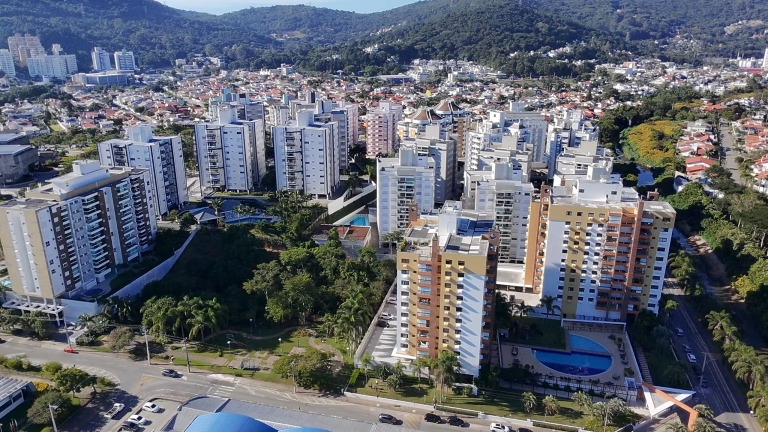
Florianópolis combines consolidated urban infrastructure, high-end beaches, and a real estate market with growing liquidity. Jurerê Internacional, in particular, attracts the profile of international buyers willing to pay for premium location and finish.
For the Chinese investor, a property in Florianópolis represents geographic diversification and protection in a currency different from the RMB. Seasonal rental generates income in BRL — a currency with a history of appreciation relative to the RMB during periods of pressure on the Chinese exchange rate.
The structure via CNPJ, in addition to circumventing capital control, allows organizing rental income within an active Brazilian company, which facilitates bank relationships and remote property management.
Frequently asked questions — Chinese buyer
Can Chinese citizens buy property in Brazil?
Yes. There is no legal restriction for urban property purchase in Brazil by Chinese nationals. Brazilian law guarantees the right to property for foreigners. The main challenge is operational: Chinese government capital control limits remittances abroad to USD 50,000 per natural person per year. Legal alternatives exist, such as offshore funds, multiple remitters, staggered purchase, or CNPJ structure.
Is China part of the Hague Convention (Apostille)?
Yes, since November 2023. China acceded in March 2023, with effect from November 7, 2023. Chinese public documents (certificates, notarial documents) can be apostilled in China for use in Brazil. Information predating this that claims otherwise is outdated.
What is the remittance limit from China to Brazil?
USD 50,000 per natural person per year, per SAFE (State Administration of Foreign Exchange) rules. As of January 2026, remittances above RMB 5,000 require facial verification at the bank. Funds held in accounts in Hong Kong, Singapore, or Macau are not subject to this limit.
Can I open a company in Brazil to buy property and circumvent capital control?
Yes. Investment via a Brazilian legal entity enters as FDI (Foreign Direct Investment), registered with Central Bank SCE-IED. This flow is not subject to the USD 50,000 limit applicable to natural persons. The company opens a bank account in Brazil and acquires the property. There are setup and ongoing accounting costs.
Do Brazil and China have a tax treaty?
No. Brazil and China do not have a treaty to avoid double taxation. Rental income and capital gains on property in Brazil are taxed here (withholding tax), without automatic credit on your Chinese tax return. It is recommended to consult a tax advisor experienced in foreign assets for your tax filing in your country of residence.
Can I pay for a property in installments from China over several years?
Yes. This is one of the most common strategies for off-plan properties. The buyer remits USD 50,000 per year during construction within the SAFE limit. The developer records the entries as foreign remittances. The Central Bank registers each foreign exchange contract separately.
Can Chinese nationals finance property in Brazil?
Yes, with permanent residence visa in Brazil. With a permanent national ID card, the Chinese buyer accesses financing from Brazilian banks with LTV up to 80% and term up to 35 years. Without permanent residence, the options are cash purchase, fintechs/SCDs with lower LTV, or direct financing from the developer. A property above R$ 1 million grants right to a 4-year temporary investor visa.
Regente Imóveis and consulting for Chinese buyers
Regente Imóveis offers consulting for international buyers, with financial and legal feasibility analysis, documentation guidance, and coordination with notaries, accountants, and partner attorneys. For the Chinese buyer, the analysis of payment structure — cash, installments, offshore, or CNPJ — must precede any property offer.