
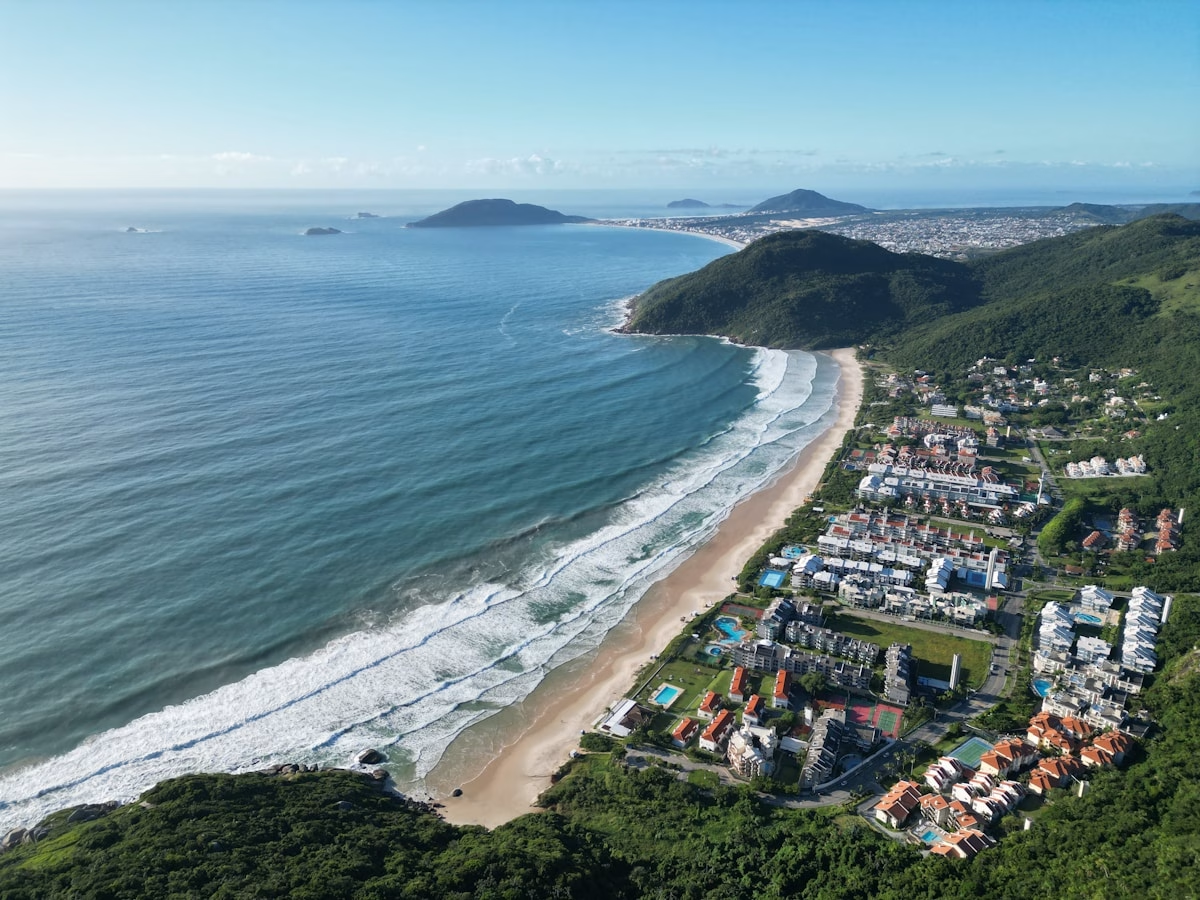
Buying a property in Florianópolis and discovering that the land belongs to the Brazilian Federal Government is a shock nobody wants after signing the contract. Riparian terrains (terrenos de marinha) affect approximately 30,000 properties in the city — and ignoring this reality generates unforeseen costs, registration delays, and for foreign buyers, restrictions that depend on the type of property. This guide demystifies the subject and explains precisely when laudêmio (riparian ground rent) applies, how much it costs, and—most importantly—when the restriction on foreign ownership does not apply.
Riparian terrains in Florianópolis: what they are and why so many properties are affected
Riparian terrains are a strip of land that belongs to the Brazilian Federal Government—not to the owner registered at the Land Registry Office (Cartório de Registro de ImóveisRegistro de Imóveis (CRI)Serviço que registra todos os atos que afetam imóveis: compras, hipotecas, penhoras e alienações. Só o registro no CRI transfere a propriedade.Ver tudo →). The rule comes from Federal Decree-Law 9.760/1946: the Federal Government owns a strip of 33 meters, measured horizontally from the position of high tide in 1831—the so-called Mean High Water Line of 1831 (Linha do Preamar Médio de 1831 or LPM/1831).
Within this strip, the Federal Government holds direct domain (full soil ownership). The individual who owns a property on it holds only useful domain—the right to use, rent, and sell that right, but not full ownership of the land itself. This legal structure, called emphyteusis or long-term lease, is analogous to perpetual ground rent.
Why Florianópolis is so heavily affected
Florianópolis is, for the most part, the Island of Santa Catarina—with more than 170 km of coastal perimeter. Virtually the entire coastline of the island lies within the 33-meter strip from the LPM/1831. The SPU (Federal Patrimony Secretariat) estimates that approximately 30,000 properties in the municipality are affected.
The neighborhoods with the highest historical incidence include:
- North: Jurerê Internacional, Canasvieiras, Lagoinha, Santinho
- East: Ingleses, Praia Brava
- Lagoon area: Lagoa da Conceição, Barra da Lagoa
- South: Campeche, Ribeirão da Ilha, Pântano do Sul
- Mainland: Estreito, Coqueiros, Balneário
Critical alert: riparian terrain is not synonymous with “beachfront.” The LPM/1831 reflects the historical sea level from nearly 200 years ago—since then, there have been landfills, river redirections, and coastal modifications. An apartment in the Estreito neighborhood, for example, may lie within the 33-meter strip with no ocean view whatsoever. A property not yet notified by the SPU does not mean it is free of riparian status: it may simply mean that formal demarcation has not yet reached that area. ⚠️ Always verify before closing the deal.
Laudêmio: what it is, how much it costs, and who pays
LaudêmioLaudêmio Federal — Terrenos de MarinhaTaxa paga à União (SPU) na venda de imóvel em terreno de marinha. Corresponde a 5% do valor da transação — obrigatória, sem exceção.Ver tudo → is the fee that the Federal Government charges whenever the useful domain of a property on riparian land changes hands through sale or other paid transaction. It is, in practice, the “license” that the soil owner (the Federal Government) charges for the transfer.
How laudêmio is calculated
- Tax rate: 5% of the value of the land, according to the SPU’s appraisal—excluding improvements and structures
- Calculation base: the value of the land according to the SPU, which may differ from the market value declared in the deed
- Who legally pays: the seller (transferor)—but in Florianópolis, it is common practice for the parties to negotiate and the buyer to assume the charge
Practical example: if the SPU appraises the land at R$ 300,000, the laudêmio is R$ 15,000. The calculation can be performed on the official portal at gov.br/pt-br/servicos/calcular-laudemio.
Laudêmio does not apply to: inheritance, donation, and other non-paid transfers. It is due exclusively in sales.
Other annual charges on riparian terrains
Beyond laudêmio (charged on sale), there are two charges paid annually:
Foro (ground rent): paid by whoever has a formal emphyteusis contract. Tax rate of 0.6% per year on the land value.
Occupation Fee (Taxa de Ocupação): paid by whoever occupies the property without a formal emphyteusis contract. Tax rate of 2% per year for SPU registrations prior to September 30, 1988, and 5% per year for registrations after that date.
⚠️ These annual charges exist as long as the property is on riparian land. Purchasing full domain directly from the Federal Government (when possible) permanently eliminates all such costs—see the section on regularization below.
The CAT: the document that locks or unlocks the deed
The Certificate of Authorization for Title Transfer (Certidão de Autorização para Transferência de Titularidade or CAT) is the document issued by the SPU that formally authorizes the transfer of a property on riparian land. Without the CAT, the Land Registry Office will not register the deed. Without it, the buyer does not become the registered owner—even after paying and executing the deed at the notary.
How to obtain the CAT
The process occurs on the portal sistema.patrimoniodetodos.gov.br:
- Obtain the RIP (Registro Imobiliário Patrimonial or Property Patrimonial Registration number) for the property—it is listed in the Land Registry record or can be requested from the SPU
- Access the portal and open the service “Issue the Certificate of Authorization for Title Transfer – CAT” (request 17)
- Declare the transaction value
- Pay the laudêmio via DARF Patrimonial (request 32 on the same portal)
- Await the SPU to issue the CAT after confirming payment
The CAT is valid for 90 days from issuance. If the deed is delayed and the CAT expires, the process starts over.
Seller’s obligation: according to settled case law in Brazil’s Superior Court of Justice (STJ), the seller has a legal obligation to notify the SPU of the transfer. If the seller omits this notification, they may be held jointly liable for future debts. Remind the seller of this point—it is protection for both parties.
Before executing the deed, also verify the property’s financial history with the SPU (request 34): arrears on foro or occupation fee can block the transfer even with laudêmio paid in full.
Can a foreigner buy a property on riparian land in Florianópolis?
This is the most frequent question from international buyers interested in the city’s waterfront—and the answer depends on the type of property.
The legal restriction on the 100-meter strip
Federal Decree-Law 9.760/1946, in Article 205, prohibits foreigners (individuals or legal entities) from acquiring property within 100 meters along the maritime coast without special authorization—a strip larger than the 33 meters of riparian terrain, encompassing all riparian land plus an additional 67 meters inland.
The exception for apartments in condominiums—the most important for international buyers
Law 13.465/2017 amended Federal Decree-Law 9.760/1946 and introduced a crucial exception: special SPU authorization is waived for autonomous units in a condominium (apartments, commercial units) regulated by Law 4.591/1964, provided that:
- The property is located in an urban area
- The ideal fractions of all foreign buyers in the condominium, taken together, do not exceed 1/3 of the total land area
Practical conclusion for Florianópolis: a foreigner may buy an apartment in a vertical condominium on the waterfront—in Jurerê Internacional, Campeche, Lagoa da Conceição, Canasvieiras, and other neighborhoods—without special SPU authorization. The 5% laudêmio is required as normal, as in any other purchase.
When special authorization is still necessary
- Purchase of a standalone house (direct useful domain of the land) within the 100-meter coastal strip
- Purchase of a lot or raw land on riparian terrain
- A condominium where ideal fractions already held by foreigners exceed 1/3 of the total land area
For these cases, the process requires a private purchase-and-sale agreement, filing an authorization request with the SPU with personal documents and property description, SPU review, and if favorable, issuance of authorization. Only then is it possible to execute the deed and issue the CAT for the laudêmio.
Why this distinction matters for feasibility analysis
The distinction between “apartment in a condominium” and “standalone house or raw land” has direct impact on timeline and purchase viability. An apartment on the 10th floor of a condominium in Jurerê requires no special authorization and follows the standard flow. An independent beach cottage requires prior authorization—an open-ended process. Identifying this difference before making an offer prevents committing resources to deals that may stall for months.
How to verify if a property is on riparian land before buying
There are two complementary methods to verify the land status of a property in Florianópolis:
Method 1 — GeoPortal of Florianópolis Municipality (visual screening):
Access geoportal.pmf.sc.gov.br/map, activate the layer “SPU Linhas Terreno de Marinha” and verify whether the property lies within the 33-meter strip. This method is a quick visual screening—sufficient for a first look, but with no legal validity.
Method 2 — SPU Portal (official query):
With the RIP number (Registro Imobiliário Patrimonial)—listed in the Land Registry record or obtainable from the SPU—access sistema.patrimoniodetodos.gov.br and use the service “Consult Cadastral Data for Federal Property” (request 38).
If the property has no registered RIP, that does not mean it is free of riparian status. It may simply indicate that the SPU has not yet formally demarcated that area. When in doubt: contact the SPU by phone at 0800 978 9005, business days from 8 a.m. to 6 p.m.
Provision 49/2025 from TJSC and its suspension by CNJ
In September 2025, the Judiciary Ombudsman Office of Santa Catarina published Provision 49/2025—a rule intended to streamline land registrations in riparian areas. In practice, the provision proposed that a property would be treated as riparian land for registration purposes only if the SPU had formally demarcated and noted it in the Land Registry record. This would unblock hundreds of transactions stalled by SPU’s delay in completing demarcations.
On April 8, 2026, the National Council of Justice (Conselho Nacional de Justiça or CNJ) suspended Provision 49/2025 on an emergency basis (CNJ case no. 0006952-48.2025.2.00.0000). The reasoning: the CNJ determined that this matter requires a uniform national rule, valid for all states—not just Santa Catarina.
What resumed force as of April 8, 2026:
- SPU’s CAT is mandatory for any transaction involving a property potentially on riparian land in SC land registries
- Properties with signs of riparian status—even if not formally demarcated—again require full verification before registration
- Adverse possession (usucapião) extrajudicial in riparian areas reverts to being unfeasible without court approval
⚠️ What this means for buyers in 2026: plan the process with the CAT as a mandatory step. The CNJ is expected to issue national regulation—with no timeline set as of May 2026. Monitor this with your real estate agent and attorney.
Will laudêmio end? The PEC 3/2022
Proposed Constitutional Amendment (PEC) 3/2022—known as the Beaches PEC—proposes eliminating riparian terrains in urban areas and transferring full ownership to occupants. This would eliminate laudêmio, foro, and occupation fees.
Current status (May 2026):
- Approved by the Chamber of Deputies in two rounds (February 2022)
- Pending in the Senate’s Constitutional and Justice Committee (CCJ), under rapporteur Senator Flávio Bolsonaro
- Not yet voted on by the full Senate
- The Federal Government (Ministry of Management) and the Brazilian Navy have positioned themselves against approval
Full Senate approval is uncertain with no defined timeline. Until approved, laudêmio continues to be required normally in all transactions. Do not structure the financial analysis of a purchase based on a legal change that has not yet occurred.
Is it possible to buy the land from the Federal Government and eliminate laudêmio permanently?
Yes—in some cases. Occupants of properties on riparian land may acquire full domain directly from the Federal Government, permanently eliminating foro, occupation fees, and future laudêmios.
The conditions are: property regularly registered with the SPU with RIP, land not classified as of strategic interest to the Federal Government, and a request to the SPU with appraisal and payment at the appraised value. The advantage is clear: the property gains full ownership with no perpetual charges for the buyer and successors.
Checklist for buyers in Florianópolis
Before closing the deal:
- Verify on the PMF GeoPortal whether the property is in the riparian strip (initial screening)
- Request the RIP from the seller or agent and consult the SPU Portal for official confirmation
- For foreign buyers: verify whether it is an apartment in a condominium (applicable exception, no special authorization) or a house/lot within the 100-meter strip (requires SPU authorization)
- Calculate laudêmio on the official portal and negotiate between parties who assumes the cost
- Verify any arrears on foro or occupation fees (request 34 on the SPU Portal)
- Secure the CAT before executing the deed (valid for 90 days)
- Pay laudêmio via DARF Patrimonial after CAT issuance
After the deed:
- Register the deed at the Land Registry with the CAT in hand—without it, the Registry denies registration
- Verify whether foro or annual occupation fees transfer to the new owner’s name after the transaction
Asset stewardship begins before the offer
Riparian terrain, laudêmio, CAT, foreign-buyer restrictions—each element affects the real cost of the transaction and the timeline to completion. Regente conducts feasibility analysis as part of consulting from first contact, identifying the land status, laudêmio cost, the need for special foreign-buyer authorization, and documents the seller must provide. This way you know the total cost and real timeline before making any offer.
Frequently asked questions about riparian terrains and laudêmio in Florianópolis
What is a riparian terrain?
A riparian terrain is a strip of land that belongs to the Brazilian Federal Government. It begins at the position of high tide in 1831 (Mean High Water Line of 1831 or LPM/1831) and extends 33 meters inland, per Federal Decree-Law 9.760/1946. Within this strip, the Federal Government holds full soil ownership. Whoever owns a property on it holds only useful domain—the right to use and to sell that right, but not integral ownership of the land. Beyond the 33-meter strip, the Federal Government also owns riparian accretions: lands that arose naturally beyond the LPM/1831 through sediment deposition or public landfills.
Why are so many properties in Florianópolis riparian terrains?
Because Florianópolis is, for the most part, the Island of Santa Catarina, with more than 170 km of coastal perimeter. Virtually the entire island’s waterfront lies within the 33-meter strip from the LPM/1831. The SPU estimates that about 30,000 properties in the municipality are affected—including neighborhoods like Jurerê Internacional, Canasvieiras, Lagoa da Conceição, Campeche, and mainland areas such as Estreito and Coqueiros.
What is laudêmio and how much does it cost in Florianópolis?
Laudêmio is the fee paid to the Federal Government whenever useful domain of a property on riparian land is transferred through sale or other paid transaction. The tax rate is 5% of the land value according to SPU appraisal—excluding structures and improvements. Legally, the seller pays; but in Florianópolis it is customary for parties to negotiate and the buyer to assume the cost. Laudêmio does not apply to inheritance or donation.
What is the CAT and why do I need it to close the deal?
The CAT (Certificate of Authorization for Title Transfer) is the document issued by the SPU that formally authorizes transfer of a riparian property. Without the CAT, the Land Registry Office will not register the deed—meaning the buyer does not become the registered owner, even after paying and executing the deed. The CAT is obtained at portal sistema.patrimoniodetodos.gov.br, after laudêmio payment via DARF Patrimonial, and is valid for 90 days.
Can a foreigner buy an apartment in a condominium on Florianópolis’s waterfront?
Yes, in most cases. Law 13.465/2017 introduced an exception to Federal Decree-Law 9.760/1946: foreigners may buy an autonomous unit in a condominium (apartment) located within the 100-meter coastal strip without special SPU authorization, provided the property is in an urban area and ideal fractions of all foreign buyers in the condominium do not exceed 1/3 of total land area. In practice, foreigners can buy apartments in vertical condominiums on Florianópolis’s waterfront—Jurerê, Canasvieiras, Campeche, Lagoa da Conceição—without special authorization. The 5% laudêmio is required as normal.
How can I verify online whether a property is on riparian land before buying?
There are two routes: the Florianópolis Municipality GeoPortal (geoportal.pmf.sc.gov.br/map)—activate the “SPU Linhas Terreno de Marinha” layer for a quick visual screening without legal force. For official query, use the SPU Portal (sistema.patrimoniodetodos.gov.br) with the property’s RIP number, available in the Land Registry record. If the property has no registered RIP, that does not mean it is free—it may indicate the SPU has not yet formally demarcated that area. When in doubt, call the SPU: 0800 978 9005, business days from 8 a.m. to 6 p.m.
Will laudêmio end? What is PEC 3/2022?
PEC 3/2022 (Beaches PEC) proposes eliminating riparian terrains in urban areas and eliminating laudêmio, foro, and occupation fees. The PEC passed the Chamber in February 2022 and has been pending in the Senate’s Constitutional and Justice Committee since then, with no vote scheduled in the full Senate. The Federal Government and Brazilian Navy oppose approval. As of May 2026, laudêmio continues to be required normally in all transactions. Do not plan a purchase or sale based on a legal change that has not yet occurred.
[FAQ_SCHEMA]