Urban Planning and Development in Agronômica: Zoning, BRT, and the Culture City Project
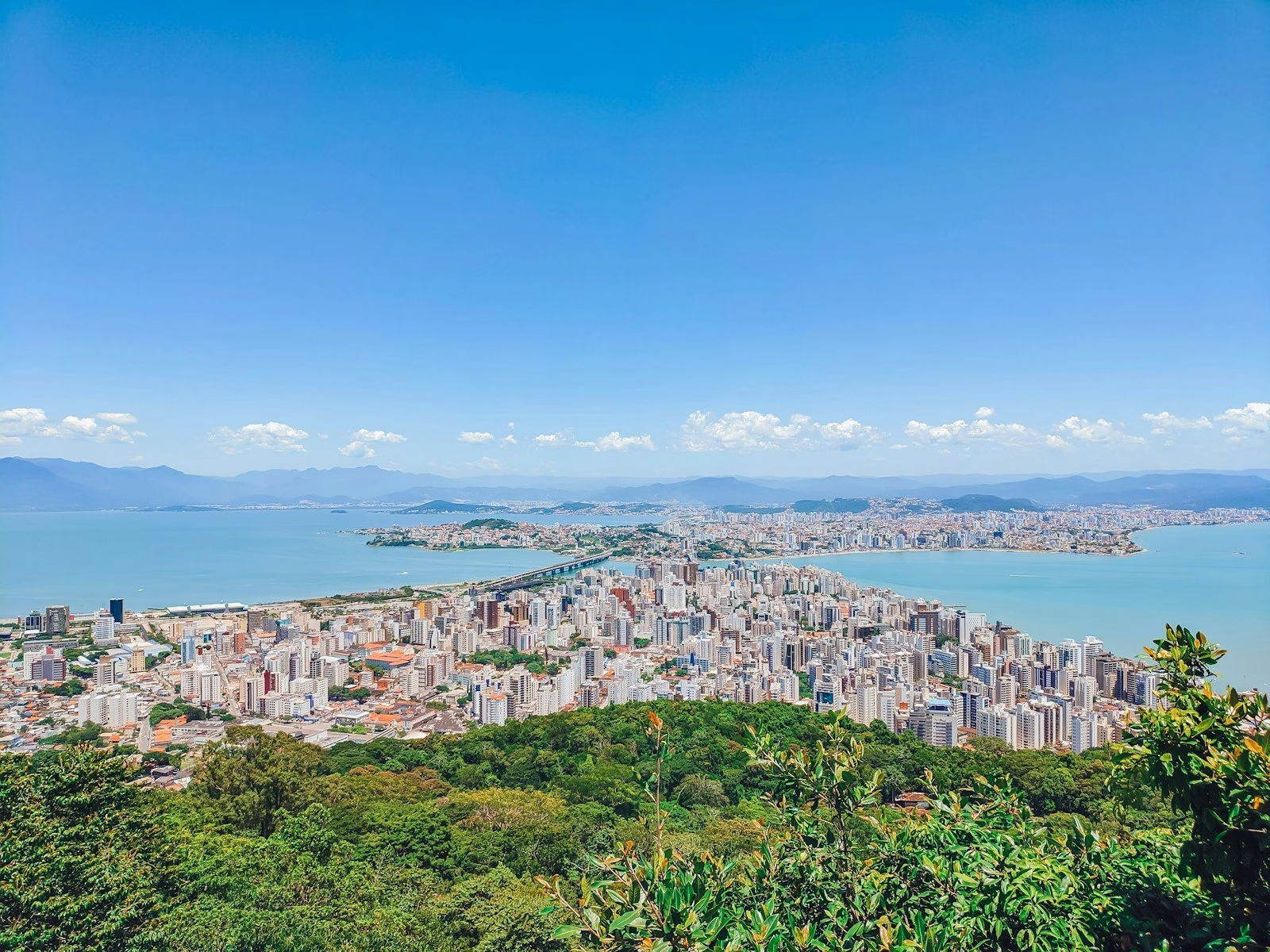
Florianópolis’s most expensive square meter is not the result of chance. Agronômica is expensive because urban planning—deliberate or shaped by the landscape itself—has made its land supply permanently limited. On one side, North Bay. On the other, the Morro da Cruz hillside. In the middle, a neighborhood that cannot expand sideways, only upward. And now, for the first time in decades, a 173,000 m² area in the interior of the neighborhood is being returned to public use.
This guide explains what the Master Plan allows you to build in Agronômica, what is arriving with the BRT, and what Culture City represents for the neighborhood’s urban development.
Geography as an urban planning factor
Agronômica has a peculiarity that few central neighborhoods in Brazilian state capitals possess: its perimeter is physically closed. North Bay defines the eastern boundary—there is no way to expand the neighborhood toward the water. Morro da Cruz defines the western boundary—the hillside is a Permanent Protection Area (APP), which prevents construction on steeper slopes. To the south, downtown. To the north, Trindade and Itacorubi.
This geographic closure has a direct consequence in the market: Agronômica has no more land to grow horizontally. What exists within the neighborhood is what will exist—and any vertical expansion depends on what the Master Plan allows block by block.
The Master Plan of Florianópolis in Agronômica
Urban planning in Florianópolis is governed by Complementary Law 482/2014 (original Master Plan) and Complementary Law 739/2023, which brought relevant updates. The Municipal Government publishes the zoning map on the municipal GeoPortal—essential for anyone planning to build or purchase land in the neighborhood.
Zones present in Agronômica
AMC—Central Mixed-Use Area: predominates in the zone closest to Av. Mauro Ramos and Beira-Mar Norte. Allows residential and commercial uses on the same lot—which explains the presence of medical offices, services, and retail on the ground floor of residential buildings. The development coefficient varies according to setbacks and lot type.
ARP—Predominantly Residential Area: occurs on more interior blocks, away from high-traffic roads. ARP zoning prioritizes residential use and restricts impactful commerce. This is where you find quieter apartments and, generally, higher cost per square meter.
ZIP—Zone of Interest for Preservation: introduced by LC 739/2023, this zone covers areas with functions of environmental, landscape, or cultural preservation. In Agronômica, it applies especially to the Morro da Cruz hillside zone and spaces with historic landmark protection or special safeguards.
What the Morro da Cruz Protected Area means in practice
The Morro da Cruz hillside is a Permanent Protection Area. This means lots directly on the hillside face severe construction restrictions—in many cases, zero occupation permitted. Properties that border the Protected Area have setback limitations and cannot use the protected zone as part of the development coefficient calculation.
For buyers: request the land use and occupation ruling from the Municipal Government before signing any agreement. What is registered on the GeoPortal may differ from what the seller claims about the property’s building potential.
The BRT on Av. Mauro Ramos: what changes for Agronômica
Avenida Mauro Ramos is the main internal road of the neighborhood—the axis connecting Agronômica to downtown and the rest of the city. This is where Florianópolis’s BRT will pass.
Project figures (Source: FloripAmanhã / TBN, 2026)
- Extension on Av. Mauro Ramos: 2.67 km with exclusive bus lane
- Complementary infrastructure: bike lane in center median and 20 new passenger shelters
- Total BRT corridor budget: R$ 389 million
- Funding sources: R$ 159 million from Novo PAC (federal government) + municipal match
- Construction timeline: start in 2026
What the BRT delivers for Agronômica residents
The neighborhood currently has ~6 bus routes with connections to the Central Terminal (TICEN), Canasvieiras Terminal, and Santo Antônio Terminal. Frequency is functional, but travel time on Av. Mauro Ramos suffers from peak-hour congestion.
With the exclusive lane, the BRT eliminates the traffic bottleneck for public transit. Those using buses will reach downtown in predictable time—not variable depending on the day’s traffic jam.
The bike lane in the median of Av. Mauro Ramos complements the existing bike lane on Beira-Mar Norte and creates an internal network within the neighborhood—currently partial.
Impact on property values
BRT projects have a documented effect of appreciating properties within the corridor’s influence radius, especially in stretches where public transit is already real demand. Agronômica, with high density of residents working downtown, is exactly that profile. The effect is not yet fully priced into listings—construction has not begun.
Culture City: the biggest urban project in the neighborhood in decades
In 2025, the State Government began the transformation of the Agronômica Penitentiary Complex into the “Culture City” project. What were 173,000 m² of area closed to public use—enclosed, partially abandoned, with no visible urban function—will be converted into a pole for culture, leisure, sports, and tourism.
What has already happened
- Public consultation: 86.9% approval for transformation into cultural space (Source: SECOM/SC)
- December 2025: demolition of old structures initiated (Source: ND+)
- Coordination: Department of Planning, InvestSC, Catarinense Culture Foundation
What is planned
- Construction of new cultural center with start planned for 2026
- Mixed use: culture, leisure, sports, and tourism—programming still being defined with the Catarinense Culture Foundation
- The area is larger than many urban parks in Brazilian state capitals
Why this matters for urban development
173,000 m² in a completely enclosed area, in the interior of a high-end neighborhood, is an urban rarity. The closest equivalent would be an entire high-density city block being replaced by park and public facilities.
The predicted impact:
1. Permeability: the area changes from enclosed to public, creating new routes for movement within the neighborhood
2. Surrounding area use: properties adjacent to the complex tend to appreciate with the arrival of green space and cultural facilities
3. Cultural offerings: the CIC, already the largest cultural complex in SC, gains a partner in the same vicinity—Agronômica could become the largest cultural pole in Southern Brazil in public use per square meter
For those buying property now: this project is a value trigger that is not yet fully reflected in listing prices. Construction is just beginning.
What the Master Plan does not allow and why it matters
Some urban planning restrictions merit attention before any property purchase decision in Agronômica:
Construction in Protected Areas: properties whose lot or part of the lot is in the Morro da Cruz Protected Area cannot be built on or expanded without special authorization—and many cannot be, regardless of any permit. Verification on the Municipal Government GeoPortal is mandatory before any agreement.
Commercial use in ARP: the ARP zone restricts commerce. Properties in ARP with functioning commercial use may be in irregular status—which affects the property’s eligibility for financing and transfer.
Height limits: the Master Plan defines maximum heights by zone. Properties announcing “building potential” must have that potential verified under current zoning—not the zoning that existed when the land was purchased.
How zoning affects property selection
In practice, what matters most for property buyers in Agronômica is understanding which zone the property is in—and what that means for the future neighborhood character.
Property in AMC: may have retail on the ground floor and mixed uses nearby. More urban life, potential for more noise, proximity to access roads.
Property in ARP: quieter surroundings, less commerce, more residential. The quiet premium is paid in walkability—may require more walking to commercial corridors.
Property near Protected Areas: depends on the specific situation. Could be the quietest with the most greenery—or the most building-restricted. Check the lot status before buying.
Frequently asked questions about urban planning in Agronômica
Can I build on the Morro da Cruz hillside?
Not in Protected Areas. The hillside has severe construction restrictions. Check the Municipal Government GeoPortal for the specific lot situation—zone, Protected Area status, required setbacks.
Will the BRT devalue properties near Av. Mauro Ramos?
There is no track record of devaluation in well-executed BRT projects—the effect is usually the opposite. The legitimate concern is the construction phase: noise, diverted traffic, and dust between 2026 and 2028. The long term tends to be positive.
When does Culture City construction begin?
Demolition of the old structures started in December 2025. The start of the cultural pole construction is planned for 2026. Follow publications from the Catarinense Culture Foundation and SECOM/SC for schedule updates.
Did the 2023 Master Plan change anything relevant for Agronômica?
LC 739/2023 introduced ZIP (Zone of Interest for Preservation) and some parameter adjustments. For decisions about construction or buying for development, consult directly with the Municipal Government—the legal text is the definitive source.
Complete series of guides: Agronômica
Regente in Agronômica
Regente has 41 active properties in Agronômica and a track record of real transactions in the neighborhood. To understand how zoning, Culture City, and the BRT affect the specific value of the property you are evaluating—rather than working with market averages—consult a specialist.
[Search properties in Agronômica] ← internal link: /pesquisar-imovel/venda/imoveis/florianopolis/agronomica/
Sources: PMF/REPLAN (LC 482/2014, LC 739/2023); SECOM/SC (Culture City); FloripAmanhã (BRT May/2025); TBN (BRT megaproject 2026); Leismunicipais (zoning); ND+ (penitentiary demolition Dec/2025).