
Ask which South American country is safest, and the regional rankings agree more than you’d expect: Uruguay first, Chile close behind, then Paraguay and Argentina. Brazil doesn’t crack that top four. If you stopped reading there, you’d rule out an entire country based on a single national average.
That average hides more than it shows. Brazil is roughly the size of the continental United States, and treating it as one data point makes as much sense as rating “American safety” from a single number that blends Manhattan with rural Wyoming.
This guide gives you the real regional ranking first — no spin, sources included — and then shows you where Brazil’s own city-level data breaks from the national story in a way that matters if you’re actually evaluating where to live, retire, or invest.
The 2026 regional ranking, and where it comes from
The Global Peace Index, published annually by the Institute for Economics & Peace, is the most widely cited measure of national peacefulness worldwide. In the 2026 edition, Uruguay ranked 43rd out of 163 countries globally — the highest of any South American nation — followed by Chile at 52nd, Paraguay at 64th, and Argentina at 72nd.
Uruguay’s position isn’t a fluke of one bad year elsewhere. The index credits it to political stability, strong institutions, and consistently low levels of conflict — the kind of structural factors that don’t swing year to year.
Brazil sits further down this same list. That’s a real, sourced fact, not a stereotype — but it’s also a single number describing a country of 213 million people spread across 26 states.
Why a national average can’t tell you about one city
A country-level index measures the whole country the same way a national GDP figure describes an entire economy: accurately, and not usefully, if what you actually want to know is how one specific place performs.
Violent crime in Brazil concentrates heavily in specific metropolitan regions — greater São Paulo and Rio de Janeiro carry outsized weight in any national figure. A state capital with a fundamentally different profile can sit far from that national number without the index ever showing it, because the index isn’t built to show it.
That’s not a defense of the national ranking. It’s the reason city-level data matters more than country-level data once you’ve narrowed your actual decision to a specific place — which is exactly the point at which most rankings stop being useful.
Florianópolis: the outlier the national number can’t show
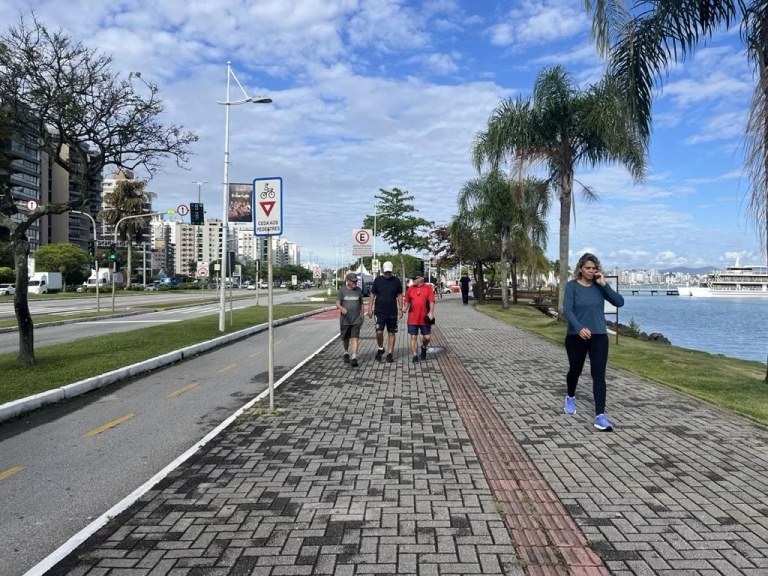
Florianópolis, the capital of the state of Santa Catarina, recorded a homicide rate of 10.7 per 100,000 inhabitants in 2025, according to Santa Catarina’s public security agency (SSP/SC). That’s the lowest rate among all Brazilian state capitals — roughly 30% below São Paulo’s over the same period.
Within the city, the pattern holds at the neighborhood level too. In Trindade, a university-adjacent neighborhood covered in more depth in Regente’s dedicated guide, 80% of residents rate their own neighborhood as safe, backed by a 24-hour civil police station and a dedicated university security division.
None of that erases Brazil’s national ranking, and it shouldn’t. What it does is show exactly why that ranking is the wrong tool for a decision about one specific city. A country-level index and a city-level homicide rate are both real, both sourced, and both answering different questions.
What this means if you’re evaluating South America as a place to live or invest
If safety is genuinely your first filter, the country-level ranking is a reasonable starting point for eliminating obvious outliers — but it’s a blunt one, and it stops being useful the moment you’ve picked a country and need to choose a city within it.
Uruguay, Chile, and Argentina earn their ranking as countries. Florianópolis earns its own case as a city, on a completely separate dataset, inside a country that ranks lower as a whole. Both facts are true, and neither cancels the other out.
The practical move is to treat the country ranking as a first pass, not a final answer — then verify the specific city with its own data, the way this guide does for Florianópolis and the way Regente’s guide to Brazil’s safety data does at the national and neighborhood level.
Frequently asked questions
What is the safest country in South America?
According to the 2026 Global Peace Index, Uruguay is the safest country in South America, ranking 43rd out of 163 countries globally — ahead of Chile (52nd), Paraguay (64th), and Argentina (72nd).
Is Brazil one of the safest countries in South America?
No, not by the national Global Peace Index ranking, where Brazil sits below Uruguay, Chile, Paraguay, and Argentina. That national figure doesn’t reflect city-level variation, though — Florianópolis specifically has the lowest homicide rate among Brazilian state capitals.
Why doesn’t a country’s safety ranking tell you about a specific city?
National indexes average an entire country into one number, which can obscure sharp regional differences. In Brazil, violent crime concentrates heavily in specific metro areas, so a state capital with a different profile can perform very differently from what the national figure suggests.
How safe is Florianópolis compared to the rest of Brazil?
Florianópolis recorded 10.7 homicides per 100,000 inhabitants in 2025 (SSP/SC), the lowest rate among Brazilian state capitals and roughly 30% below São Paulo’s rate over the same period.
Should I rule out Brazil entirely based on its country-level safety ranking?
Not if you’re evaluating a specific city rather than the country as a whole. A national ranking is a reasonable first filter, but city-level data — like Florianópolis’s homicide rate and neighborhood-level safety reporting — is what actually applies to a decision about where to live or invest.
What makes Uruguay, Chile, and Argentina rank so highly?
The Global Peace Index credits their rankings to political stability, strong institutions, and consistently low levels of conflict — structural factors rather than short-term trends.
A regional ranking and a city’s own data can both be true at the same time without contradicting each other. Uruguay’s national ranking is real. So is Florianópolis’s homicide rate. Neither one is the full picture on its own, and treating either as the final word skips the verification step that actually matters once you’ve narrowed a country down to a specific place.
If Florianópolis is on your shortlist, talk to Regente — we’ll walk you through the city and neighborhood data for the specific area you’re considering, not just the national headline.