
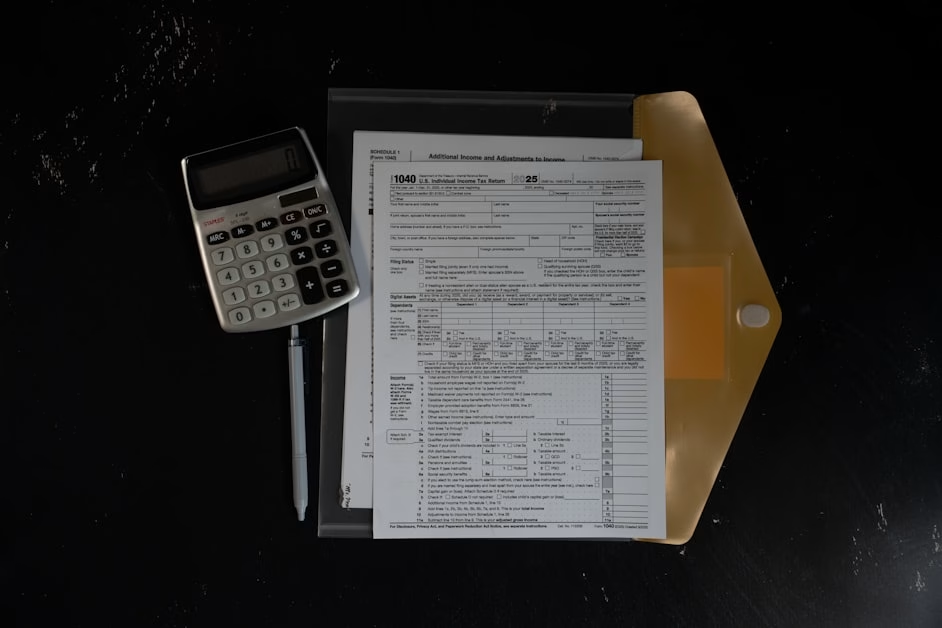
Rental income received is taxable income. The Federal Revenue Service (Receita Federal) knows the property exists—and expects the corresponding tax return.
The problem is not reporting income. It is reporting it wrong: omitting months, using the wrong tax return field, ignoring legitimate deductions, or paying more tax than required.
Who is required to report rental income?
Every property owner who receives rental income from an individual or a business entity is required to include those earnings in their Annual Income Tax Return (Declaração de Ajuste Anual, IRPF). The requirement applies regardless of amount—receipt of income already constitutes taxable earnings.
What varies is the tax rate: the progressive IRPF table applies different percentages according to the monthly income bracket. Below the current exemption threshold (⚠️ VERIFY—2026 progressive table), tax due is zero. Above it, rates climb up to 27.5%.
For details on how the CIB (Brazilian Property Registry) affects Federal Revenue Service oversight of rental contracts, the guide on CIB and the Federal Revenue Service explains what changed.
How monthly taxation works—the carnê-leão
When a property owner receives rent directly from an individual tenant, tax must be collected monthly via carnê-leão—not just on the annual tax return.
The monthly payment is calculated on the gross amount received, minus allowable deductions, and must be paid by the last business day of the month following receipt.
Deductions allowed on the carnê-leão:
- Property tax (IPTU) on the property, when paid by the landlord (owner) — not the case in contracts managed by Regente, where the tenant is responsible for the IPTU
- Real estate management fee, when a property management company is used
- HOA fees, when paid by the landlord (not passed on to the tenant)
- Building insurance premium paid by the landlord
Not deductible on the carnê-leão: renovation expenses, maintenance, property depreciation, or real estate agent commission.
What changes when a property management company manages the property
When a property management company manages the rental, the tax scenario changes:
If the property manager is only an intermediary (passes through the gross rent and the owner pays the tenant directly): the owner remains responsible for the carnê-leão.
If the property manager receives the rent and passes it on to the owner (Regente model): the property manager files the DIMOB (Declaration of Real Estate Activity Information) with the Federal Revenue Service at year-end—a tax obligation of the property manager itself regarding the intermediated transactions, not a document delivered to the owner. Monthly, Regente issues a statement of account to the owner showing the amounts received, deductions applied (management fee, etc.), and the net remittance.
Regente does not withhold income tax at the source. The owner uses the monthly statement of account to fill out the carnê-leão and pay the IRPF—earnings continue to be reported under Income from Individuals, since no withholding occurs. At the start of each year, Regente issues the consolidated annual statement to make filling out the annual tax return easier.
With professional management, the owner receives the income statement at the start of the year with everything consolidated—without needing to reconstruct it month by month.
For details on how the management fee is calculated and what it includes, the guide on real estate management fees in Florianópolis breaks down the calculation basis and related tax deductions.
How to report on the annual IRPF
On the Annual Income Tax Return, rental income goes into different fields depending on its source:
| Payer | IRPF field |
|---|---|
| Individual (direct tenant) | Taxable Income Received from Individuals/Abroad |
| Property manager (business entity) | Taxable Income Received from Business Entities |
| Company (business-entity tenant) | Taxable Income Received from Business Entities (tax withheld at source) |
The carnê-leão paid throughout the year is reported under the “Carnê-Leão” field and deducted from the tax owed on the annual return—avoiding double payment.
The most common mistakes
Owners who self-manage make the same mistakes repeatedly:
- Omitting months: believing that below the monthly exemption threshold there’s no obligation to report (there is—reporting is mandatory; the tax may be zero, but the record is not)
- Not paying the monthly carnê-leão: holding everything for the annual return generates a penalty of 0.33% per day on the tax owed, capped at 20%, plus interest
- Ignoring deductions: paying property tax (IPTU) on the rental property and not deducting it means paying more tax than required
- Reporting on the wrong field: when the property manager withholds income tax at the source, rent must be reported as income from a business entity—but that is not Regente’s model. Regente does not withhold income tax at the source: the owner reports normally under Income from Individuals, based on the monthly statement of account.
With professional management, the documentation already comes organized
Owners who self-manage need to reconstruct 12 months of receipts, calculate deductions month by month, and ensure the carnê-leão payments are correct. Any error exposes them to the risk of being flagged for a detailed review (malha fina).
With Regente’s Total Guarantee, the property manager issues the monthly statement of account and the consolidated annual income statement at the start of each year—with the gross amounts received, deductions applied (management fee and HOA fees, where applicable), and the documented net remittance. IPTU does not appear on this list because, in contracts managed by Regente, payment is the tenant’s responsibility—the owner has no such expense to deduct. The owner hands the statement to their accountant, fills out the carnê-leão based on that data, and closes the matter.
For details on what happens when the tenant doesn’t pay and how that affects the income to be reported, the guide on delinquent tenant describes the rights and collection process involved.
Frequently asked questions about reporting rental income on your tax return
Do I need to report rent even if the amount is low?
Yes. The obligation to report exists regardless of amount. Tax due may be zero if the income falls below the taxable bracket, but omitting the income is subject to a tax assessment.
What is the carnê-leão and when do I have to pay it?
It is the monthly collection of IRPF on income received from individuals without withholding at the source—including rent paid by an individual tenant. It is due on the last business day of the month following receipt.
Can I deduct property renovations on the carnê-leão?
No. Renovation, maintenance, and improvement expenses are not deductible on the carnê-leão. Only IPTU, HOA fees, and the management fee are deductible—and only when paid directly by the landlord. In contracts managed by Regente, IPTU is paid directly by the tenant, so it does not factor into the owner’s deductions.
Does the property manager withhold tax on the rent?
Regente does not withhold income tax at the source. The owner receives the monthly statement of account with the amounts received and deductions applied, and is responsible for paying the IRPF monthly via the carnê-leão. At the start of each year, Regente issues the annual income statement to make filing the IRPF easier.
What happens if I don’t report the rent?
The Federal Revenue Service cross-references CIB data, registered contracts, and tenant tax returns. Omitting rental income is one of the items monitored automatically—and it generates a tax assessment with penalties and retroactive interest.
Sources: Normative Instruction RFB No. 1,500/2014 (Brazilian Federal Revenue Service); Income Tax Regulation (RIR/2018) (Planalto.gov.br); Regente Imóveis operational data (2026).