In 1922, an ailing governor signed a $10 million contract with bankers in New York. He knew he probably wouldn’t live to see the result. He was right. And the bet was the most profitable in Santa Catarina’s history.
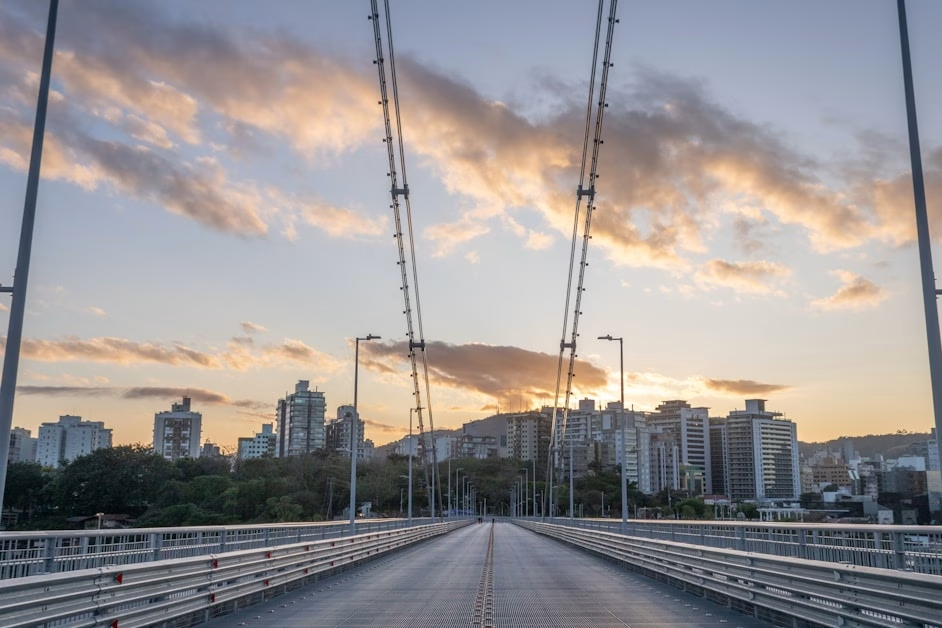
The governor was Hercílio Luz. The contract was to build an 821-meter bridge over the Strait. The work would take four years, American engineers, and a debt that the state would only pay off 52 years later.
But the question that matters to the investor of 2026 is not whether the bet paid off. It’s: what did it create—and why hasn’t that effect ended yet?
The Impossible Bet of 1922—and What It Proves About Florianópolis
Before 1926, Florianópolis was a capital of 40,000 residents dependent on ferries. Any rough sea isolated the city for days. There was serious political pressure to move the capital to the interior of the state.
The construction of the bridge was not consensus. It was an imposition of vision against inertia.
The loan was contracted in New York. The engineers were American—David B. Steinman and Holton D. Robinson, hired to create a structure that didn’t yet exist in the world. The governor who envisioned the work died before the inauguration.
On May 13, 1926, it rained at the ceremony. About 40,000 people—half the city’s population—went to the shores of the Strait. The bridge was 821 meters long. It cost the equivalent of decades of state tax revenue.
And yet it was the right decision.
This is the central characteristic of Florianópolis’s real estate market: fundamentals built against the convenience of the moment—and that withstand any cycle.
What happened next confirms every penny of the bet.
The Three Pillars That the Bridge Built—and the Market Expanded
The Hercílio Luz Bridge didn’t just connect the island to the mainland. It created the structure of three forces that still today explain why investing in property in Florianópolis has a different outcome than in any other capital in the South.
Pillar 1—Scarcity That Has No Solution
The island has physical limits. It’s not possible to expand horizontally without limit like in mainland cities. Each new condominium competes with increasingly scarce available land.
The equation is simple: growing demand + physically limited supply = permanent price pressure.
No government decision, no economic cycle, and no zoning change alters that geometry.
Pillar 2—Migration That Doesn’t Stop
Florianópolis has consolidated an identity that attracts a specific type of migrant: high income, purchasing power above the national average, and deliberate choice of the city—not by employment obligation.
UFSC, one of the best universities in the country. The technology hub that became known as the “Silicon Island”. One of the highest HDIs in Brazil. The coast with 42 beaches.
The city’s real estate demand doesn’t depend only on the local economy. It absorbs income from throughout Brazil—and increasingly from abroad.
Pillar 3—Infrastructure That Appreciates in Waves
The Hercílio Luz Bridge was the first major infrastructure investment. Then came the Colombo Salles Bridge (1975), the Pedro Ivo Campos Bridge (1991), the Southern Expressway, the UFSC campus, and the Sapiens Park in the North of the Island.
Each layer of infrastructure created a wave of appreciation in different neighborhoods.
The investor who learned to identify the next vector always arrived before the price curve.
The Cycles of Decline—and What They Prove About Resilience
Real estate markets go through slowdowns. Florianópolis did. But two historical episodes reveal something that growth data alone doesn’t show.
The Closure of the Hercílio Luz Bridge (1982–2019)
In 1982, a 60-centimeter crack was detected in an eyebar of the Hercílio Luz Bridge. The bridge was closed. No one died—the structure with four bars per pin had time to react.
But the economic effect was real. The Center-Strait axis, which had operated for decades, lost intensity. Traffic flow migrated to the other bridges.
The real estate market didn’t collapse—it reorganized.
The North and South of the island grew rapidly during the 37 years of closure. Neighborhoods connected by the other bridges appreciated in ways that would not have happened with the Hercílio Luz Bridge open.
This demonstrates that Florianópolis’s real estate demand is not tied to a single vector. It’s tied to the city.
The Pandemic (2020)
Forced isolation, paradoxically, repositioned Florianópolis on the national and international map.
The search for quality of life, space, and proximity to the sea accelerated migration of professionals with remote work. The city entered the radar of buyers who, in 2019, weren’t even considering it.
The 97% boom in sales volume in Q1 2025 (versus Q1 2024) is, in part, the belated result of this repositioning.
The Data from 2025–2026 That Confirms the Historical Thesis
Recent numbers are not an anomaly. They are the contemporary expression of a secular trend.
Appreciation of the m²:
– R$ 13,208 — average price per m² in Florianópolis in April 2026
– 9.44% — annual appreciation in 2025, versus 5.2% of the national average (FipeZAP)
– Florianópolis is among the two most expensive capitals in Brazil in 2025–2026
Trading Volume:
– 1,942 units sold in Q1 2025 — a 97% increase over Q1 2024
– R$ 1.6 billion VGV in Q1 2025 — a 67.2% increase
Rental Income:
– Rent appreciation above inflation in 2024–2025
– Vacancy rate among the lowest of Brazilian capitals
Neighborhoods with Greatest Recent Appreciation:
– North of the Island (Jurerê Internacional, Ingleses): above R$ 20,000/m² in premium standards, with de facto dollarized demand—foreign and ultra-high-income national buyers
– Estreito: R$ 11,451/m² with 12% appreciation in 2025 (FipeZAP)
– Historic Downtown: stable demand, high liquidity, supply in constant renewal
– Trindade / Santa Mônica: permanent demand due to proximity to UFSC
But there was a detail that few investors notice when looking at these numbers.
The 2019 Turning Point—and Why It Hasn’t Ended Yet
On December 30, 2019, the Hercílio Luz Bridge was reopened to pedestrian and cyclist traffic. The rehabilitation took 13 years of technical work—210,000 rivets replaced, 360 eyebars changed, heating techniques above 1,100°C.
The New Year’s Eve from 2019 to 2020 took place with 200,000 people on the Beira-Mar Norte. Some of them crossed the Hercílio Luz Bridge on foot that night—something that Florianópolis’s younger residents had never done.
The real estate effect was immediate in the Estreito. And is underway in the surroundings of the island headland, in Historic Downtown.
The bridge’s candidacy for UNESCO World Heritage status—currently under review by IPHAN-SC—adds a new vector: sustained international visibility, which converts into demand from foreign buyers with a long-term horizon.
The cycle begun in 1926 has not closed. It opened a new chapter.
How to Structure Investment by Profile
Real estate wealth advisory in Florianópolis begins with defining the objective. Each profile has a different strategy.
For long-term capital appreciation
– Neighborhoods: North of the Island (premium), Estreito, Trindade, Lagoa da Conceição
– Typology: apartments with usable area above 70 m², or studios in high-demand clusters (close to UFSC or Downtown)
– Horizon: minimum 5 years to capture full appreciation maturity
For rental income
– Neighborhoods: Trindade (student and professional rental), Downtown (corporate and residential), Canasvieiras/Ingleses (seasonal)
– Typology: studios to 2-bedroom units, properties with managed HOA
– Rentability: between 0.4% and 0.7% per month in income, depending on neighborhood and management
For second residence and mixed use
– Neighborhoods: Jurerê Internacional, Lagoa da Conceição, Santo Antônio de Lisboa
– Typology: houses or apartments with good views and proximity to leisure
– Differential: liquidity guaranteed by the demand from seasonal visitors and national and international high-income buyers
For personalized analysis by profile and budget, the team at Regente Imóveis provides real estate wealth advisory in Florianópolis.
FAQ—Frequently Asked Questions About Real Estate Investment in Florianópolis
Why does Florianópolis lead real estate appreciation in Southern Brazil?
Florianópolis combines three factors that most cities don’t have simultaneously: geographical scarcity of land (island with physical limits), continuous demand for qualified migration (technology, entrepreneurship, quality tourism), and historical infrastructure built over 100 years since the Hercílio Luz Bridge. The result is 9.44% annual appreciation in 2025, versus 5.2% of the national average (FipeZAP).
What is the rental yield in Florianópolis in 2026?
Rental yield varies by neighborhood and typology. Studios and 1-bedroom apartments near UFSC (Trindade, Santa Mônica) and Downtown have yields between 0.5% and 0.7% per month. Seasonal properties in the North of the Island can exceed 1% per month in high season, with average annual rental income of 0.45%–0.55% when considering low months. Premium properties in Jurerê have lower rental yield, but higher capital appreciation potential.
Can foreigners invest in properties in Florianópolis?
Yes. The Migration Law (Law 13.445/2017) and the Civil Code guarantee foreigners the same rights as Brazilians for the purchase of urban property. The only universal requirement is a CPF. There are no nationality restrictions for urban properties. For more details on the complete process, see our guide to property purchase for foreigners in Florianópolis.
Which neighborhood in Florianópolis has the best appreciation potential in 2026?
There is no single answer—it depends on the investor’s profile. For those seeking capital appreciation with liquidity, Trindade and Estreito present solid fundamentals and more accessible pricing. For premium standards with international demand, Jurerê Internacional and Lagoa da Conceição are references. For those starting their portfolio with a smaller budget, neighborhoods in the process of densification like Abrahão and Capoeiras (mainland) show potential to enter before the price curve.
How does the Hercílio Luz Bridge affect the current real estate market?
The reopening of the Hercílio Luz Bridge in 2019 reactivated the Center-Strait axis, which had lost intensity during the 28 years of closure. Estreito recorded 12% appreciation in 2025 (FipeZAP). Beyond the direct impact, the bridge’s restoration signals Florianópolis’s capacity to preserve and enhance its historical heritage—a factor that contributes to positive perception by national and international investors.