Property appreciation in Florianópolis is neither coincidence nor a passing cycle. According to FipeZAP data, the city’s residential market accumulated between 85% and 100% nominal appreciation between 2019 and 2024 — with nominal CAGR close to 22% per year in BRL. This performance places Florianópolis among the markets with the highest price growth among Brazilian state capitals during the period.
What sustains this movement? Two structural vectors in constant collision: chronically restricted supply and demand with multiple simultaneous origins. Below, the analysis of five factors that explain why the trend tends to persist — and where the greatest catalysts for the coming years are located.
Property Appreciation in Florianópolis: Why Does Supply Never Meet Demand?
Supply restriction is the most permanent and difficult-to-reverse factor in Florianópolis’s real estate market.
The island as an insurmountable physical limit
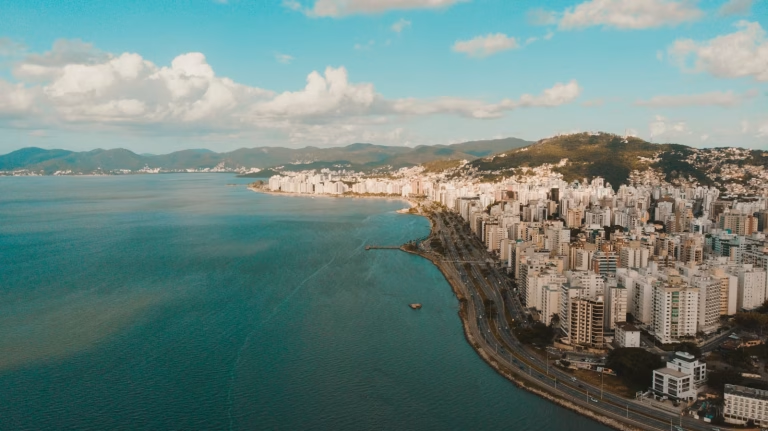
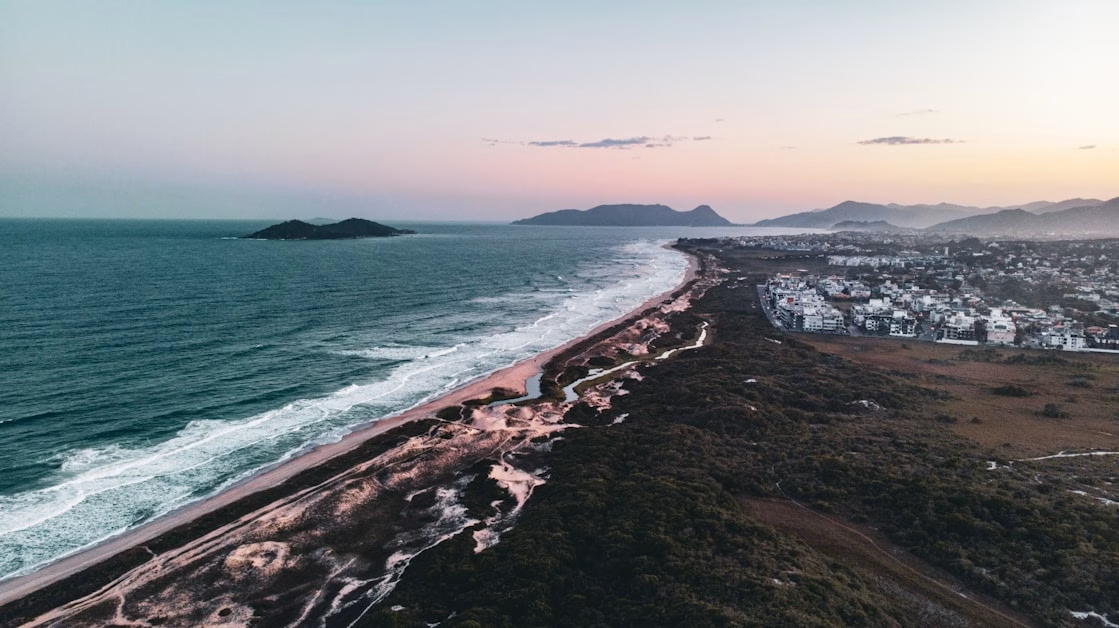
Florianópolis has approximately 424 km² of insular area. Much of this territory corresponds to hills, dunes, lagoons, mangroves, and slopes with declivity exceeding 45 degrees — all protected by law. The effectively urbanizable area is progressively saturated.
Continental cities like Curitiba and São Paulo can expand the urban perimeter toward adjacent land when demand grows. Florianópolis does not have this valve. Every new project competing for land on an island of fixed size structurally raises land cost — and this cost transfers to the property’s final price.
Master Plan that limits verticalization
Florianópolis’s Master Plan (Complementary Law 482/2014) establishes a maximum building height of two to six stories in most of the island’s territory. Zones permitting greater verticalization concentrate in the Center and a few continental neighborhoods.
In high-value neighborhoods — Lagoa da Conceição, Jurerê Internacional, Ingleses, Campeche — developers cannot launch large towers. The result is new supply per square meter chronically lower than demand. When little new stock enters the market, what already exists tends to appreciate.
Protected Areas (APP) and marine lands reduce urbanizable stock
Protected Areas of Permanent Preservation (APP) remove land from the urbanizable stock definitively and regulatory. Dunes receive mandatory protection bands in the north and east of the island. Mangroves have total protection. Marginal bands of lagoons vary from 30 to 100 meters of APP.
Beyond APPs, approximately 30,000 properties in Florianópolis are on marine lands (SPU), subject to annual foro of 0.6% per year and 5% laudêmio on sale. This additional cost filters short-term buyers without preventing long-term appreciation — the backing is the scarcity of the asset.
Approval lag amplifies scarcity
The average timeframe for approving a development in Florianópolis — from land purchase to certificate of occupancy (habite-se) — ranges from four to seven years, according to SINDUSCON-SC. This lag includes FLORAM, IPUF, SPU licensing when the land is marine, and Property Registration (CRICRIVer tudo →) records.
The practical consequence is that any increase in demand today creates price pressure that lasts at least five to seven years before new supply can provide relief. No other variable explains so clearly why prices rise quickly and stay high for so long.
Why Do So Many People Choose to Live in Florianópolis?
If supply is restricted, demand determines appreciation speed. In Florianópolis, demand has multiple simultaneous origins — which creates resilience: when one source recedes, others compensate.
Population growth above national average
Florianópolis grew approximately 2.0% per year between 2010 and 2022, according to IBGE — more than double the national average of 0.8%. Greater Florianópolis, including São José, Palhoça, and Biguaçu, grows around 2.5% per year and forms a metropolitan area of approximately 1.1 million inhabitants.
After 2020, with the consolidation of remote work, the migratory flow to the city accelerated. The predominant profile includes technology and finance professionals, entrepreneurs relocating from larger capitals, and families with young children seeking safety and quality of life. This profile has high income and strong willingness to pay.
Second-residence demand and digital nomads
Florianópolis is the primary second-residence destination for families from Southern Brazil. Property owners from Paraná, Rio Grande do Sul, and interior Santa Catarina use the property two to three months per year and rent it out the remainder via short-stay platforms. This profile has lower price sensitivity — primary income comes from elsewhere.
Digital nomads and remote workers without obligatory geographic ties also systematically choose Florianópolis. The combination of beaches, safety, gastronomy, internet infrastructure, and coworking spaces places the city in national rankings for best destinations for this profile.
More on the rental market and how this demand affects prices: understand why rent in Florianópolis is expensive
Foreign demand — especially Argentina
Argentines are the primary foreign buyer group in Florianópolis. The mechanism is straightforward: a property in BRL has low correlation with the Argentine peso — it functions as currency hedging. Argentina’s history of crises (2001, 2018, 2023) created structural demand for wealth diversification abroad.
With the end of the exchange rate ceiling in April 2025, formal currency access became easier for Argentines. In Jurerê Internacional, local broker estimates indicate that 30 to 40% of seasonal sales involve foreign buyers or tenants.
Florianópolis Has Quality-of-Life Fundamentals That Sustain Demand
Quality of life does not directly cause appreciation — it sustains long-term demand. A city that loses quality of life loses buyers and, with it, loses its appreciation vector.
Florianópolis accumulates advantages across multiple dimensions:
- HDI: 0.847, top 15 position among Brazilian municipalities (PNUD/IBGE Atlas)
- Safety: one of the three safest capitals in Brazil (Brazilian Public Security Forum)
- Education: UFSC among the three best federal universities in Brazil (CWUR and QS rankings); consolidated network of bilingual schools
- Per capita GDP: approximately R$ 48,000/year (IBGE 2022) versus national average of R$ 38,000
- Natural assets: 42 beaches, lagoons, state parks, subtropical climate with approximately 300 days of sun per year
The technology ecosystem — with companies like Intelbras, Involves, Resultados Digitais, and Conta Azul operating in the city — sustains qualified employment and elevated per capita income. This economic foundation expands the pool of buyers with payment capacity.
Air connectivity to São Paulo in approximately one hour, direct flights to Rio de Janeiro, and seasonal routes to Buenos Aires reinforce Florianópolis’s position as a second-residence destination and relocation hub for high-income professionals. #
Which Infrastructure Projects Will Still Drive Appreciation?
Specific projects create point appreciations and anticipatory pricing — the market prices the improvement before it is delivered. In Florianópolis, three initiatives converge toward the same geographic pole: the island’s north.
Northern Ring Road — expected delivery in 2027-2028
The primary bottleneck in Florianópolis is access to the north of the island. Ingleses, Canasvieiras, and Jurerê depend on a single route — SC-401 via Beira-Mar Norte. In high season and holidays, congestion reaches three or four hours.
The Northern Ring Road creates a direct connection from BR-101 to the island’s north, bypassing Florianópolis’s center. The expected reduction in travel time is 40 to 60 minutes. The projected appreciation for beneficiary neighborhoods — Ingleses, Canasvieiras, Jurerê, and Vargem Grande — is 15 to 25% additional in the medium term, according to local market analysis.
For the investor with a three-to-five-year horizon, this is the most clearly substantiated bet in Florianópolis’s current market. Part of the anticipated appreciation has already been priced, but the main upside occurs upon project delivery. #
Sapiens Technology Park — innovation hub in the island’s north
Sapiens Park occupies approximately 3,500 hectares at the far north of the island, between Ingleses and Canasvieiras. The technology, biotechnology, and innovation cluster project has companies like Embraco and Intelbras in Phase 1, plus startups linked to UFSC.
The real estate impact is twofold: it creates residential demand from high-income professionals wanting to live near the employment hub and progressively elevates the socioeconomic profile of neighborhoods that are today more popular and touristic. Combined with the Northern Ring Road, the north can be repositioned as one of Florianópolis’s most valued poles in the next decade.
Expansion of Hercílio Luz Airport
The concession of Hercílio Luz Airport to Vinci Airports in 2017 included terminal expansion and runway works underway. Current capacity is approximately 6 million passengers per year, with a goal of doubling after the works.
Greater international flight capacity — including potential for direct routes from Buenos Aires, Miami, and Lisbon — structurally elevates foreign and premium second-residence demand. The direct impact on Coqueiros and Estreito neighborhoods is medium, but the systemic effect on the entire city’s attractiveness is significant.
How Does Florianópolis Compare with Other Southern Cities?
Demand for Florianópolis is relative — it depends on the city being perceived as better than available alternatives.
Versus São Paulo: Equivalent properties cost 40 to 60% less in Florianópolis than in upscale São Paulo neighborhoods like Jardins or Itaim. With remote work consolidated, the high-income Paulista does not need to be in São Paulo five days a week. A 100m² apartment sold in Itaim for R$ 1.5 to 2 million buys a high-standard house in Jurerê or Campeche — with capital left over to invest.
Versus Porto Alegre: The May 2024 floods in Rio Grande do Sul caused the largest climate disaster in the state’s history. Informal data from Florianópolis brokers report a 20 to 30% increase in Rio Grande do Sul resident inquiries in the second half of 2024 and in 2025. Porto Alegre’s climate risk — located in a flood plain of the Guaíba and Jacuí basins — is physical and structural, unresolved by emergency works.
Versus Balneário Camboriú: Balneário Camboriú has Brazil’s most expensive per-square-meter outside São Paulo, with R$ 17,000 to 25,000/m² in high-standard launches. Florianópolis still has a 30 to 50% discount relative to this premium standard — and as the city becomes more sophisticated, the gap tends to narrow. Balneário Camboriú functions as a price-reference ceiling for Florianópolis long term.
More on market comparison: # | #
What Are the Risks Every Investor Should Consider?
Honest analysis of any investment requires evaluating risks — not just favorable fundamentals.
The 22% nominal CAGR between 2019 and 2024 included an atypical period of low Selic rates (2020-2021) and BRL depreciation that likely will not repeat with the same intensity. Conservative projections for the base scenario work with 8% to 10% per year nominal appreciation.
The Master Plan could be revised. A potential verticalization liberalization in neighborhoods currently restricted would increase supply and dampen price pressure — although this process requires municipal legislation with long procedural timelines.
Florianópolis’s market presents a price-to-rent ratio of 20 to 27 times — indicating that part of the appreciation has already priced in future growth. In some neighborhoods, long-term rental yield of 3 to 4.5% per year is below the Selic rate. Total returns only exceed fixed income when combined with long-term appreciation.
Detailed analysis of yield, IRR, and comparison with fixed income: see return analysis
Frequently Asked Questions About Property Appreciation in Florianópolis
Will properties in Florianópolis continue to appreciate?
The structural fundamentals — restricted supply due to being an island, Master Plan with limited building height, and extensive APPs — do not change in the short and medium term. Demand also has multiple simultaneous origins: qualified domestic migration, second residences, foreign demand, and tourism. Conservative projections work with 8% to 10% per year nominal appreciation. The primary risk is a Master Plan revision that permits broad verticalization, which would require a legislative process lasting several years.
Which Florianópolis neighborhoods have the greatest appreciation potential now?
The island’s north concentrates the greatest point catalysts for 2026-2030: the Northern Ring Road with partial delivery expected in 2027-2028, the expanding Sapiens Technology Park, and airport expansion. Ingleses, Canasvieiras, and Jurerê Internacional are the neighborhoods with the most documented upside in the three-to-five-year horizon. Campeche and Lagoa da Conceição maintain strong demand and limited stock, with more stable appreciation.
Is it better to buy property in Florianópolis cash or financed?
It depends on investment horizon and available rate. With historical 10% per year appreciation, a financed property with 20% down payment can generate IRR of approximately 21% per year on equity — versus 12% on all-cash purchase. SBPE financing cost is around 12 to 13% per year effective. Leverage is positive in years when appreciation exceeds debt cost. Operational cash flow tends to be negative in the first years, since long-term rent rarely covers the financing payment.
What makes Florianópolis different from other coastal cities?
The combination of physical scarcity (island), restrictive regulation (Master Plan), and demand diversity (domestic migration, second residences, foreign demand, tourism) is rare among Brazilian coastal cities. Balneário Camboriú has similar dynamics, but is more vertically saturated and with less diversified economic base. Florianópolis still has a top 3 federal university in Brazil, a consolidated technology ecosystem, and an HDI of 0.847 — factors that sustain high-income family demand long term.
What is typical investment return on Florianópolis property?
Gross long-term rental yield varies from 4.5% to 6.5% per year depending on neighborhood and standard. After operating costs (administration, property tax/IPTUIPTUVer tudo →, maintenance, vacancy, insurance), net yield is between 3.0% and 4.5% per year. For properties in touristic neighborhoods operated via Airbnb, net yield can reach 6% to 12% per year. Total IRR — incorporating appreciation and rent in a five-year horizon with financing — sits between 18% and 22% per year in the base scenario.
The analysis of five factors — physical supply restriction, conservative Master Plan, demand diversity, quality of life, and infrastructure catalysts — shows that property appreciation in Florianópolis has structural, not cyclical, causes. To analyze the viability of your investment in Florianópolis, speak with the Regente team.