APP, restinga, mangrove and land title regularization in Florianópolis form one of the most complex issues in the capital of Santa Catarina’s real estate market. Depending on the interpretation of the restinga concept, between 26% and 66% of Florianópolis territory may be classified as Permanent Protected Area (Source: FLORAM estimates and academic studies from UFSC).
This variation creates legal uncertainty for thousands of property owners. Whoever owns a property in a coastal area of Florianópolis needs to understand what the legislation and case law say, and what paths exist to regularize property under these conditions.
APP Florianópolis restinga mangrove regularization: what is the scope of the problem
Florianópolis is an island with 172 kilometers of coastline and coastal ecosystems that occupy a significant portion of its territory. The Forest Code (Law 12.651/2012) classifies as APP, among others, the restinga strips that fix dunes and stabilize mangrove, as well as the mangrove ecosystems themselves.
The problem: the technical definition of restinga generates divergent interpretations. A broad reading—all vegetation on coastal sandy substrate—would place most of the island’s plains as APP. A restrictive reading—only restinga that serves to fix dunes or protect mangrove—drastically reduces the protected area.
Restinga: not all coastal vegetation is APP
The Forest Code protects as APP restinga in two specific situations:
- Dune-fixing vegetation that prevents dune advancement over occupied areas
- Mangrove-stabilizing vegetation that protects adjacent mangrove ecosystems
Outside these ecological functions, restinga is native vegetation protected by the Atlantic Forest (Law 11.428/2006), but does not automatically fall under APP status. This distinction makes an enormous difference for the property owner.
Mangrove: complete protection without exception
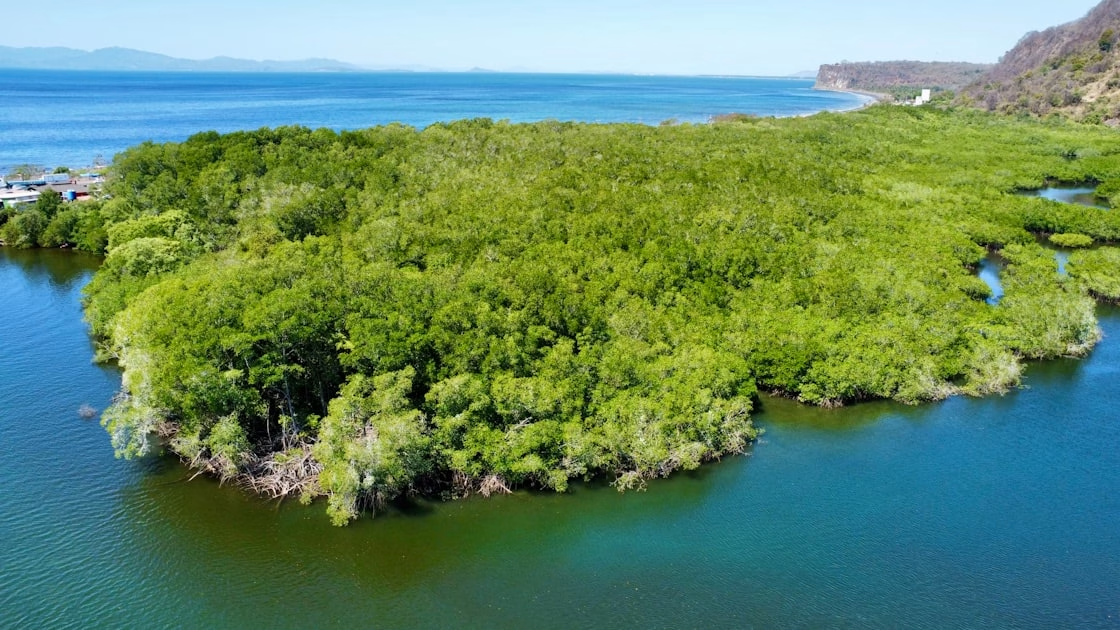
Mangrove ecosystems possess absolute protection as APP under the Forest Code. Unlike restinga, there is no ambiguity in interpretation regarding mangrove. Every mangrove area is APP, without exception.
In Florianópolis, mangrove ecosystems concentrate in North and South bays: Itacorubi, Saco Grande, Ratones, Tapera and Rio Tavares. Many of these areas are in irregular neighborhoods of the city, where 40% of properties lack formal registration. Properties situated on mangrove fill face the most severe restrictions of environmental law.
What did the STJ decide about restinga as APP?
The Superior Court of Justice (STJ) established jurisprudence that brought greater legal certainty to the issue. In recent rulings, the STJ consolidated the following position:
Restinga is only APP when it exercises the ecological function of fixing dunes or stabilizing mangrove (Source: STJ, REsp 1.462.208/SC and precedents from the 2nd Panel).
This interpretation rejects the thesis that all restinga vegetation would be APP in itself. The STJ requires proof of the specific ecological function: dune fixation or mangrove protection.
Practical consequences of this decision:
- Properties in restinga areas without dune-fixing function may have legal viability for regularization
- Classification as APP depends on a technical report proving the ecological function
- Areas already urbanized on restinga without dune-fixing function have favorable legal arguments
- Each case requires individual analysis based on remaining vegetation and local geomorphology
REURB in APP area: when the law permits regularization
Law 13.465/2017 opened the possibility of REURB in APP, but with stringent conditions. The rules vary according to the REURB modality.
REURB-S in APP: social interest with environmental study
Social Interest REURB (REURB-S) permits regularization in APP when occupation is prior to December 22, 2016. Mandatory requirements:
- Environmental technical study proving that regularization improves environmental conditions
- Approval by the competent environmental agency (FLORAM in Florianópolis)
- Implementation of essential infrastructure (sanitation, drainage)
- Proof that removal would cause greater social damage than permanence
REURB-S serves families with income up to 5 minimum wages or enrolled in housing programs. The law prioritizes the permanence of low-income populations in consolidated areas, even in APP.
REURB-E in APP: severe restrictions
Specific Interest REURB (REURB-E) faces much stricter restrictions in APP. The law does not expressly prohibit it, but the environmental agency requires:
- Complete environmental study with compensatory measures
- Proof of consolidated occupation prior to the time marker
- Absence of geotechnical risk
- Approval by the Municipal Environmental Council
In practice, few REURB-E projects in APP obtain approval in Florianópolis. FLORAM adopts a conservative stance, especially in mangrove areas and restinga areas with proven ecological function.
FLORAM and environmental licensing in Florianópolis
The Municipal Foundation for the Environment in Florianópolis (FLORAM) is the agency responsible for environmental licensing and APP enforcement in the municipality.
FLORAM’s role in the process
FLORAM operates on three fronts in regularizing properties in APP:
- Analysis of the environmental technical study presented by the applicant
- Issuance of an opinion on regularization viability
- Oversight of works and interventions in protected areas
FLORAM’s favorable opinion is a mandatory requirement for the Municipality to approve REURB in an APP area.
Environmental documentation required
To file a regularization request in APP, the property owner must present:
- Environmental technical study prepared by a qualified professional
- Topographic survey with APP identification
- Current vegetation coverage report
- Environmental recovery project (when required)
- ART from the responsible technical professional
Environmental study costs range from R$ 5,000 to R$ 20,000, depending on the area’s complexity and the property’s size. For an overview of regularization costs, see the cost guide.
Real risks of buying or keeping property in APP
Whoever acquires or maintains property in APP without regularization faces concrete risks:
- Embargo and demolition: the Public Ministry may file a public civil action demanding removal of the building
- Environmental fine: FLORAM and IBAMA impose fines that can reach R$ 50 million (art. 66, Decree 6.514/2008)
- Impossibility of registration: the Property Registry denies registration for construction in APP without licensing—unlike maritime land, which has its own regime
- Devaluation: buyers and banks avoid properties with environmental pending issues, and ITBI cannot even be collected without licensing
- Criminal liability: art. 38 of Law 9.605/1998 criminalizes destroying or damaging APP vegetation
Frequently asked questions about APP and regularization in Florianópolis
My property is in a restinga area. Is it automatically APP?
No. The STJ decided that restinga is only APP when it performs the function of fixing dunes or stabilizing mangrove. A technical report can prove that your land’s restinga does not perform this function—and make regularization viable.
Can I build in an APP area with City Hall authorization?
New construction in APP is prohibited by the Forest Code—unlike already-consolidated works that may seek a regularization certificate of occupancy, except under legal exceptions (public utility, social interest, or low-impact activities). City Hall cannot authorize construction that violates federal law.
Does REURB work for a high-end property in APP?
Technically, REURB-E applies. In practice, approval is rare in Florianópolis. FLORAM and the Public Ministry contest regularizations of high-end properties in environmentally sensitive areas.
Who pays for the environmental study in REURB-S?
In REURB-S, the Municipality assumes the costs of the environmental technical study. The beneficiary does not pay for the report or the registry notary fees.
Is there a deadline to regularize property in APP?
The time marker under Law 13.465/2017 requires that occupation be prior to December 22, 2016. Occupations after this date do not fall under REURB and face removal risk.
Protect your assets in sensitive areas
Discover how to regularize your property. Fill out the form and receive free analysis from a lawyer specializing in land title regularization in Florianópolis.
[RD STATION FORM]
- Tag: regularizacao-imobiliaria
- Fields: Name | Email | Phone | Property Location
| Slug | app-florianopolis-restinga-mangue-regularizar |
|---|---|
| Title | APP Areas in Florianópolis: Restinga, Mangrove, and What Can Be Regularized |
| Description | APP Florianópolis restinga mangrove regularization: learn what the STJ decided, when REURB permits regularization and FLORAM’s role in the process. |
| Categoria | Land Title Regularization · Housing Programs |