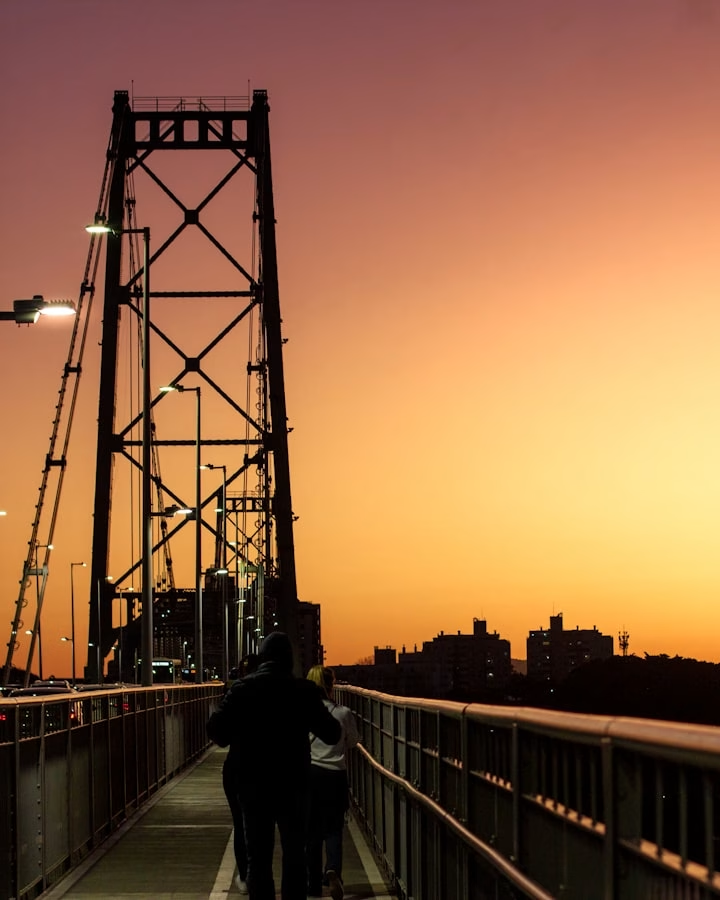
You have photographed the Hercílio Luz Bridge. Almost everyone who passes through Florianópolis has. The silhouette against the late-afternoon sky has become the city’s most reproduced symbol. But there is a detail in that structure that rarely makes it into the frame, and it is precisely that detail that holds the bridge up.
Look again, closely. The central span does not hang from braided steel cables, as it does on most suspension bridges in the world. It hangs from long chains of eyebars — solid steel pieces linked to one another by pins, like the links of a giant chain. What looks like a continuous cable from afar is, in fact, a sequence of metal plates fitted into one another.
What eyebars are
An eyebar (barra de olhal in Portuguese) is a straight steel piece with a loop at each end. Joined by pins, several of them form a chain capable of withstanding enormous tension. The Hercílio Luz was built this way, and the solution was so distinctive that it earned its own name in engineering: the “Florianópolis-Type Bridge.”
The bridge was inaugurated on May 13, 1926. For decades it connected the mainland to the Island (Florianópolis sits on Santa Catarina Island) before any landfill or the bridges that came later. And throughout all that time, it was the eyebars that carried the weight of the suspended span.
Why this was forgotten
The detail faded from memory for a simple reason. The bridge became scenery. When something turns into a postcard, you stop looking inside it and start seeing only the outline. The silhouette is what gets photographed. The engineering becomes invisible.
Add to that the long stretch when the bridge was closed. It sat shut for nearly 28 years and only reopened on December 30, 2019, after a lengthy restoration. For almost three decades, the Hercílio Luz was a beautiful, distant image rather than a structure you could examine up close.
Why it matters today
The eyebars are orphan parts. The industry that produced them no longer exists; there are no catalog replacements. Each of those steel plates is irreplaceable in the literal sense: recovering them required study, measurement, and craftsmanship during the restoration, not a simple swap.
That is why the configuration is rare. The Hercílio Luz is described as one of the last great bridges of its kind still standing in the world. Accounts say that similar structures were dismantled in other countries over the course of the 20th century. This one remains, granted heritage protection by the municipality in 1992 and by IPHAN (Brazil’s national historic-heritage institute) in 1998, spanning the sea in front of the city center.
Knowing this changes the way you look at the bridge. What seemed like an ornament in the landscape is the very reason the structure exists as it does. The beauty is not only in the outline against the sky. It is in the steel links that almost no one notices.
Getting to know the Island from the inside
Getting to know Florianópolis from the inside is exactly this: discovering that the forgotten detail is often what holds up the rest. Regente’s curation is born of the same attention — the care to look beyond the silhouette and understand what holds up each corner of the Island.
Read also: the history of Florianópolis and why the Hercílio Luz Bridge is unique in the world.