Before it was a booming real estate destination, Florianopolis was an archipelago of stories told on the porch at dusk, when the south wind swept in off the Island. Witches dancing on the rocks, a serpent of fire crossing the fields, benzedeiras (folk healers who cure with prayer and herbs) mending people with a blessing and a cup of tea. It was this repertoire that gave the city the nickname you now find on postcards: the “Island of Magic” (Ilha da Magia).
This guide gathers the main legends of Florianopolis and, more importantly, explains where they come from. Nothing here claims that witches exist. What it does claim is something else, and more interesting: these stories exist as cultural tradition, brought by Azorean immigrants in the 18th century and documented with rigor by one of the city’s greatest researchers.
This guide traces the Azorean origin of that imaginary world, the best-known legends, the places where they can still be “visited” on the Island, and the contemporary rereading that replaces the demonized witch with the silenced folk healer. It is the Florianopolis that does not fit in a property listing — and that may better explain why so many people grow attached to this city.
Where the legends come from: the Azorean heritage
The legends of Florianopolis were not born on the Island. They crossed the Atlantic.
From the mid-18th century onward, couples from the archipelagos of the Azores and Madeira (Portuguese Atlantic islands) landed on what was then the Island of Santa Catarina, encouraged by the Portuguese Crown to settle the southern coast. They arrived around 1750, when the Inquisition was still operating in Europe and belief in witches was an ordinary part of daily life in any Portuguese village.
In their intangible luggage came the myths: witches, the boitatá (a serpent of fire), the werewolf, the wandering souls. Over generations, this imaginary world blended with the local landscape — the beaches, the rocky shores, the cassava-flour mills — and found an address on the Island.
It is worth separating two things. The arrival of the Azoreans was an immigration of settlers who founded parishes and brought a culture of their own, from the boi-de-mancarra (a traditional Azorean folk pageant) to bobbin lace. The legends are one chapter of that culture, not folklore invented for tourists. When you read “legend” in this guide, the meaning is “a record of a way of seeing the world” — Azorean immigration is documented historical fact; the supernatural the legend describes remains folklore.
The witches and the ball at Itaguaçu
The legend most associated with the city is that of the witches — and it has a famous stage: Itaguaçu beach, on the mainland.
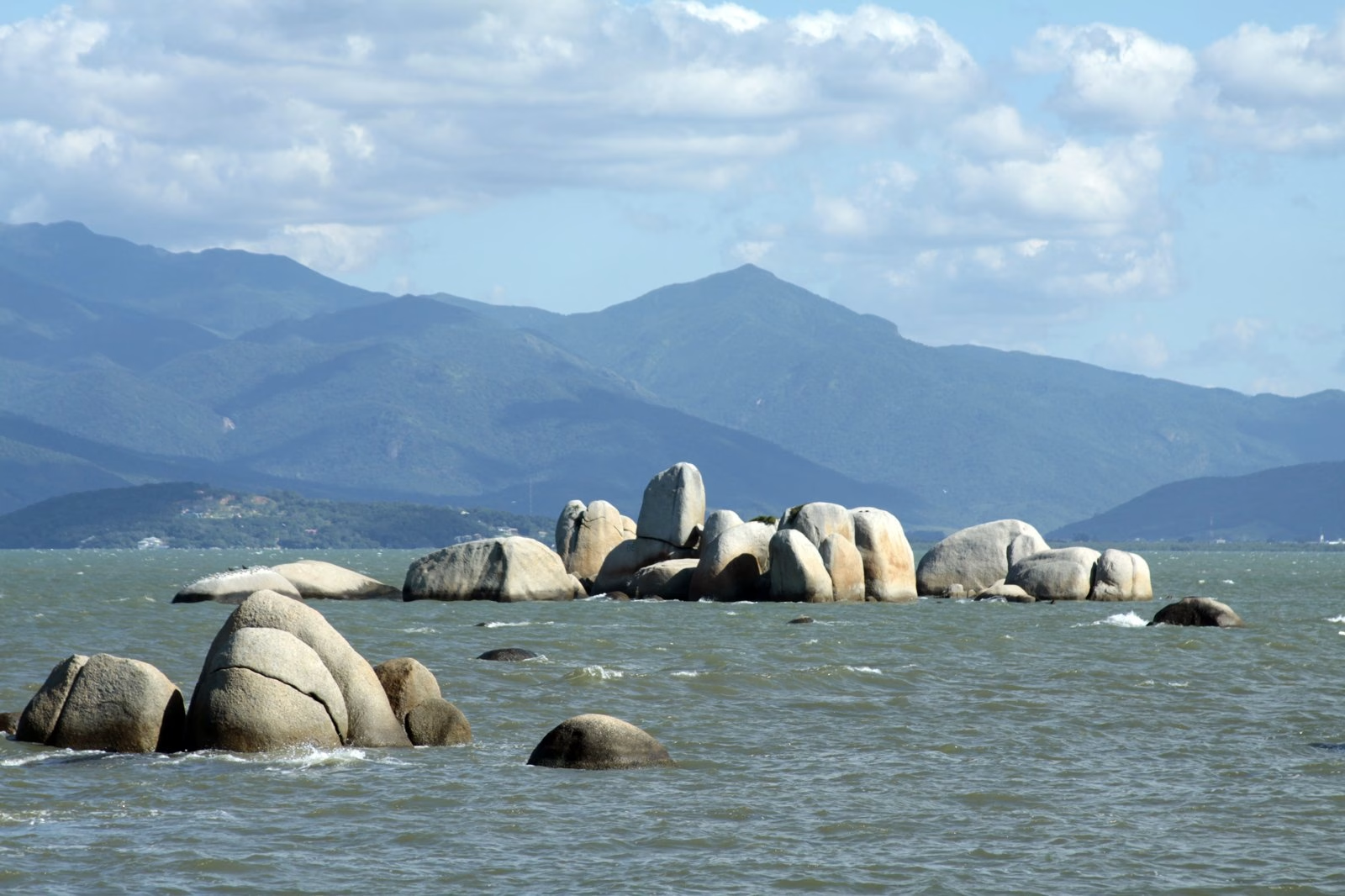
Tradition holds that the region’s witches wanted to throw a ball worthy of high society, and chose Itaguaçu as the setting. Werewolves, headless mules (mulas-sem-cabeça) and Indigenous myths such as the curupira (an Indigenous forest guardian) and the boitatá were invited. Only one was left out: the devil, because of the smell of sulfur and the demands he made. Offended, he is said to have appeared in the middle of the party and turned everyone present to stone. The great rocks that still break the surface of the waters at Itaguaçu are said to be that frozen ball.
The story is no longer only oral. In 2014, the Itaguaçu rocks (the so-called “Witches’ Ballroom”) were recognized as natural, scenic and cultural heritage of the municipality. The legend officially became part of the territory.
This is how the legends of Florianopolis work: a poetic explanation for a geographic feature. The rock exists; the witch is the way the community found to tell the story of the rock.
The boitatá and other hauntings of the Island
Not every legend is witchcraft. The Island’s pantheon is broader.
The boitatá is a serpent of fire — a myth of Indigenous origin that merged into the Azorean repertoire. In tradition, it protects the fields and frightens anyone who sets fire to the bush carelessly. At night, it is said to be seen as a luminous streak racing close to the ground.
Also in circulation are the werewolf, the seventh son who is said to transform on nights of the moon; the mula-sem-cabeça (headless mule); and the wandering souls tied to old manor houses and to stories of treasure buried by former residents. Many of these hauntings are attached to real places (a rocky shore, a trail, a corner house), which helps the legend survive: as long as the place is there, the story has somewhere to live.
The honest point is always the same: these are narratives. Their value lies in being a portrait of a community’s fears, values and way of explaining its own land.
Franklin Cascaes: the man who saved the legends from oblivion
Much of what is known today about the legends of Florianopolis reached us because of one man: Franklin Cascaes.
Cascaes was born in 1908 in the Itaguaçu neighborhood and died in 1983. He was a teacher, artist, ceramist and researcher. For roughly 30 years, he traveled the Island listening to fishermen, lacemakers and farmers, writing down the stories passing from mouth to mouth before urbanization could erase them.
The result is an enormous collection — thousands of ceramic pieces, hundreds of drawings in ink and pencil, plus texts, short stories and chronicles. Witches, boitatás and Azorean daily life are the recurring themes, almost always with a layer of social criticism and religiosity beneath the fantastical. Part of this body of work is held by the Federal University of Santa Catarina (UFSC).
Without Cascaes, many of these legends would have been lost with the generation that told them. That is why one can speak of them as ethnographic fact: they exist recorded, dated and attributed as the documented memory of a culture.
From witches to folk healers: a necessary rereading
There is a contemporary reading of the witch legends worth knowing, because it changes the meaning of the story.
Who, in real life, were the women called witches? In most cases, benzedeiras, midwives, healers — women who mastered herbs, prayers and the care of the body, or simply women who lived outside the expected norm. In a time of Inquisition and strict religious control, this female knowledge was viewed with suspicion and easily labeled witchcraft.
Researchers and outlets such as Portal Catarinas have proposed reading the “witch” of the legends as this silenced figure: the woman of knowledge who was stigmatized. In that key, the legend also holds the memory of a persecution.
And it is not a closed chapter. In traditional communities on the Island, such as Lagoa da Conceição, Ribeirão da Ilha and Rio Vermelho, benzedeiras are still active, keeping the practice alive. Seen this way, the Island’s magic is above all folk knowledge that has endured over time.
Where to feel this imaginary world today
The legends did not stay in the books. They have an address in the city — and you can work them into an itinerary.
- The Itaguaçu rocks, on the mainland: the petrified “ball,” now municipal heritage, is a lookout and a place to read the legend where it happened.
- The Franklin Cascaes collection, at UFSC: ceramics and drawings that give a face to the witches and the boitatá.
- Historic parishes such as Ribeirão da Ilha and Santo Antônio de Lisboa: Azorean architecture, mills and the setting where these stories were born.
For those who want to cross this cultural layer with the city’s living calendar, it is worth following the cultural calendar of Florianopolis, which features theater, exhibitions and events tied to the Island’s memory. And to understand how history and territory meet, the story of the Hercílio Luz Bridge shows another symbol that became identity.
Frequently asked questions
Why is Florianopolis called the “Island of Magic”?
The nickname comes precisely from the witch legends and the Azorean imaginary world brought over in the 18th century. Stories of witches were so widespread that they came to define the city’s reputation. Over time, tourism marketing adopted the phrase “Ilha da Magia” (Island of Magic), which is now used to refer to the state capital.
Are the legends of Florianopolis true?
The legends exist as cultural tradition — that is a fact. What they narrate, however, is not presented as historical truth or proven supernatural fact. They are folk narratives, passed down orally and later documented, that express the worldview of the Azoreans and their descendants on the Island.
Who was Franklin Cascaes?
Franklin Cascaes (1908–1983) was a teacher, artist and researcher born in Florianopolis. Over roughly three decades, he collected accounts of witches, boitatás and Azorean daily life, producing a collection of thousands of ceramic pieces, drawings and texts. He is considered chiefly responsible for saving the Island’s legends from oblivion.
What is the legend of Itaguaçu beach?
According to tradition, witches held a ball at Itaguaçu and did not invite the devil, who, offended, is said to have turned everyone present to stone. The great rocks in the beach’s waters are said to represent that petrified ball. The rocks were recognized as natural, scenic and cultural heritage of the municipality in 2014.
Were the witches of the legends connected to real women?
A contemporary reading links the figure of the witch to the benzedeiras, midwives and healers — women who held folk knowledge and who, in a context of strict religious control, were stigmatized. In this interpretation, the legend also preserves the memory of these silenced women. In neighborhoods such as Lagoa da Conceição and Ribeirão da Ilha, benzedeiras are still active.
Getting to know the Island from within
The legends of Florianopolis are not a picturesque detail. They are part of how the Island took shape — alongside the market and the landscape stands the memory that came from the Azores and stayed. Those who know this layer understand the neighborhoods by a measure beyond price per square meter.
At Regente Imóveis, this reading of the territory is part of the curation: we know the neighborhoods through their history, not just their price. If you are thinking about living in Florianopolis and want to know the Island from within — among the Azorean parishes, the trails and the stories still being told — that is exactly what we like to talk about.
Read also: the history of Florianopolis