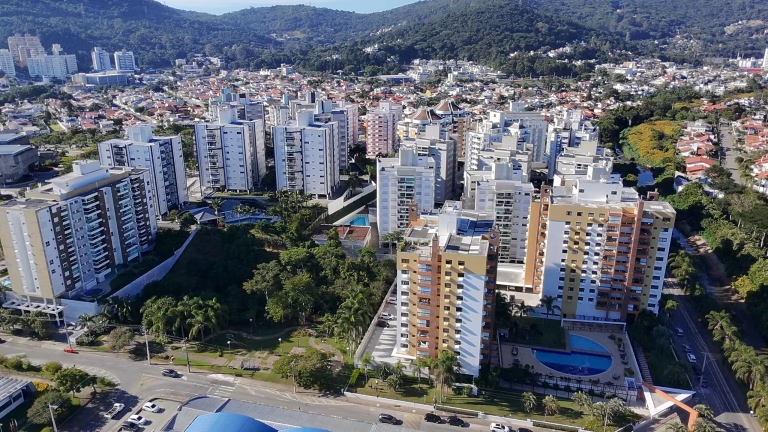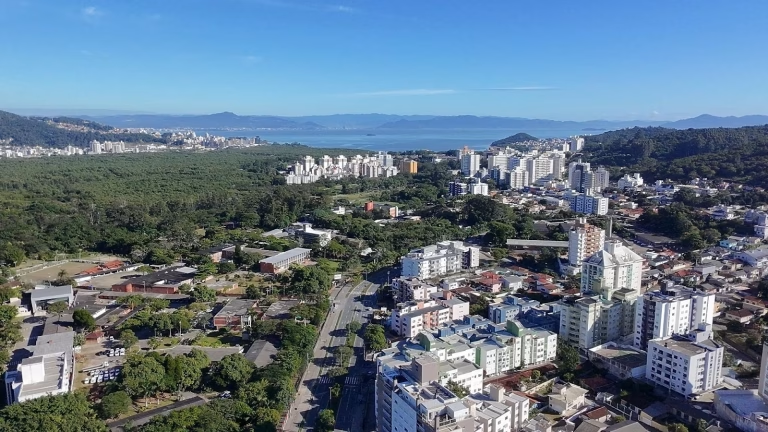
When people arrive from São Paulo with a list of neighborhoods to research, they quickly discover that the method doesn’t work in Florianópolis. The city doesn’t have one central hub with a corridor of quality spreading outward. Each neighborhood is a different ecosystem—price, pace, traffic, neighborhood profile. Choosing based on a name or a beach photo can mean six months stuck in the wrong place.
The guide below uses real price data (FipeZAP, November 2025), safety data (SSP/SC, 2025), and what you learn from living daily in each neighborhood. Ten neighborhoods, direct criteria, no artificial ranking.
Best neighborhoods in Florianópolis: what makes one work for you
Before reading the profiles, it’s worth defining two or three criteria that are non-negotiable for your case. Four that usually separate the decisions:
Where you will work defines the corridor that makes sense. Trindade and Itacorubi are excellent if your job is in that region. If your job is downtown, moving to Coqueiros could mean 40 minutes on the bridge during rush hour every day.
Public transit dependency. Florianópolis’s transit system works well near the integration terminals—there are six on the island. Away from the terminals, without a car, life gets expensive in time.
Children in school. It changes everything. Santa Mônica, Agronômica, and Coqueiros rise in the ranking when this criterion comes into play; Trindade falls.
Full budget. The ad shows the rent. HOA fees, water bills, and property tax don’t appear. In high-end neighborhoods like Agronômica and Beira-Mar Norte, HOA fees can reach R$1,400 per month.
University neighborhoods: Trindade, Itacorubi, and Córrego Grande
Florianópolis’s university corridor runs from Trindade to Itacorubi, with Córrego Grande in between. UFSC has two campuses in this band—the main one in Trindade, the Agronomy campus in Itacorubi. UDESC’s CEART campus is also in Itacorubi. This concentration of universities and the growth of the local tech hub made this corridor the most expensive and most competitive in the city.
Trindade
R$59.00/m² — up 26% in 12 months. The most expensive in Florianópolis.
The main UFSC campus is inside the neighborhood. You can wake up at 7:50 and walk to class by 8. University commerce—restaurants, pharmacies, stationary stores, gyms—is on the street. Terminal TITRI is in Trindade: buses to downtown, to the island’s other terminals, and to the mainland leave from there.
What nobody mentions: the noise is real. Weekends with barbecues in apartment buildings, heavy traffic on Rua Edu Vieira during class hours, constant flow of people. A neighborhood that never stops—which for some is the best part, for others is reason to move one neighborhood over.
Trindade is for those who want to be in the center of university life without needing a car. It’s not for those with small children or who need quiet to work.
Itacorubi
R$52.60/m² — 11% below Trindade.
For students of Agronomy and Aquaculture (UFSC) and Visual Arts, Fashion, and Design (UDESC CEART), Itacorubi is the right neighborhood. Both campuses are inside the neighborhood, walkable. Parents researching Trindade for their child studying Agronomy are in the wrong neighborhood.
The neighborhood has supermarkets, clinics, gyms, and commerce grew along with the university expansion in recent years. SC-401 cuts through the neighborhood, and traffic during rush hour is intense for those heading downtown. For those working in the university corridor itself or working from home, this isn’t a real problem.
Córrego Grande
R$51.60/m² — 13% below Trindade.
The neighborhood that people living in Florianópolis usually recommend when someone says “I want to be close to UFSC but not in Trindade’s noise”. It sits between Trindade and Itacorubi, 1.5 to 2.5 km from the main campus. Córrego Grande Park is one of the few well-structured green areas in Florianópolis—trail, lake, space to run.
More residential, less nightlife commerce, families with children mixed with graduate students. For those working remote, it’s probably the best value on the island: central access to everything (UFSC, Itacorubi, downtown in less than 20 minutes), residential quiet, good infrastructure, and price a notch below Trindade.
Family neighborhoods: Agronômica, Santa Mônica, and the mainland
Agronômica
R$54.90/m² — down 5.6% in the last 12 months, the only neighborhood that dropped while the rest climbed.
Central residential neighborhood, close to University Hospital (HU) and Hospital Celso Ramos. Historically one of the city’s quietest, frequently cited alongside Santa Mônica and Córrego Grande when the criterion is safety. The price drop amid a rising market could be a window of opportunity for those planning a move in 2026—or it could signal the neighborhood lost properties to renovation. Worth checking available stock before concluding.
Less local commerce than Trindade and Itacorubi. For large supermarket, you need a car or a bus trip.
Santa Mônica
Doesn’t show up in FipeZAP’s top 10 most expensive because demand is lower than university neighborhoods. That’s exactly the neighborhood’s profile—quieter, more removed, historically with few incident reports. Families with children and retirees are the majority.
The point that determines if Santa Mônica works for you is mobility. Without a car, the neighborhood gets expensive in time. Public transit exists, but frequency isn’t like neighborhoods with integration terminals.
Coqueiros and Estreito—the mainland as a real alternative
Coqueiros: R$40.50/m² | Estreito: R$45.10/m² (+15.6% in 12 months)
The mainland is where Florianópolis hides the best options for those who don’t need to be on the island every day. Coqueiros has a view of Baía Norte and a family neighborhood pace that central island doesn’t have. Estreito has the mainland’s most complete commerce—large supermarkets, schools, clinics, bank branches.
Prices are 24% to 35% below Trindade. With the same monthly rent, you get a bigger apartment or pay less.
The bridge is the real cost. Those crossing during rush hour—Monday to Friday between 7:30 and 9 a.m. on the way out, 5:30 and 7 p.m. on return—lose 30 to 60 minutes per day. For those working remote or with flexible schedules, the mainland makes a lot of sense. For those with fixed commitments at 9 a.m. downtown or in Trindade, the math changes.
Which neighborhood to choose for remote work?
Florianópolis’s internet infrastructure is good in central neighborhoods. Fiber optic with 300 to 500 Mbps runs R$100 to R$150/month in most neighborhoods below. What differentiates neighborhoods for remote work is the pace of daily life, not internet speed.
Córrego Grande combines the best of both: central access to everything (UFSC, Itacorubi, downtown in less than 20 minutes), residential quiet, Córrego Grande Park on foot, price 13% below Trindade.
Coqueiros costs 35% less than Trindade. If your outings don’t have fixed hours, the mainland works very well. You need a car for most activities outside the neighborhood.
Itacorubi has complete infrastructure and growing commerce. Traffic isn’t a problem for those who don’t depend on rush hour to get out.
Florianópolis’s tech hub—with companies concentrated in the UFSC-Itacorubi axis and downtown area—has attracted IT professionals from other capitals. Those working hybrid for these companies tend to prefer being in this corridor.
Comparative table: the 10 neighborhoods in summary
FAQ—Questions about Florianópolis neighborhoods
Which Florianópolis neighborhood is safest?
Florianópolis is Brazil’s safest capital in 2025—10.73 homicides per 100,000 residents (third consecutive year, FloripAmanhã). Within the city, the neighborhoods with fewest historical incidents are Santa Mônica, Agronômica, and Córrego Grande. The neighborhoods with most records—downtown, Trindade, Ingleses—concentrate more cases per volume of flow, not residential insecurity.
Which neighborhood has the best cost-benefit for families?
Agronômica and Córrego Grande if you want to stay on the island. Coqueiros if you accept the mainland. Agronômica is dropping in price while keeping central location—this data deserves attention.
Is the mainland worth it instead of the island?
For those with flexible schedules or working remote, yes. The price difference is real (24% to 35%) and Coqueiros and Estreito’s infrastructure is complete. For those with fixed commitments during rush hour on the island, every day, the financial gain can be consumed by time lost on the bridge.
Which neighborhoods have the best public transit?
Trindade (Terminal TITRI), downtown (Terminal TICEN), and neighborhoods near the island’s other four integration terminals. Santa Mônica, Ingleses, and northern island depend more on cars.
Did Agronômica drop in price because it has a problem?
There’s no record of specific problem. The 5.6% drop may reflect properties exiting for renovation and stock renewal—or simply correction of an earlier spike. Central neighborhood, close to hospitals, with a quiet history. Worth checking available stock before concluding.
How to define the right neighborhood for your move
Most people coming from outside start with the property. Those who start with the neighborhood save time and avoid regretful rental contracts.
Five questions to ask before calling any real estate agency:
- Where will you work and what is your schedule?
- Will you have children in school in the next two years?
- Do you need public transit or will you use a car?
- What’s your real budget—rent plus HOA, not just the ad?
- What’s your pace: do you want to be in the middle of the action or away from it?
Regente Imóveis has properties in Trindade, Itacorubi, Córrego Grande, Agronômica, and adjacent neighborhoods. The rental process is 100% digital. See rental prices by neighborhood in Florianópolis and the guide to renting for UFSC students for supplementary information. Talk to a consultant—if you don’t yet know Florianópolis, this diagnosis before you start visiting properties saves several weeks.
| Slug | |
|---|---|
| Title | Best Neighborhoods in Florianópolis to Live in 2026: Complete Guide |
| Description | Best neighborhoods in Florianópolis to live in 2026: real prices, safety, transit, and neighborhood profile in this complete guide. |
| Categoria | Neighborhoods of Florianópolis > Living in the Neighborhood |
| Neighborhood | R$/m² | 12m Var. | Transit | Best for |
|---|---|---|---|---|
| Trindade | R$59.00 | +26% | Excellent (TITRI) | UFSC students / tech |
| Downtown | R$58.30 | — | Excellent (TICEN) | Urban professionals |
| Agronômica | R$54.90 | -5.6% | Good | Families / healthcare |
| Itacorubi | R$52.60 | — | Good | UDESC-Agronomy students / families |
| Saco dos Limões | R$51.80 | -0.9% | Good | Mixed residential |
| Córrego Grande | R$51.60 | — | Good | Remote / couples / graduate |
| Estreito | R$45.10 | +15.6% | Good | Families / mainland |
| Ingleses | R$44.50 | +15.4% | Fair | Beach / mixed |
| Coqueiros | R$40.50 | — | Fair | Families / remote |
| Capoeiras | R$38.20 | — | Good | Budget-friendly with infrastructure |