There is a number that many buyers never ask their real estate agent for — and it has more impact on the long-term value of a property than finish quality, the number of parking spaces, or the apartment’s square footage.
That number is the walkability index of the neighborhood.
Walkability is not an abstract concept. It is the measure of how much a person can accomplish in daily life without using a car. And it affects property prices, rental demand, and resale liquidity in ways that most buyers underestimate.
1. What is walkability
Walkability is a neighborhood’s capacity to be traversed on foot efficiently and pleasantly to meet daily needs: shopping, services, recreation, transportation.
The concept has objective and subjective dimensions:
Objective dimensions:
– Walking distance to grocery store, pharmacy, school, public transportation stop
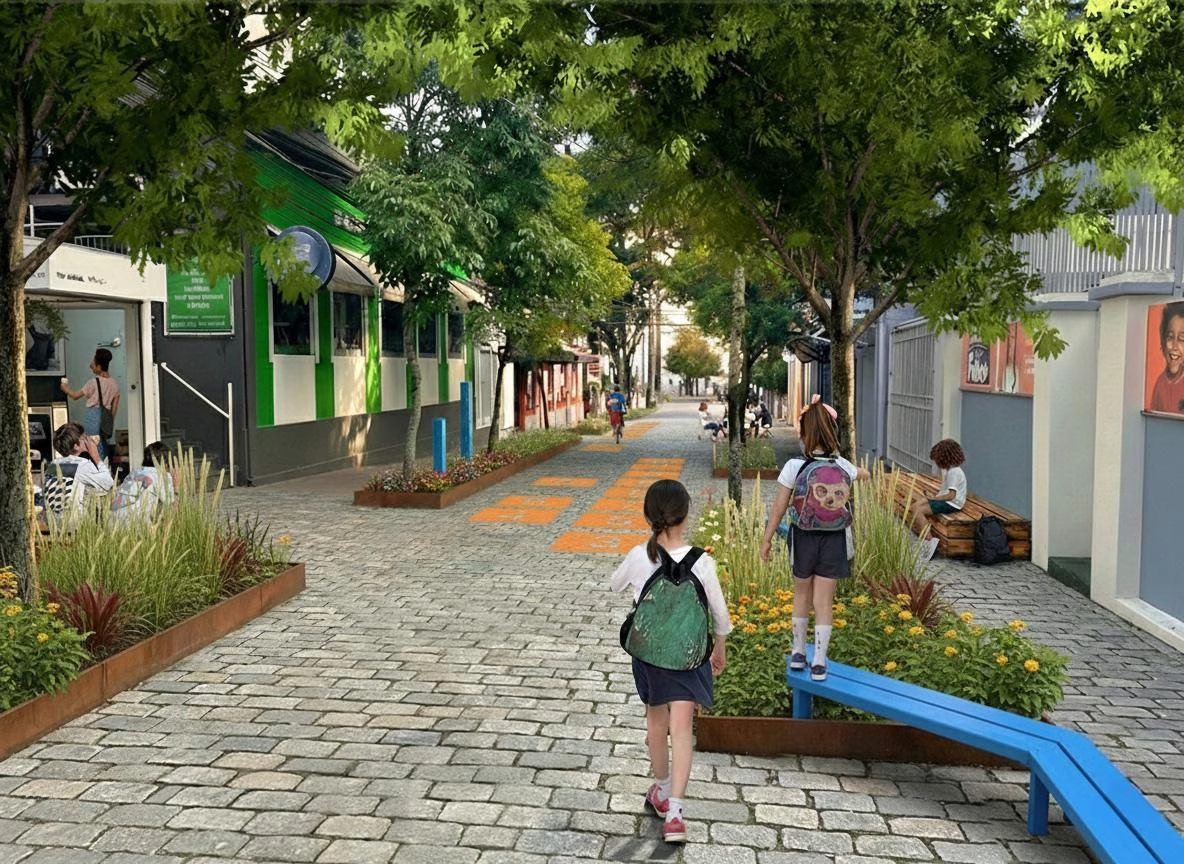
– Sidewalk quality (paving, width, continuity, absence of obstacles)
– Presence of tree canopy and shade along the route
– Traffic speed and volume on adjacent streets
– Existence of safe crossings
Subjective dimensions:
– Sense of safety (lighting, pedestrian movement)
– Appeal of the route (active commerce, interesting facades, variety of uses)
– Thermal comfort
The most well-known measurement tool is Walk Score, which assigns a number from 0 to 100 for each address based on distance algorithms and destination density. American cities have the index mapped with precision. In Brazilian cities, Walk Score has limited coverage — but the concept can be applied with a 20-minute field analysis.
2. The relationship between walkability and property price
In markets where Walk Score is widely used — mainly the United States and Europe — research documents the correlation consistently:
- Each additional point on the Walk Score (scale 0–100) is associated with an average increase of US$3,000 to US$5,000 in property value, depending on the city and market segment
- Properties with Walk Score above 80 (“highly walkable”) are traded at an average premium of 15 to 30% compared to similar properties in neighborhoods below 50
These numbers vary by market, but the pattern is consistent: more walkable neighborhoods have more expensive properties — and this difference grows over time.
The logic is the same as the complete neighborhood concept: greater walkability means a larger base of potential buyers and renters. More demand on the same supply = higher price.
3. Walkability and rental: the multiplier that few calculate
For those who buy to rent, walkability is even more relevant than for those who buy to live — because it directly affects the renter profile and the rental price.
The renter who seeks high walkability:
– Young professional without a car — wants to accomplish gym, grocery shopping, and work within a 15-minute walk
– Digital nomad — travels light, without a car, wants the city at their door
– Medium to long-term tourist — prefers urban experience to resort
– Student — active mobility is necessity, not choice
These profiles pay more for less square footage — provided the neighborhood is walkable. A studio of 22 m² in a walkable neighborhood competes with larger apartments in neighborhoods where a car is necessary, because what the renter is buying is city access, not living room footage.
The direct implication: compact property in a high-walkability neighborhood has better rental yield per square meter than a larger property in a low-walkability neighborhood. Square footage is one factor — but the radius of city that the property accesses is another factor, often more determinative.
4. How the Gehl Plan increases walkability in Florianópolis Downtown
The masterplan delivered in February 2026 is, at its essence, a project to increase walkability in the Downtown of Florianópolis.
The proposals directly attack the bottlenecks that reduce walkability:
| Current bottleneck | Gehl proposal |
|---|---|
| Narrow, poorly maintained sidewalks | Minimum 2.5 m sidewalks on M-type corridors; general widening |
| Dangerous crossings on Beira-Mar | Raised and widened crosswalks; speed reduction to 60 km/h |
| Absence of tree canopy | East–west green corridor on Av. Paulo Fontes; native species on all interventions |
| Blind garage facades | Active facades on the axis R. Esteves Júnior → Av. Rio Branco |
| Streets with heavy traffic and high speed | 30 km/h zones as standard; street-to-plaza on R. Esteves Júnior North (10 km/h) |
| Absent or discontinuous bicycle lanes | Segregated bicycle lane on Av. Gama D’Eça as pilot project |
The cumulative effect of these interventions is a relevant increase in the Walk Score of Downtown — which, by documented precedent in other cities, tends to be reflected in higher prices and greater liquidity of properties in the area.
5. How to evaluate walkability before buying in Florianópolis
In the absence of a formal index, a 20-minute field checklist gives an accurate reading:
Destinations test — from property on foot:
| Destination | Reference acceptable distance | Applies to |
|---|---|---|
| Grocery store / produce market | Up to 10 min | Housing + investment |
| Pharmacy | Up to 10 min | Housing + investment |
| Bus stop (2+ lines) | Up to 7 min | Housing + investment |
| Plaza or park | Up to 10 min | Housing + quality of life |
| Bakery / café | Up to 5 min | Vitality indicator |
| School (if relevant) | Up to 15 min | Family housing |
If four or more destinations are within the radius: high walkability. If two or fewer: low walkability.
Sidewalk test:
Walk the route from the property to the nearest commerce. Is the sidewalk continuous? Are there abrupt level changes? Are there obstacles (poles, poorly positioned trash bins, cars parked on the walking surface)? Is there shade?
A sidewalk that forces constant detours or that lacks comfortable use conditions reduces real walkability, regardless of the formal existence of the sidewalk.
Facade test:
Look at the ground floors of buildings within a 5-minute radius. Active commerce, cafés, restaurants, services = urban vitality and high walkability. Garages, walls, and blank facades = neighborhood that forces car use even when the distance would be short.
6. What changes when walkability increases
Downtown Florianópolis already has relatively high walkability compared to the rest of the city — the concentration of services and commerce is the highest in the municipality. What the Gehl Plan proposes is to correct the quality deficit of the walking experience: poor sidewalks, blind facades, unsafe crossings, absence of tree canopy.
When these deficits are corrected, what happens is documented in other contexts:
- Compact properties that were already good for rental become even more competitive — because what appreciates the product is city access, and access improves
- Renter profiles that today avoid Downtown because of the walking experience — young professionals who prioritize public space quality — begin to consider it
- Resale liquidity increases because the neighborhood now serves more buyer profiles
Downtown Florianópolis is today in an interesting position: high functional completeness, good walkability in distances, poor walkability in experience. The Gehl Plan attacks exactly the experience gap.
FAQ
What is walkability?
Walkability is the measure of how much a neighborhood can be traversed on foot to meet daily needs: shopping, services, recreation, and transportation. A neighborhood with high walkability has sidewalks in good condition, useful destinations at short distance, safe crossings, tree canopy, and active facades that make the walk pleasant. It is measured formally by Walk Score (scale 0–100) in countries where the tool has coverage, and can be evaluated by field checklist in any city.
Does walkability affect property prices?
Yes, in a documented way. Research in markets where Walk Score is widely used shows that each additional point on the scale is associated with an average increase of US$3,000 to US$5,000 in property value. Properties with Walk Score above 80 are traded at a 15 to 30% premium compared to similar properties in low-walkability neighborhoods. The mechanism is simple: greater walkability expands the base of potential buyers and renters, which sustains the price.
How do I evaluate a neighborhood’s walkability before buying?
The most practical test is to check on foot the distance to: grocery store (up to 10 min), pharmacy (up to 10 min), bus stop with at least two lines (up to 7 min), and plaza or park (up to 10 min). If four of these destinations are within the indicated radius, the neighborhood has high walkability. Also check sidewalk quality (continuity, absence of obstacles, shade) and the ground floors of buildings — active commerce indicates urban vitality; garages and walls indicate low effective walkability.
What is the relationship between walkability and rental yield?
In rental, walkability functions as a value multiplier. Profiles that primarily seek walkable neighborhoods — young professionals without cars, digital nomads, medium to long-term tourists — pay more for less square footage, because what they are buying is city access. A compact apartment in a high-walkability neighborhood frequently yields more per square meter than a larger apartment in a neighborhood where a car is necessary for everything.
Does Florianópolis have neighborhoods with high walkability?
Yes. Downtown Florianópolis has the highest concentration of services and commerce in the municipality — the walkability by distance to destinations is high. The Downtown deficit is in the quality of the walking experience: poorly maintained sidewalks, unsafe crossings, absence of tree canopy, and blind facades that make the walk uncomfortable. The Gehl Plan (February 2026) proposes to correct exactly these problems with concrete interventions on sidewalks, crossings, tree canopy, and active facades on the axis R. Esteves Júnior → Av. Rio Branco.