The Brazilian real estate market operates in cycles. The current cycle — nominally positive since 2020 and with real returns above the IPCAIPCAVer tudo → since 2022 — is historically long. At some point, it will cool.
The relevant question for anyone who owns or is considering acquiring property in Florianópolis is different: when the national cycle slows, does FLN move with it?
The answer requires examining fundamentals, not intuitions. And the available data suggests that Florianópolis has structural reasons to behave differently — while also presenting real limits that any honest analysis needs to name.
1. What it means to be an “exception” to the national cycle
Being an exception does not mean being immune. It means that local fundamentals are robust enough to sustain demand and restrict supply independently of national cycle fluctuations.
FLN consistently above average: FipeZAP data
| Year | FLN Variation | Brazil Variation | Difference |
| 2020 | +7.02% | +3.67% | +3.35 p.p. |
| 2021 | +15.74% | +5.29% | +10.45 p.p. |
| 2022 | +11.33% | +6.16% | +5.17 p.p. |
| 2024 | +9.44% | +7.73% | +1.71 p.p. |
| 2025 | +8.65% | +6.52% | +2.13 p.p. |
Source: FipeZAP/FIPE, annual reports for each period.
In 2021, when the national market advanced 5.29%, Florianópolis posted almost three times that — +15.74%. This pattern repeated over five years is not noise: it indicates that local factors operate independently of the national cycle.
2. Fundamental 1 — Permanent Supply Restriction
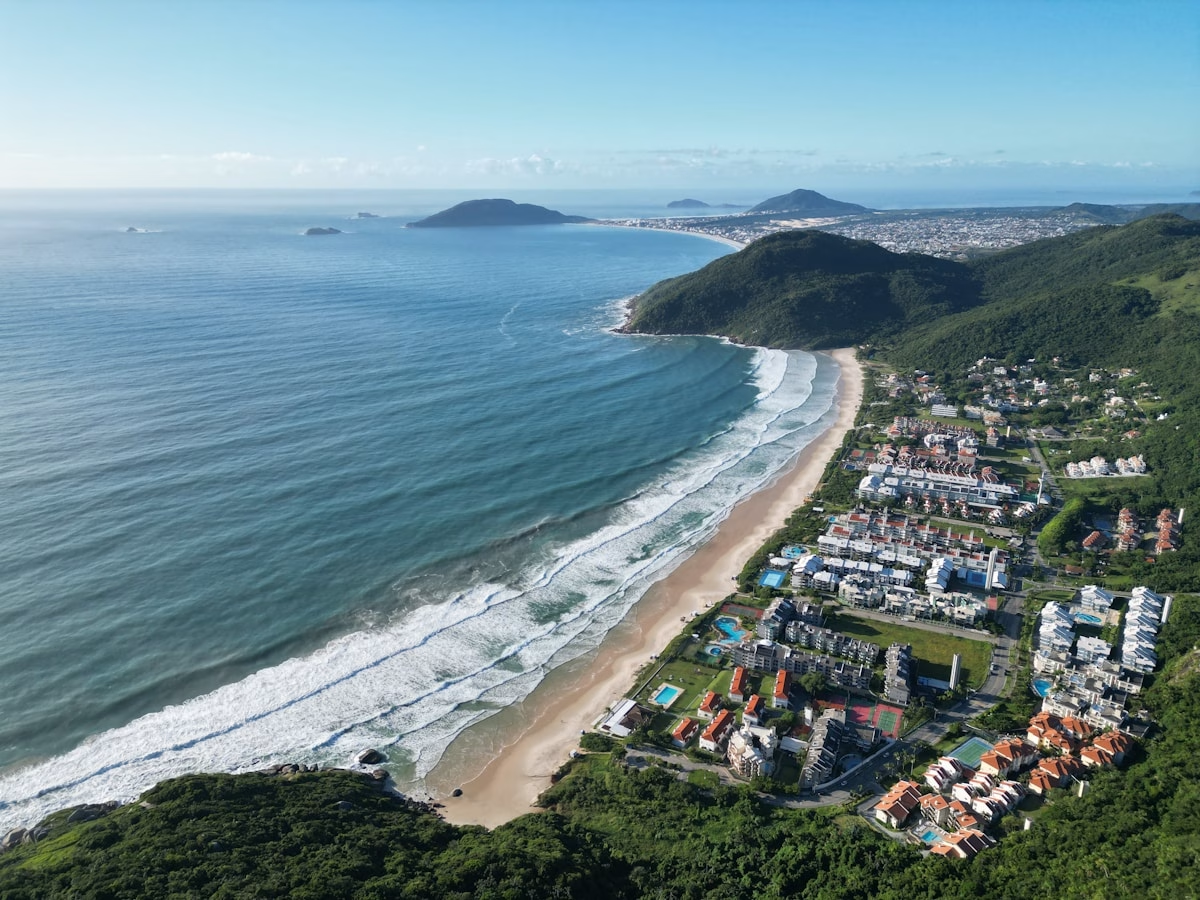
21 conservation units and 45% Atlantic Forest
The municipality of Florianópolis has 674 km², including the Island of Santa Catarina and a continental portion. Of that territory:
- 21 Conservation Units (UCs) cover 27.19% of the municipality
- Nearly 45% of the territory has native Atlantic Forest vegetation preserved
- Protected Areas (APPs) represent at least 26.46% of the territory. A 2025 STJ ruling on restinga vegetation could expand that proportion to as much as 66.14% of the municipality
Combined hills, mangroves, restingas, APPs of dunes, and maritime strip, more than half the municipal territory is barred or severely restricted from construction. This is not temporary restriction — the UCs are federal and state-level, and the Atlantic Forest has constitutional protection. It is a permanent supply restriction.
3. Fundamental 2 — Demand Expansion at Constant Rate
Population growth four times above the national average
The 2022 IBGE Census revealed that Florianópolis grew from 421,300 inhabitants in 2010 to 537,211 in 2022 — growth of +27.5% in 12 years. The national average in the same period was approximately 6.5%. FLN grew four times faster than Brazil.
Estimates for 2025 point to 587,486 inhabitants, with approximately 50,000 new residents between 2022 and 2025.
Tech hub: high-income employment concentrated in the city
In 2024, Federal Law 14,955 recognized Florianópolis as the National Capital of Startups. The numbers:
- More than 6,000 technology companies active in the municipality
- 38,000 direct jobs in the tech sector
- 7.4 technology companies per thousand inhabitants — the highest density among Brazilian capitals
- 25% of local GDP linked to the technology sector
- US$ 298 million in venture capital raised between 2020 and 2024
4. Fundamental 3 — External and International Demand
Digital nomads: a new and expanding market
In 2025, Florianópolis had 5,666 active digital nomads — growth of +224% in six years. The projection is 13,000 by 2030. DashCity ranked Florianópolis as the second most attractive city in the world for remote entrepreneurs, behind only Dubai.
Demand from foreign buyers
The square meter in Florianópolis, even at the level of R$ 12,773/m² (Dec/2025), costs around US$ 2,300/m² — below any comparable coastal destination in Western Europe or North America. As long as exchange rates remain favorable to foreign buyers, this demand is structural.
5. Where FLN’s fundamentals hit limits
- Selic rates high: compresses credit via SBPE and makes low-risk investment returns higher than gross rental yield in FLN (4% to 6%).
- Price ceiling and market absorption: at some point, price reaches a level of limited absorption. The signal to watch is sales velocity and the discount between asking price and closing price.
- Sectoral risk concentration: if the tech hub suffers a relevant contraction, part of qualified demand may weaken.
- Changes in rules for digital nomads: exchange rates, visa ease, and tax rules for residency in Brazil are relevant external variables.
6. What this means for the wealth accumulator and the strategist
For the wealth accumulator — seeking to preserve value over a horizon of 10 years or more — FLN’s fundamentals present a relatively solid thesis: restricted supply from permanent environmental restrictions, demand sustained by population growth above the national average, qualified employment hub, and international attractiveness.
For the capital strategist — comparing property to other assets — the picture is more nuanced. With Selic at 15%, the opportunity cost of fixed income is real. The thesis for physical property is not short-term returns: it is long-term protection against inflation, exchange rates, and credit cycles, with upside from appreciation in a supply-restricted market.
Property with a horizon shorter than five years carries high transaction costs — ITBI, real estate commission, notary fees — that consume part of nominal returns. With a 10-year or longer horizon, these costs dilute and structural fundamentals have time to operate.
FAQ — Frequently Asked Questions
Why does Florianópolis appreciate more than other capitals?
The sustained difference in appreciation between FLN and the average of capitals rests on three structural pillars: physical restriction of supply (more than half the territory barred from construction by APPs, conservation units, and Atlantic Forest), population growth above the national average (+27.5% between 2010 and 2022, four times faster than Brazil), and concentration of qualified employment in the technology sector coupled with demand from digital nomads and international buyers.
Will Florianópolis continue to appreciate?
It is not possible to state with rigor what will happen in the coming years. The structural fundamentals that sustained appreciation above average remain active. Solid fundamentals reduce the risk of abrupt reversal, but do not eliminate the possibility of deceleration, especially during periods of high Selic rates.
What is the price per m² in Florianópolis in 2026?
The most recent available data is from FipeZAP in December 2025: R$ 12,773/m² for Florianópolis — the second most expensive capital in the country, behind Vitória.
What restricts the supply of properties in Florianópolis?
The restriction is predominantly environmental and geographic. The 21 Conservation Units cover 27.19% of the territory. Nearly 45% of the municipality has native Atlantic Forest. APPs cover at least 26.46% — and a 2025 STJ ruling may expand that proportion to up to 66% of the municipality.
Can foreigners buy property in Florianópolis?
Yes. Brazilian law allows foreigners to acquire urban properties without relevant restrictions. The process involves obtaining a CPF, opening a bank account in Brazil, and hiring a lawyer for legal advice. Payment can be made in reais, with currency exchange conducted by an institution authorized by the Central Bank.