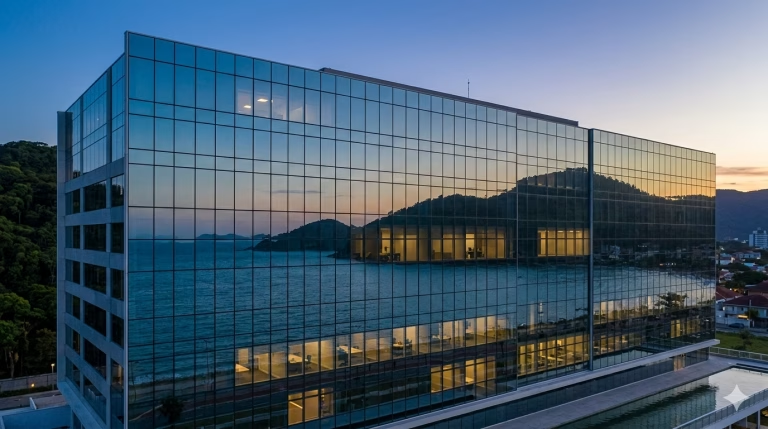

Classic real estate market theory is straightforward: high interest rates freeze credit, reduce qualified buyers, and hold prices down. Low rates do the opposite. For most of Brazil, this logic holds with reasonable consistency. Florianópolis, however, shows a looser relationship between interest rates and the real estate market — and understanding why this happens is essential for any purchase or investment decision on the Island.
Between 2022 and 2025, the Selic rate rose from 2% to 14.75% — the most aggressive tightening cycle in the last decade. In other markets, nominal prices stagnated or declined. In Florianópolis, the FipeZAP index consistently ranked the city in the top 3 for appreciation in Brazil throughout this period. This is not immunity — it is structural resilience, sustained by factors that do not depend on the credit cycle.
How high interest rates affect the real estate market under normal conditions
Interest rates and the real estate market connect through a well-documented mechanism: the Selic sets the cost of money, banks price real estate credit based on it (plus spread), and the cost of financing determines how many families can qualify to buy.
Brazilian history illustrates this mechanism:
- 2009-2012 (Selic falling to 7.25%): national real estate boom. Builders like MRV, Gafisa, and PDG expanded aggressively. Two and three-digit appreciation in São Paulo, Rio de Janeiro, and Florianópolis. Cheap credit via Caixa Econômica Federal, combined with the expansion of FGTS, was the main catalyst.
- 2015-2017 (Selic at 14.25%): national contraction. Defaults exploded, nominal prices stagnated or declined in real terms, and several mid-size builders faced financial restructuring.
- 2020-2021 (Selic at historic low of 2%): liquidity supercycle. Record launches, pent-up demand released, and strong appreciation in smaller cities and capitals outside the São Paulo-Rio axis — with Florianópolis leading.
The transmission of the Selic to real estate credit, and then to prices, is not immediate. Historical lag is between 6 and 18 months. When the Central Bank raises the rate, the real estate market takes months to feel the full effect — and the same applies to rate cuts.
One relevant detail: the real estate financing rate of the Brazilian Savings and Loan System (SBPE) does not track the Selic proportionally, because banks raise funds via savings accounts — a lower funding cost than the Selic. In 2025, with Selic at 14.75%, the SBPE rate settled at ~11% per year, according to Abecip — a spread of ~3.75 percentage points.
Why Florianópolis does not follow national logic — the four factors
The relationship between interest rates and the real estate market in Florianópolis is weaker than the Brazilian average. Four structural factors explain this exception.
1. Restricted supply — geography that no monetary policy can change
Florianópolis is an island. Topography limits available land for construction, and the municipal Master Plan sets additional height and zoning restrictions. New developments require permits in increasingly limited areas. This chronic supply deficit in the mid-to-high segment sustains prices independently of the credit cycle — because pent-up demand does not disappear when credit becomes expensive; it simply waits.
2. Demand for quality of life — the buyer who does not need financing
The profile of the buyer in Florianópolis is different from the average national buyer. The city attracts migrants from São Paulo, Curitiba, and Rio de Janeiro who sell properties in pricier markets and arrive with capital to buy cash or with a substantial down payment. Digital professionals, entrepreneurs, and high-income retirees choose Florianópolis for quality of life — an intangible asset that does not lose value when the Central Bank raises rates. This profile is less sensitive to traditional bank credit than the first-time homebuyer.
3. Tech hub and structural migration demand
The technology ecosystem of Florianópolis — with companies like TOTVS, Involves, Hivecloud, and dozens of startups — generates high-income employment independent of the national economic cycle. Technology professionals working remotely discovered Florianópolis as an alternative to major capitals, and this migration demand is not correlated with the Selic rate.
4. Tourism demand and second-home ownership
Domestic and international tourism sustains a second-home demand that follows its own rhythm. The buyer of a vacation property in Jurerê Internacional or Ingleses does not finance — they buy with their own capital, often from capital gains on another asset or inheritance. This demand does not disappear when real estate credit becomes more expensive.
In practice, what I see is that these four factors operate independently of each other — not all need to be present at the same time to sustain the market. Any two or three of them already create a meaningful buffer against credit cycle pressures.
What historical data shows: appreciation in Florianópolis during high-Selic cycles
The 2022-2025 period is the most recent test of the thesis. The Selic rose from 2% to 13.75% in 2022, and the national real estate market felt it: launch volume declined, financings fell, and prices stagnated in several capitals.
In Florianópolis, the dynamic was different. The FipeZAP index recorded the city among the top three with the highest nominal appreciation in Brazil in 2022, 2023, and 2024. Post-pandemic migration demand did not reverse — on the contrary, professionals who moved to the Island during remote work decided to stay, generating additional demand for permanent properties.
The 2015-2017 cycle (Selic at 14.25%) showed the same relative resistance: while the national market contracted, Florianópolis saw a slowdown in appreciation rate, but did not register nominal price declines in the mid and high segments. The local housing deficit and quality-of-life demand served as a buffer.
The real estate financing rate has a structural floor recognized by Abecip — even at the historic low Selic of 2% in 2020, the SBPE rate did not fall below 6.75% per year. This means the window for truly cheap credit for real estate financing is narrower than Selic cycles suggest.
The analysis of whether to buy or rent in Florianópolis in the context of high interest rates is an exercise that changes conclusions depending on the buyer’s profile — and the time horizon considered. To understand how these interest rates translate to monthly payments, see the real estate financing guide.
How long can this exception last?
Florianópolis does not have immunity to interest rates — it has structural resilience. These two concepts need to be kept separate in the investor’s analysis.
Resilience has limits. If the Selic stays above 12% for more than 18 to 24 months, the cumulative effect on financing volume begins to reduce demand even in markets with strong drivers. The buyer who would need financing to purchase simply postpones the decision — and the queue of pent-up demand grows, but the market slows in transaction volume.
The real risk is not price decline — it is deceleration in appreciation speed, reduction in launch volume, and longer time to sell. For the long-horizon investor, this represents entry opportunity at less competitive prices. For the short-horizon investor, it is liquidity risk.
The four structural factors — restricted supply, quality-of-life demand, tech hub, and second-home tourism — do not disappear with high Selic. They simply operate at slower speed. When interest rates fall, these same factors accelerate again.
For real estate leveraging strategy in Florianópolis, the correlation with the rental market follows different logic: high Selic increases financing costs, reduces buyers, increases renters — which sustains rental income even during high-interest cycles.
Frequently asked questions — interest rates and properties in Florianópolis
Why does Florianópolis appreciate even with Selic high?
Four structural factors sustain demand independently of the credit cycle: restricted supply due to island geography and urban legislation, migrant buyers with their own capital who do not depend on financing, tech hub with high-income employment, and tourism and second-home demand. These factors do not disappear with high interest rates — they simply slow down.
Does real estate financing rate rise the same as the Selic?
No. Real estate financing uses savings accounts as its main funding source, with lower cost than the Selic. According to Abecip, with Selic at 14.75% in 2025, the SBPE rate was ~11% per year — a spread of ~3.75 percentage points. The historical spread between Selic and SBPE rate varies from 3 to 7 p.p. depending on the cycle.
Is it better to wait for Selic to fall before buying in Florianópolis?
Those who wait for Selic to fall face two simultaneous risks: prices may rise before the rate falls, and other buyers enter the market when credit becomes cheaper, increasing competition. In Florianópolis, with restricted supply, the cost of waiting has real opportunity cost.
Does the housing deficit affect the real estate market in Florianópolis?
Yes, as a price-sustaining factor. The local housing deficit pressures mainly the lower-income segment, but the structural imbalance between supply and demand permeates all segments — and sustains both sale prices and rental rates above theoretical equilibrium.
Can Florianópolis have price declines if Selic stays very high for a long time?
It is not impossible, but history suggests that the most likely outcome is deceleration in appreciation rate, not nominal decline. The 2015-2017 cycle, with Selic at 14.25%, showed stagnation, not decline, in the mid and high segments. Nominal decline would require a combination of very high Selic for extended period (>24 months) with reversal of migration and quality-of-life factors — a less likely scenario given the city’s trajectory.
Follow the Florianópolis real estate market with monthly analysis
Florianópolis does not blindly follow national logic on interest rates and property prices. The four structural factors of the Island — restricted supply, migration demand, tech hub, and tourism — create a market with its own dynamic that requires specific analysis, not generic analysis.
Regente Imóveis produces monthly analysis of the Florianópolis real estate market — with appreciation data by neighborhood, transaction volume evolution, and current-cycle reading. See also the article on real estate financing indices to understand how TR and IPCAIPCA (Índice Nacional de Preços ao Consumidor Amplo)Principal indicador oficial de inflação do Brasil, medido pelo IBGE mensalmente. Referência para reajuste de aluguéis, financiamentos e títulos do Tesouro.Ver tudo → affect credit cost over the contract term, how to negotiate the rate with the bank, and the difference between SACSAC (Sistema de Amortização Constante)Sistema de Amortização Constante: cada parcela amortiza o mesmo valor do principal. Os juros caem ao longo do tempo, tornando as parcelas decrescentes.Ver tudo → and Tabela PriceTabela Price (Sistema Francês de Amortização)Sistema de amortização com parcelas fixas durante todo o prazo. No início, a maior parte é juros; no fim, é amortização de principal.Ver tudo → in total cost.
Get the Regente market report — monthly analysis of Florianópolis.
[IMAGES — via Unsplash]
- Featured image:
Suggested query: "florianopolis aerial city skyline coastal buildings"
Alt text: Aerial view of Florianópolis showing real estate growth and city appreciation
File name: taxa-juros-mercado-imobiliario-florianopolis.jpg
[SUMMARY VERSION FOR DISTRIBUTION]
- Instagram caption (up to 300 chars): Selic at 14.75% — and Florianópolis is still in Brazil’s top 3 for appreciation. Why? Restricted island supply, buyers who don’t need financing, tech hub, and tourism. Not immunity — structural resilience. Learn more on the blog.
- Hook for Reels: "Everyone says high interest rates freeze the real estate market. Someone forgot to tell Florianópolis."
- LinkedIn excerpt: With Selic at 14.75%, the national real estate market slowed. Florianópolis ranked in Brazil’s top 3 for appreciation for the third consecutive year, according to FipeZAP. No coincidence — it is structure: limited supply due to island topography, migrant buyers with their own capital, tech ecosystem with high income, and second-home demand independent of credit. We published an analysis of the four factors explaining this exception on the blog.
| Slug | |
|---|---|
| Title | Interest Rates and Real Estate Market: Why Florianópolis Keeps Rising When the Selic Rate Goes Up |
| Description | High interest rates should slow the real estate market — but Florianópolis keeps appreciating. The four structural factors that shield the Island from national logic. |
| Category | Real Estate Financing · Financial Planning |