This question has arrived in many forms across conversations over recent months. Sometimes it’s the investor who looked at Downtown two years ago and remained uncertain. Sometimes it’s the buyer researching now and wondering if they arrived too late.
The honest answer requires separating what the data shows from what is speculation — and naming both.
1. What Downtown Florianópolis Is Today
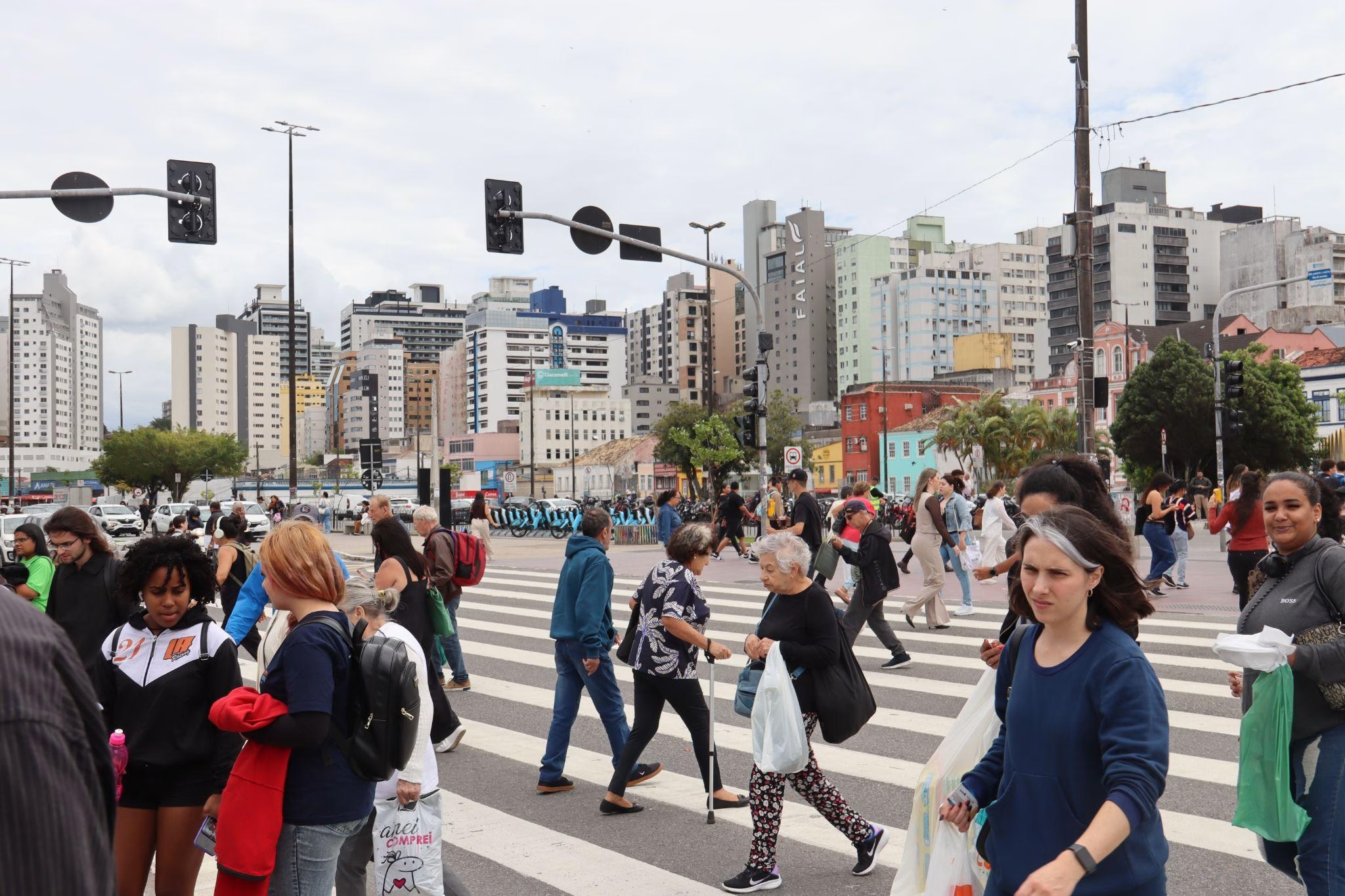
Downtown is the most complete neighborhood in Florianópolis: the highest concentration of services, commerce, culture, transportation, and connection to the rest of the island. It’s the only neighborhood where you can live without a car with reasonable viability.
This is not new. What changed in 2026:
1. The Gehl Plan was delivered. In February 2026, the Gehl Architects office (Copenhagen) delivered a 136-page masterplan contracted by ACIF, CDL, and the Florianópolis City Hall. The document proposes concrete interventions in mobility, public spaces, facades, and three pilot projects with defined phasing.
2. The price has not yet embedded the project. Apartments in Downtown are trading below R$22,000/m². Projection based on international precedent — Copenhagen Gehl, Lisbon Nations Park, Bilbao — sits in the range of R$28,000 to R$40,000/m² for the direct influence region of the masterplan after consolidation.
3. Construction has not yet begun. The masterplan is a directives document. It is not an approved execution plan with a start date. This is a risk — and it is also precisely the point where international cases show the highest potential return for those who buy.
2. The Investment Thesis: What the Data Supports
2.1 Location within Downtown Matters
Not all of Downtown will behave the same way. The masterplan identifies a specific corridor as the epicenter of transformation: the strip between Esteves Junior Street, Bocaiúva Street, Rio Branco Avenue, and the waterfront.
This corridor concentrates two of the three pilot projects (Mercado Vivo and School Zone), the street classified as Type M (Rio Branco Ave.) with a proposal for cycle tracks and qualified sidewalks, and the axis identified as priority for active facades.
A property within this corridor has a different relationship with the project than a property in another part of Downtown.
2.2 Current Price in Context
| Reference | Price/m² |
|---|---|
| Downtown Florianópolis (May 2026) | < R$22,000 |
| Projection based on international precedent (post-Gehl) | R$28,000 – R$40,000 |
| Balneário Camboriú (SC comparison) | 30–50% above Downtown FLN today |
| Copenhagen — areas with Gehl intervention vs. rest of city | +20–40% permanent differential |
Downtown Florianópolis today is below what comparable markets suggest for a neighborhood with such functional completeness. Some of this discount is historical — the quality of public space in Downtown has been systematically below its functional potential. The Gehl Plan proposes to attack precisely this gap.
2.3 The Right Product within the Right Neighborhood
Investing in Downtown is not about buying any product in the neighborhood. The product that captures the potential of transformation has specific characteristics:
- Typology: studios and compact 1-bedroom units — the tenant seeking high walkability and urban living doesn’t need 3 bedrooms
- Furnished: eliminates friction of entry for short and medium-term rental
- Location: within the transformation corridor, not just “Downtown”
- Active Facade: a building that contributes to street vitality, not to deterioration
Buying the wrong product in the right neighborhood creates an illiquid asset in a neighborhood that appreciated. The analysis must include the product, not just the neighborhood.
3. The Risks: What Can Go Wrong
3.1 The Project May Remain on Paper
The Gehl masterplan is a directives document. Execution depends on:
– Public budget approved by City Council
– Political will across multiple administrations (the project has a 10–15 year horizon)
– Approval of execution plans
– Bidding and contracting
Large-scale urban projects have mixed history in Brazil. Some were executed with fidelity (Orla Conde in Rio). Others were announced and abandoned.
The risk of non-execution must be in the account of anyone buying on this thesis.
3.2 The Speed of Appreciation Is Uncertain
Even if the project is executed, time to maturity varies. Lisbon’s Nations Park took a decade to consolidate +300%. King’s Cross took over 15 years. Anyone buying on this thesis needs a compatible horizon — this is not a two or three-year asset.
3.3 The Market May Price It Before Construction Begins
If the market anticipates appreciation strongly before construction begins, anyone buying later will pay part of the premium without having the execution risk offset by the entry price.
Today, in May 2026, the price has not meaningfully embedded the project — Downtown is below R$22,000/m². But this could change as the masterplan gains visibility.
4. What Happened in Comparable Cities at This Cycle Stage
The pattern documented across eight cities is consistent: the largest differential is captured before construction begins.
| City | When Buying Generated Highest Return |
|---|---|
| Lisbon (Nations Park) | 1998–2002: during and shortly after Expo works |
| Bilbao | 1993–1997: before and during Guggenheim construction |
| King’s Cross (London) | 2003–2008: before project consolidation |
| Copenhagen (Gehl interventions) | Before each intervention was completed |
| Curitiba (Rebouças) | Before revitalization priced in |
| Brighton (New Road) | Before pedestrianization |
In all cases, those who waited for the project to be “complete” paid for the result — and may still have made a good deal, because appreciation continued. But the largest value capture happened before.
Florianópolis, in May 2026, is at the stage of “masterplan delivered, construction not initiated”. If the historical pattern holds, this is the entry point with the highest potential return — and with highest risk, because the project is still not certain of execution.
5. The Question Every Buyer Must Answer
Before any product or price analysis, there are two questions that define whether the Downtown thesis makes sense for each specific profile:
1. What is the horizon?
If the horizon is two to three years, the Downtown thesis with the Gehl Plan is risky — the project has 10 to 15 years of phasing. If the horizon is eight to twelve years, international precedent is more favorable.
2. Is the objective income, resale, or living?
– Income: Downtown already generates income today, with or without the Gehl Plan — the neighborhood’s functional completeness supports rental. The project is additional upside.
– Resale: resale return is more directly tied to project execution. Higher potential, higher risk.
– Living: if the decision includes quality of life, Downtown already delivers today — the project improves what already exists.
FAQ
Is Downtown Florianópolis a good investment in 2026?
It depends on profile and horizon. Downtown has solid fundamentals independent of the Gehl Plan: it is the most complete neighborhood in the city, with the highest concentration of services, commerce, and transportation. For those seeking rental income with a five to ten-year horizon, these fundamentals already sustain the investment. The Gehl Plan, delivered in February 2026, adds an additional appreciation thesis — but with execution still uncertain and a 10 to 15-year horizon.
What is the average price of apartments in Downtown Florianópolis in 2026?
Apartments in Downtown Florianópolis are trading in May 2026 below R$22,000/m². The range varies by typology, floor, state of preservation, and specific location within the neighborhood. The corridor identified in the Gehl Plan as the epicenter of transformation — between Esteves Junior Street, Rio Branco Avenue, and the waterfront — tends to present prices in the upper end of the range.
Will the Gehl Plan appreciate properties in Downtown Florianópolis?
There is no guarantee. What exists is: (1) a detailed masterplan delivered by an office with documented history across 250+ cities; (2) international precedent where equivalent projects generated 20% to 150% appreciation in direct influence areas; (3) current price that has not yet meaningfully embedded the project. If the project is executed, the fundamentals for appreciation are present. The risk is execution — large-scale urban projects in Brazil have mixed history.
Which part of Downtown Florianópolis is within the Gehl corridor?
The masterplan identifies the strip between Esteves Junior Street, Bocaiúva Street, Rio Branco Avenue, and the waterfront as the epicenter of active mobility transformation. Rio Branco Avenue is classified as a Type M corridor with a proposal for cycle tracks, widened sidewalks, and active facades. Two of the three pilot projects (Mercado Vivo and School Zone) are in this strip. Properties within this corridor have a more direct relationship with planned interventions than properties in other parts of Downtown.
What is the biggest risk of buying in Downtown Florianópolis on the Gehl Plan thesis?
The primary risk is project non-execution. The masterplan is a directives document — implementation depends on public budget approved, political will across multiple administrations, and execution of plans across a 10 to 15-year horizon. If the project does not materialize, the investment must be sustained by Downtown’s current fundamentals — which are solid, but do not justify the appreciation premium that the Gehl thesis implies.