Special urban adverse possession (usucapião) 250m² is the constitutional pathway for anyone living in property they own for at least five years without formalizing title. Brazil’s 1988 Federal Constitution created this legal mechanism to protect the right to housing, and it remains one of the most effective tools to regularize property in Florianópolis.
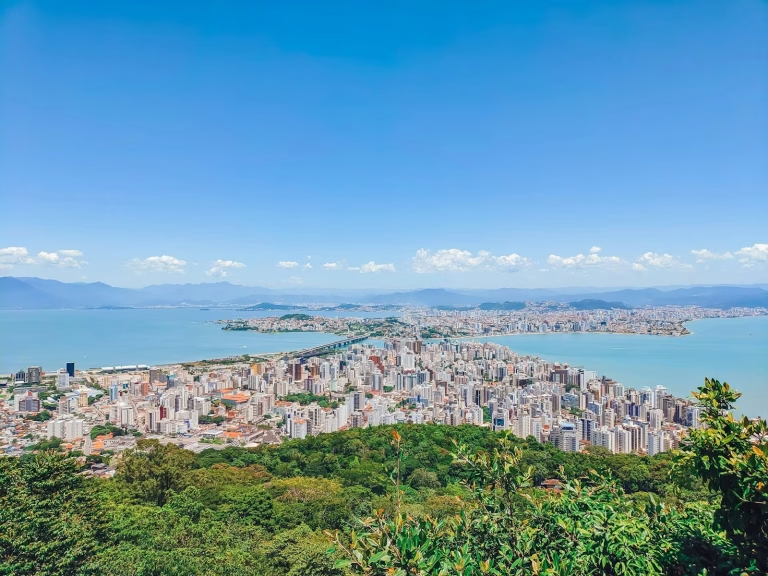
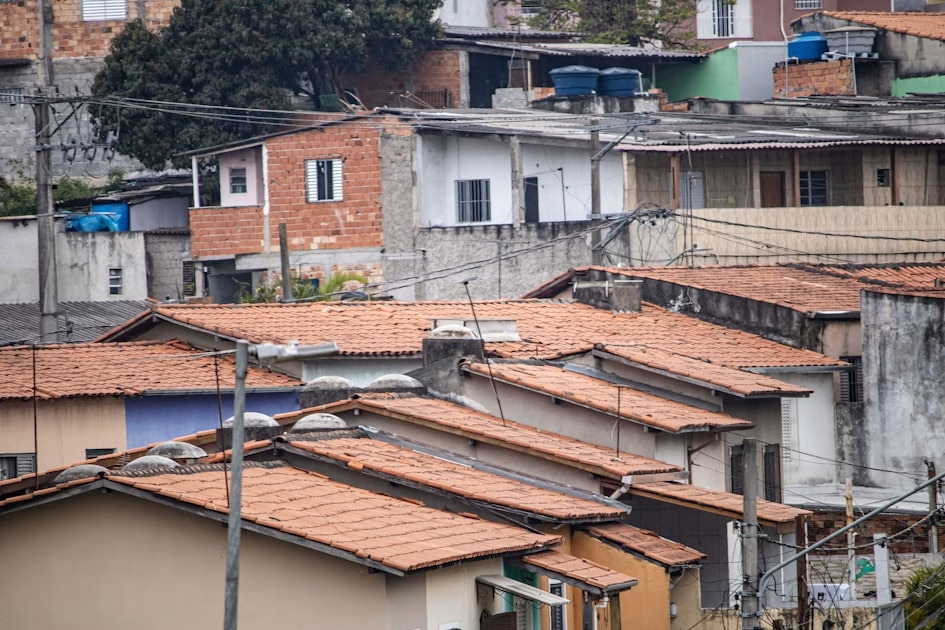
Thousands of residents in the capital of Santa Catarina live in homes up to 250m² without registered title. They pay property tax (IPTUIPTU (Imposto Predial e Territorial Urbano)Tributo municipal anual sobre imóveis urbanos. A base de cálculo é o valor venal, definido pela prefeitura e quase sempre abaixo do valor de mercado.Ver tudo →), maintain the property, have raised families there, but lack formal ownership documentation. Special urban adverse possession (usucapião) resolves this situation.
Special urban adverse possession 250m²: what the Constitution says
Special urban adverse possession 250m² has direct constitutional provision. Two legal provisions support this modality, and both protect the occupant who uses the property for housing.
Article 183 of the Federal Constitution
Article 183 of CF/88 establishes:
> “Whoever possesses as their own an urban area of up to two hundred fifty square meters, for five years, uninterruptedly and without opposition, using it for their own housing or that of their family, shall acquire ownership of it, provided that they are not the owner of another urban or rural property.”
This right cannot be recognized more than once for the same person. The Constitution guarantees acquisition but limits the benefit to a single opportunity (Source: planalto.gov.br, Federal Constitution, art. 183).
Article 1.240 of the Civil Code
The Civil Code reproduces the constitutional rule in article 1.240 and adds that the title of ownership shall be granted to the man or woman, or to both, regardless of marital status (Source: planalto.gov.br, Law 10.406/2002).
The judge or registrar recognizes the acquisition of ownership. The occupant becomes a registered property owner on the property’s title. Understand the difference between property registration record vs. possession to grasp what changes in practice.
What are the requirements for special urban adverse possession?
The law requires simultaneous fulfillment of five requirements. The absence of any one prevents recognition.
Up to 250m² of area
The property must have a maximum of 250 square meters of total land area. Majority case law considers the lot area, not the constructed area. Properties above this limit must pursue other forms of adverse possession (usucapião).
5 years of continuous possession
The occupant must prove five years of uninterrupted, peaceful and lawful possession. “Peaceful” means without opposition from the registered owner. “Lawful” means without violence or concealment.
Evidence accepted by courts and notary offices:
- Proof of payment of property tax (IPTU) at the address
- Bills for water, electricity, telephone in the occupant’s name
- Purchase and sale agreement (even informal)
- Declarations from neighbors (witnesses)
- Photos of the property over the years
- Registration at a health clinic, school in the neighborhood
Family housing and no other property
The occupant must use the property for their own housing or that of their family. A rented, loaned, or exclusively commercial property does not qualify under this modality. For these cases, REURB may be a viable alternative.
Additionally, the occupant cannot be the owner of another urban or rural property. The Property Registration Office (Cartório de Registro de ImóveisRegistro de Imóveis (CRI)Serviço que registra todos os atos que afetam imóveis: compras, hipotecas, penhoras e alienações. Só o registro no CRI transfere a propriedade.Ver tudo →) verifies this condition through negative certificates.
Extrajudicial or judicial path: which route to choose
Since 2015, the Code of Civil Procedure (article 216-A) has allowed recognition of adverse possession directly at the notary office, without requiring a court process. The choice between routes depends on the specific situation.
Extrajudicial adverse possession at notary office: 5 to 12 months
The extrajudicial route occurs at the Property Registration Office and follows this process:
- The occupant gathers documentation and hires a lawyer (mandatory)
- The lawyer prepares a notarial deed at the Notary Office
- The lawyer files the request at the Property Registration Office with all documentation
- The registrar notifies the registered owner, neighboring property owners, and public entities
- If no one files an objection within 15 days, the registrar approves the request
- The notary office opens or updates the property registration record in the occupant’s name
Total timeline varies from 5 to 12 months. The extrajudicial route works well when there is no conflict between occupant and registered owner. For those who already have a contract, forced adjudication may be faster.
Judicial adverse possession: 2 to 5 years
The judicial route is mandatory when:
- The registered owner contests the extrajudicial request
- There are disputes over possession
- The property has no registration record at the notary office (property without registration origin)
- The occupant requests free legal assistance and cannot afford notary fees. The TJSC’s Lar Legal program also offers installment payment options for fees
The judicial process is heard in the civil court (vara cível) of the Florianópolis district court. Average timeline ranges from 2 to 5 years, depending on complexity and court calendar.
Stages of the judicial process:
- Initial petition with complete documentation
- Service of process on registered owner and neighboring property owners
- Intervention by the Public Ministry
- Technical expert evaluation (when necessary)
- Hearing for instruction and judgment
- Judgment declaring adverse possession
- Registration of judgment at Property Registration Office
What does special urban adverse possession cost in Florianópolis?
Total cost varies according to the route chosen and property value. General estimate ranges between 10% and 30% of the property’s market value. Compare with the costs of other modalities.
Costs by route and stage
Extrajudicial route:
- Attorney fees: R$ 3,000 to R$ 8,000
- Notarial deed: R$ 500 to R$ 1,500
- Notary registration fees: R$ 1,000 to R$ 3,000
- Topographic survey and site plan: R$ 1,500 to R$ 4,000
- Total estimated: R$ 6,000 to R$ 16,500
Judicial route:
- Attorney fees: R$ 5,000 to R$ 15,000
- Court fees: R$ 500 to R$ 2,000 (or free)
- Expert evaluation: R$ 2,000 to R$ 5,000
- Registration fees: R$ 1,000 to R$ 3,000
- Total estimated: R$ 8,500 to R$ 25,000
For low-value properties in Florianópolis neighborhoods, the judicial route with free legal assistance can reduce cost to only attorney fees — and the Public Defender’s Office serves those who cannot afford a lawyer. The investment pays off: registered properties appreciate up to 50% compared to properties without title. In informal urban settlements, REURB through the Floripa Regular program may be a more economical alternative.
Difference between special, ordinary, and extraordinary adverse possession
Brazilian law provides several forms of adverse possession (usucapião). Each addresses a distinct situation.
Special urban adverse possession offers the shortest timeline (5 years) and does not require just title or good faith. In exchange, it limits area to 250m² and requires housing use. Post-registration appreciation justifies the investment in the vast majority of cases.
For properties over 250m², the occupant must resort to ordinary extrajudicial adverse possession (if possessing just title and good faith) or extraordinary (without title, 15-year timeline — reduced to 10 with proof of housing).
Frequently asked questions about special urban adverse possession
Can I add the previous owner’s possession time to mine?
Yes. *Accessio possessionis* allows addition of the predecessor’s possession time, provided transmission is documented (purchase agreement, possession assignment). If you purchased from someone who lived there for 3 years and you have lived there for 2, the total reaches 5 years.
Does a federal maritime zone accept adverse possession?
No. Public property (including federal maritime zones) is imprescriptible and does not permit adverse possession (usucapião) in any form. Florianópolis has extensive federal maritime zone areas, especially downtown and along the waterfront. Verify your property’s status with the SPU (National Assets Secretariat / Secretaria de Patrimônio da União).
I live in an unsettled inherited property. Can I request adverse possession?
Yes, provided you meet all requirements. The STJ (Superior Court of Justice) admits adverse possession (usucapião) among co-owners and heirs, when one exercises exclusive possession with *animus domini* (intent to own) for the statutory period.
Does extrajudicial adverse possession require a lawyer?
Yes. Article 216-A of the Code of Civil Procedure requires that the request be filed by a lawyer with express powers of attorney. The lawyer’s presence is mandatory both in the notarial deed and in filing at the Property Registration Office.
Can I use special urban adverse possession for an apartment?
Yes. The STJ and mainstream legal scholarship admit adverse possession (usucapião) of an autonomous unit in a condominium building, provided the private area does not exceed 250m² and all other requirements are met.
Formalize your property ownership
Discover how to regularize your property. Fill out the form and receive a free assessment from a lawyer specializing in property regularization in Florianópolis.
[RD STATION FORM]
- Tag: regularizacao-imobiliaria
- Fields: Name | Email | Phone | Property Location
| Slug | usucapiao-especial-urbana-250m2-florianopolis |
|---|---|
| Title | Special Urban Adverse Possession: How to Acquire Property Up to 250m² in 5 Years |
| Description | Special urban adverse possession (usucapião) 250m²: learn the requirements, timelines, and costs to acquire your property in Florianópolis through extrajudicial or judicial route. |
| Category | Property Regularization · Real Estate Law |
| Modality | Timeline | Maximum Area | Just Title | Good Faith | Housing Required |
|---|---|---|---|---|---|
| Special urban | 5 years | 250m² | Not required | Not required | Yes |
| Ordinary | 10 years | No limit | Required | Required | No |
| Extraordinary | 15 years (or 10 with housing) | No limit | Not required | Not required | No (shortens timeline) |