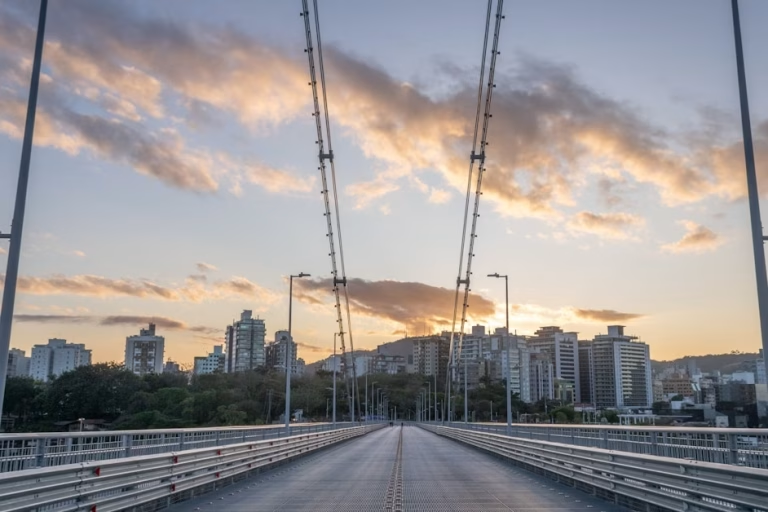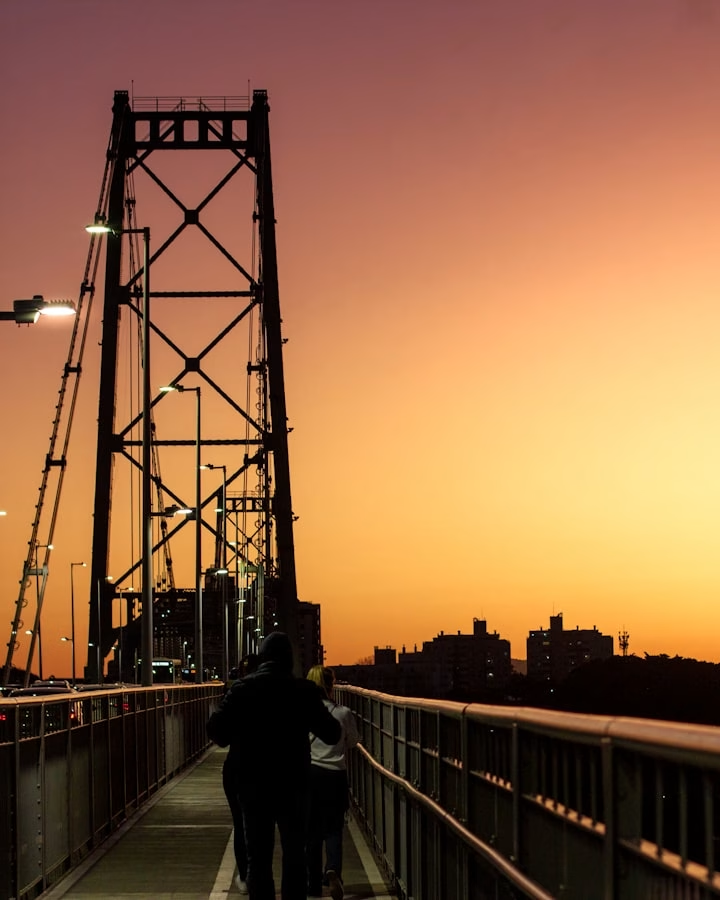
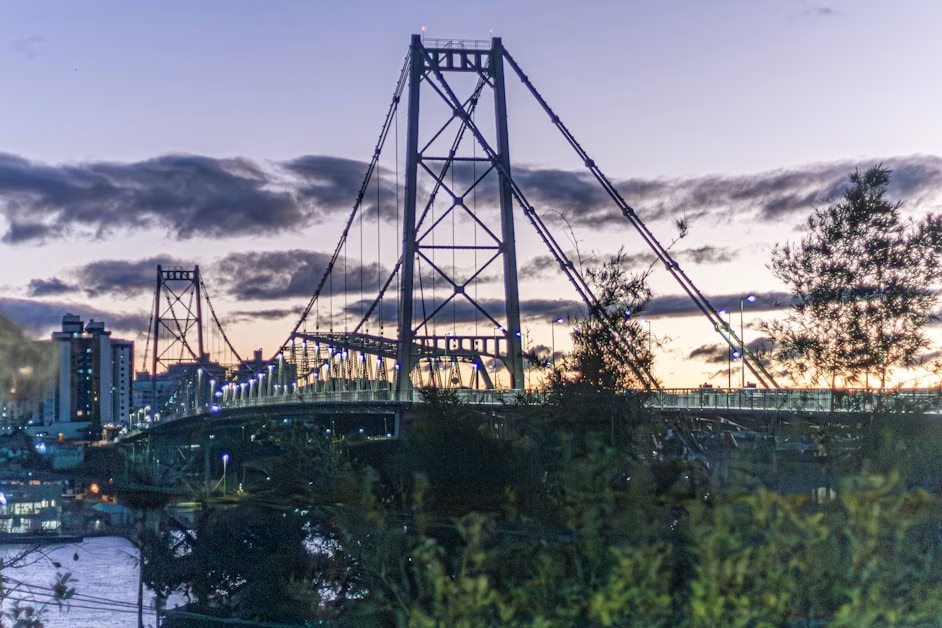
5:04 p.m., December 15, 1967. Rush-hour traffic on the Ohio River. In less than 60 seconds, the bridge disappears. Forty-six people die. The cars sink into the river.
The bridge that collapsed was identical to the Hercílio Luz. Same technology, same design, same engineers.
So why is ours still here, 100 years later?
The answer to that question changes what you think about Florianópolis.
A family of three bridges—and what remains
In bridge engineering, there exists a structural typology called the “Florianópolis-Type Bridge.” The name is no coincidence: it was created specifically for the Hercílio Luz.
American engineer David B. Steinman reformulated the original design to use eyebar chains integrated into the rigidity truss of the central span. It was a technical solution that had never been done before. And it avoided paying royalties to the Roebling family—owners of the steel cable patent for the Brooklyn Bridge.
Robinson & Steinman designed three bridges with this same technology, around the same time:
| Bridge | Location | Inauguration | Outcome |
|---|---|---|---|
| Hercílio Luz Bridge | Florianópolis, Brazil | 1926 | In operation |
| Silver Bridge | Ohio River, USA (WV × OH) | 1928 | Collapsed in 1967 |
| Fort Steuben Bridge | Ohio River, USA (OH × WV) | 1928 | Demolished |
The Hercílio Luz was the first. It is the only one that remains.
But there was a detail that explains everything—and it was in the design from day one.
What happened to the Silver Bridge
On December 15, 1967, the Silver Bridge was crossing rush hour on a Friday. Traffic was backed up.
At 5:04 p.m., a microscopic crack 2.5 millimeters deep—one that had been growing silently for years, accelerated by corrosion—ruptured suddenly. In less than 60 seconds, the bridge collapsed into the Ohio River. Forty-six people died.
The cause was located in a single eyebar.
What made the Silver Bridge so vulnerable was exactly what it lacked: redundancy. Each side chain had only 2 eyebars per pin. The rupture of one eyebar overloaded the other immediately. The collapse was progressive—and there was nothing to stop it.
The U.S. federal government created, in response, a national bridge inspection program.
Fifteen years later, that program would reach the Hercílio Luz.
Why the Hercílio Luz survived where the Silver Bridge did not
In 1982, a crack was found in an eyebar of the Hercílio Luz Bridge. The fissure measured 60 centimeters—24 times larger than the crack that destroyed the Silver Bridge.
But the Hercílio Luz did not collapse.
The difference lay in three design factors that Steinman had incorporated since 1921:
1. Four eyebars per pin, not two
The Hercílio Luz was built with 4 eyebars at each connection pin. The Silver Bridge had only 2. With 4 eyebars, the failure of one does not destroy the system—the other three absorb the load while the rupture is detected. It is the principle of structural redundancy: no single point of failure.
2. Integrated rigidity truss
The “Florianópolis-Type” configuration integrates the eyebars into the rigidity truss of the central span. This distributes the loads differently from the Silver Bridge, which did not have an equivalent central truss.
3. Inspection that led to closure—not disaster
The 60-centimeter crack was detected before compromising the assembly. The ruptured eyebar was identified. The bridge was safely closed in 1982.
No one died.
What happened after the closure is as revealing as the collapse that did not occur.
Thirty-seven years of closure—and what the bridge did while idle
The Hercílio Luz remained closed from 1982 to 2019. Thirty-seven years.
During that time, the bridge did not fall. It was not demolished. The state of Santa Catarina chose to preserve the structure and seek resources to restore it.
Rehabilitation actually began in 2006 and lasted 13 years. Three hundred sixty eyebars were replaced. Two hundred ten thousand rivets were exchanged one by one, using heating techniques above 1,100°C—the same as the original construction. The work was completed 6 months ahead of schedule.
On December 30, 2019, the Hercílio Luz was reopened. On New Year’s Eve, 200,000 people went to Beira-Mar Norte. Many crossed the bridge on foot that night—something Florianópolis’s younger generation had never done.
There was a detail no one had calculated precisely: the impact on the real estate market of the surrounding area.
What the technical rarity of the Hercílio Luz means for Florianópolis
The candidacy of the Hercílio Luz Bridge for UNESCO World Heritage status—currently under review by IPHAN-SC—is based precisely on this singularity:
- Brazil’s largest suspension bridge (821 meters)
- The world’s largest eyebar suspension bridge when inaugurated (central span of 339.5 m)
- The only operational bridge of the “Florianópolis Type” on the planet
Bridges unique in the world are no longer built. What exists is what there is.
This technical rarity reinforces a narrative that is already true in the real estate market: Florianópolis is a city that made unique decisions—and has kept its best decisions standing.
The same determination that restored the bridge against decades of inertia is what keeps the city as a consistent destination for those seeking quality of life and property security.
For an island city with physical limits to expansion, having a technical heritage unique in the world is not just cultural. It is an identity asset that sustains long-term real estate demand.
The Estreito neighborhood appreciated 12% in 2025. The historic center—where the bridge’s island-side header is installed—maintains stable demand and high liquidity. These figures have a history behind them.
FAQ
Can the Hercílio Luz Bridge become a UNESCO World Heritage site?
It is in process. IPHAN-SC is conducting the analysis of the candidacy for the UNESCO World Heritage List. The criteria invoked include: exceptional engineering value (unique of its kind in the world), historical relevance for Brazil and South America, and authenticity and structural integrity after the 2019 restoration. The final decision rests with the World Heritage Committee.
What are eyebars in suspension bridges?
Eyebars are steel pieces with holes at the extremities—like rectangular chain links. They are connected by steel pins and form chains that support the bridge deck. The technology existed before the Hercílio Luz, but Steinman was a pioneer in integrating them into the rigidity truss of the central span, creating the “Florianópolis-Type Bridge” typology. The original application process required heating above 1,100°C—a technique replicated in the 2019 restoration with 210,000 new rivets.
Which engineer designed the Hercílio Luz Bridge?
The design was by David B. Steinman (1886–1960), in partnership with Holton D. Robinson. The firm Robinson & Steinman was created specifically for this project in 1921. Steinman would become one of the world’s most renowned bridge engineers, designing over 400 bridges on five continents—including the Mackinac Bridge (Michigan, 1957), one of the world’s largest suspension bridges. The Hercílio Luz was his first major international work.
Does Florianópolis have other candidates for UNESCO World Heritage status?
The Hercílio Luz Bridge is the most advanced candidacy and has the greatest international visibility. The historic center of Florianópolis, with its Luso-Brazilian architecture and colonial fortresses (Fort Sant’Ana, Fort São José da Ponta Grossa), is part of heritage protection debates, but without a formal active candidacy at the same level as the bridge.