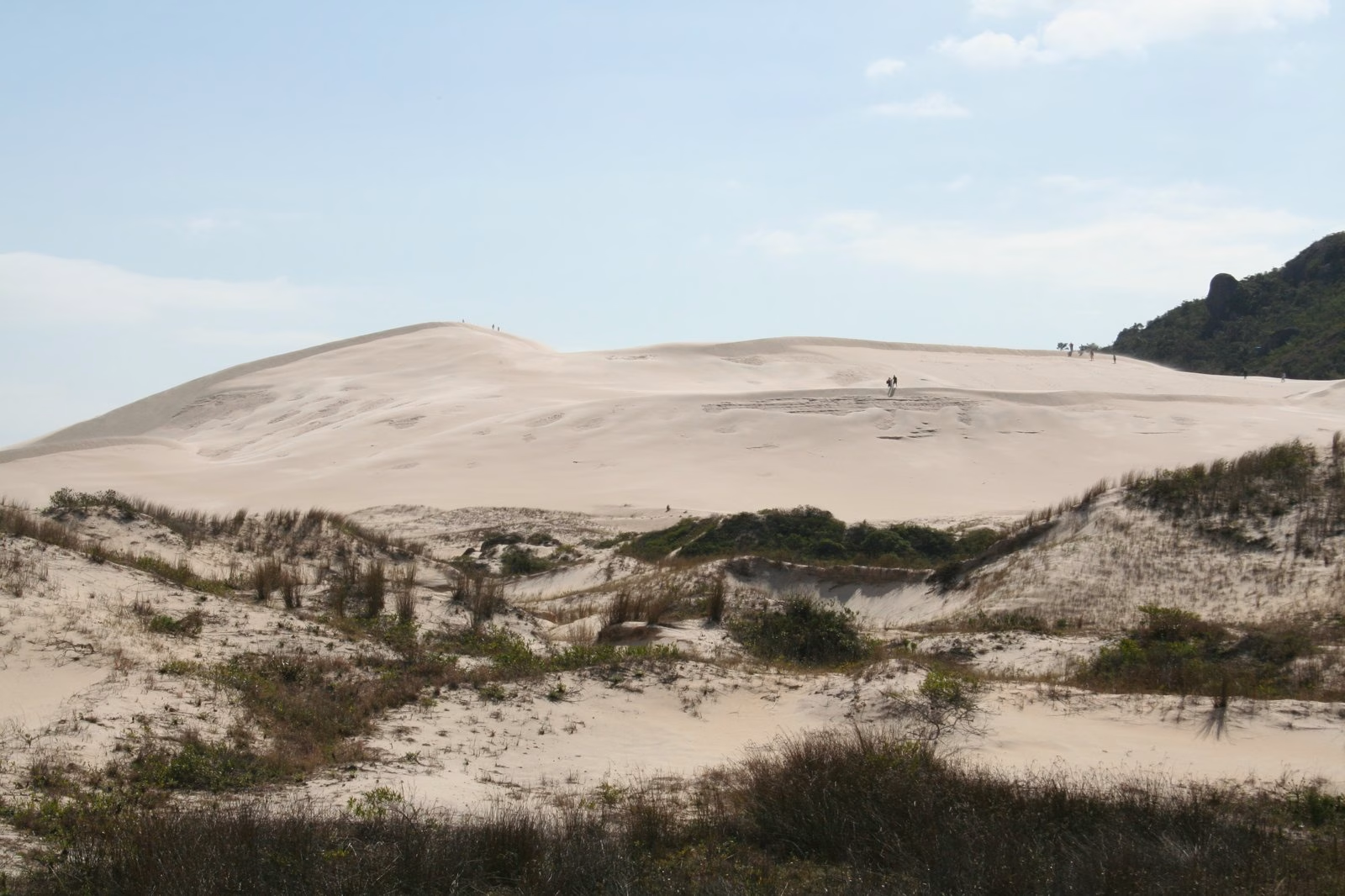
Few places in Florianópolis pack so much landscape into so little space. Between Praia da Joaquina (Joaquina Beach) and Lagoa da Conceição, on the eastern side of the Island, a field of fine white sand rises in waves that the wind redraws every day. These are the Dunas da Joaquina, the Joaquina Dunes, one of the city’s most photographed sandy landmarks.
What almost no one notices, stepping off a board or pausing for the sunset, is that this scene is a protected conservation area with boundaries, rules, and wildlife that depends on you staying within the lines. Understanding that changes how you visit the place.
This guide gathers what matters before you go: how the dune forms, what you can do there, how to get there, the best time to visit, and what the law allows and forbids. No inflated folklore, and with a source for every figure.
What the Joaquina dunes actually are
The dunes are an aeolian formation: the constant wind blowing across the shoreline pushes the sand from the beach inland and piles it into ridges that shift and change shape over time, a landscape that redraws itself with every season.
They stretch between Praia da Joaquina and Lagoa da Conceição, covering much of the route between the sea and the lagoon. Over the sand grows restinga vegetation (the low, salt-tolerant coastal scrub native to Brazil’s Atlantic shore), adapted to the poor soil and the salt, which helps anchor the dunes and shelters the local wildlife.
This combination of shifting sand and restinga is what makes the area ecologically sensitive. And it is why it became a park.
The dune park: the protected area under your feet
Its official name is Parque Natural Municipal das Dunas da Lagoa da Conceição (Lagoa da Conceição Dunes Municipal Nature Park). It was created in 1988 by Florianópolis Municipal Decree No. 231, to halt the spread of urban development across the dune field between Joaquina and the Lagoa.
In 2018, Florianópolis Municipal Law No. 10,388 reorganized and expanded the unit, incorporating stretches of restinga in the Campeche area and water sources such as Lagoa Pequena and Lagoa da Chica. The new boundaries emerged from three public hearings held in 2014 with the communities of Lagoa, Rio Tavares, and Campeche.
Today the park protects 706.76 hectares and is managed by Floram, the Florianópolis Municipal Environment Foundation.
The protection rests on field surveys: research has catalogued at least 326 species of vascular plants in the area, among them the orchid Epidendrum fulgens, along with dozens of bird species and populations of lizards, amphibians, and mammals. The main mapped threats are illegal construction, fires, litter left by visitors, and the invasion of the exotic pine Pinus elliottii.
What to do at the dunes
Sandboarding
This is the attraction that made the place famous. Sandboarding, surfing on sand, is done by riding down the slopes on a board, standing or sitting. Kiosks rent boards right there, at the foot of the dunes.
Rental usually runs between R$30 and R$50 (Brazilian reais) per hour, depending on the provider, according to a survey by news outlet NSC Total. Most spots allow more than one person to share the same board, which brings the cost down for groups and families.
If you have never ridden before, start on the lower dunes. The sand is soft and the falls are gentle, but the bigger slopes pick up speed fast.
Walking and taking in the view
You don’t need a board to enjoy it. Plenty of people climb the dunes just to walk, take photos, and take in the view that opens onto the sea on one side and Lagoa da Conceição on the other.
Late afternoon there has its own following: the low light gives the sand relief, and the sunset over the lagoon closes out the day.
A spot between sea and lagoon
The dunes sit a few steps from Praia da Joaquina, one of the Island’s premier surf spots, and a short distance from Lagoa da Conceição, with its bars, restaurants, and nightlife. You can fit the visit into a larger itinerary along the east coast without wasting time getting around.
How to get there and where to park
The dunes are in the eastern part of Florianópolis, on the approach to Praia da Joaquina, a few minutes’ drive from Lagoa da Conceição. Access to the dune field is free and open to the public.
By car, the most-used route runs along Avenida das Rendeiras, in Lagoa, heading toward Joaquina. There are paid parking lots nearby and some public spaces close by. By bus, municipal lines serve Joaquina and Lagoa; it’s worth checking the current route in the transit network’s app.
One thing to note: the area lacks proper facilities for people with reduced mobility, since access is over the sand itself.
Best time of day and year
Go early, right after sunrise, or in the late afternoon, from 4 p.m. on. In the middle of the day the sand gets very hot and the sun is strong, with no shade around.
Late afternoon comes with the bonus of the sunset. For sandboarding, local guides point to a light-to-moderate northeast wind as the most favorable for the sport.
As for the season, Florianópolis’s summer, from November to March, offers the warmest, driest weather. But spring and fall deliver equally good dunes with fewer people.
Bring water, sunscreen, sunglasses, and light clothing. There is no shade atop the dunes.
The conservation rules you need to respect
Being inside a conservation area carries responsibilities. The park’s management plan, revised in 2023, divides the area into zones with different uses.
One of them is the so-called intangible zone: a strictly protected stretch where visitation is barred and any activity requires prior authorization from Floram. The rule applies across this entire zone, which is meant to protect the park’s most fragile vegetation and wildlife, and access is prohibited.
Across the rest of the area, the rules are environmental common sense, and they always apply:
- Don’t leave trash. Take back everything you brought.
- Don’t light fires. Fire is one of the main threats to the park.
- Don’t remove plants or disturb the wildlife.
- Stay in the public-use areas and respect the signage.
Preserving that scene depends, in practice, on each visitor. It’s what keeps the dunes there for the next season.
Frequently asked questions
Do you have to pay to enter the Dunas da Joaquina?
No. Access to the dune field is free and open to the public. What may carry a cost is parking nearby and renting a sandboard. The park’s Environmental Education Base operates by prior appointment with Floram.
Where can you rent a sandboard and how much does it cost?
There are kiosks that rent boards right at the foot of the dunes, on the Joaquina approach. The price usually runs between R$30 and R$50 (Brazilian reais) per hour, depending on the provider, according to a survey by NSC Total. Many spots let several people share a board.
What is the best time to visit the dunes?
Early morning or late afternoon, from 4 p.m. on, when the sun is lower and the sand is cooler. Late afternoon also offers the sunset over Lagoa da Conceição. Avoid the middle of the day, since there is no shade atop the dunes.
How do you get to the Dunas da Joaquina?
They are in the eastern part of the Island, on the approach to Praia da Joaquina, near Lagoa da Conceição. By car, the most common route runs along Avenida das Rendeiras, in Lagoa, toward Joaquina, with paid parking lots and some public spaces nearby. There are also municipal bus lines to the area.
Are you allowed to climb and walk on any part of the dunes?
No. The park has an intangible zone, strictly protected, where visitation is prohibited and any activity requires authorization from Floram. In the other areas, movement is allowed, but with rules: don’t leave trash, don’t light fires, and don’t remove plants or disturb the wildlife. Always respect the signage.
The Dunas da Joaquina show how Florianópolis grows alongside legally protected areas, not in spite of them. This coexistence of development and conservation shapes much of the Island’s real estate value.
At Regente, this insider’s perspective is what guides our curation of properties on the Island, from the eastern beaches to the neighborhoods of Lagoa and beyond. If you are thinking of living near settings like this one, start with the complete guide to living in Florianópolis, see the best neighborhoods to live in the city, and, if your work is remote, learn how Floripa welcomes those who live from anywhere.
Read also: the history of Florianópolis