
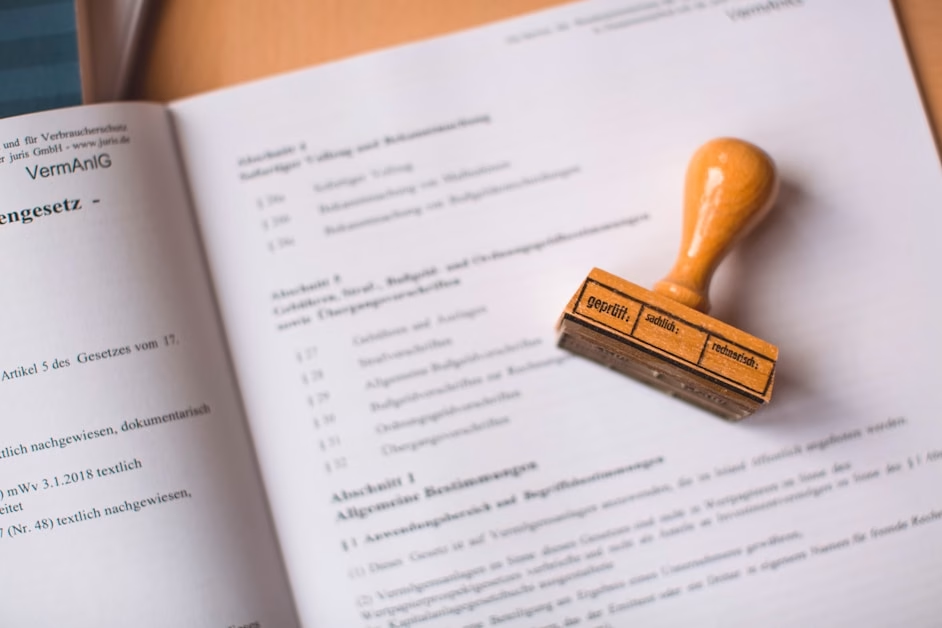
The Hague Apostille is the certificate that validates the origin of a public document for use in another country. For foreigners buying property in Florianópolis, understanding where and how to obtain an apostille is essential — because the process begins in the country of origin of the document, not in Brazil.
This guide explains what an apostille is, which documents require one, which notaries in Florianópolis offer the service, and how much it costs.
Hague Apostille in Florianópolis: What It Is and Why It Is Necessary
The Hague Apostille is a standardized certificate that authenticates the origin of a public document — it confirms who signed it, the official’s title, and the institutional seal. It derives from the Hague Convention of 5 October 1961, which entered into force in Brazil on 14 August 2016 (Decree n° 8.660/2016), regulated by CNJ Resolution n° 228/2016.
Before the convention, authenticating a foreign document for use in Brazil required a lengthy consular legalization process — which could take months. The apostille dramatically simplified this process among signatory countries.
In Brazil, the apostille authority is the CNJ, which delegated the service to the network of notaries. All notaries public in state capitals are required by CNJ to provide the apostille service.
Sources: Decree 8.660/2016 — Planalto; CNJ — Hague Apostille
Which Countries Participate in the Hague Convention
Over 125 countries are part of the convention (2024). For property buyers in Florianópolis, the most relevant signatory countries include:
- United States, United Kingdom, and all countries of the European Union
- Argentina, Chile, Uruguay, Colombia, and Peru
- Australia, Japan, and South Korea
For documents from non-signatory countries — such as Iran and some countries in Africa and the Middle East — the apostille does not exist. The alternative is consular legalization at the Brazilian consulate or embassy in the country where the document was issued.
Complete and updated list: cnj.jus.br — signatory countries
Important Notice for Chinese Documents: Rule Updated in 2023
China acceded to the Hague Convention on 8 March 2023, effective as of 7 November 2023. Chinese documents issued after that date follow the standard apostille process — obtained from the Ministry of Foreign Affairs of China or its provincial delegations. Chinese consulates in Brazil have suspended the consular legalization service for these documents.
Source: HCCH — China Accession
The Fundamental Rule That Prevents the Most Common Mistake
| Situation | What to Do |
|---|---|
| Foreign document for use in Brazil | Apostille issued in the country of origin — never in Brazil |
| Brazilian document for use abroad | Apostille issued at an authorized notary in Brazil |
Foreign buyers who arrive in Brazil with documents lacking an apostille must return to their country of origin to have them apostilled — or wait for the process by mail, which delays closing the deal by weeks.
The apostille must be obtained before sending any document to Brazil. After the apostilled document arrives in Brazil, it still requires a # sworn translation to be valid in notary offices.
Which Foreign Documents Require an Apostille for Use in Brazil
For the purchase of # property in Florianópolis by a foreigner, documents that typically require an apostille are:
- Foreign birth certificate — when requested by the notary
- Foreign marriage certificate — mandatory if the buyer is married (affects spousal consent)
- Foreign death certificate — in cases of estate or inheritance
- Power of attorney drawn up at a foreign notary — when the buyer cannot be in Brazil
- Diplomas and certificates for official recognition
- Criminal background certificate
The passport does not require an apostille for use at a Brazilian notary. It is an international identity document with direct validity — only a sworn translation of the relevant pages is needed.
Brazilian Documents That Require an Apostille for Use Abroad
If you need to use a Brazilian document in another signatory country, apostille is obtained at authorized notaries in Brazil:
- Civil registry certificates (birth, marriage, death)
- Public deeds
- Public powers of attorney
- Sworn translations
- Diplomas and school documents
Notaries With Hague Apostille in Florianópolis
Where to Get an Apostille in Florianópolis
Florianópolis has four notary offices that provide the apostille service. The official directory of authorized notaries is at cnj.jus.br — authorized notaries.
| Notary Office | Address | Phone | Apostille |
|---|---|---|---|
| 1st Notary Public and 3rd Protest | Rua Emílio Blum, 131 – Hantei Building, Downtown, ZIP 88020-010 | (48) 3113-2357 | Yes |
| 2nd Notary Public and 1st Protest (Quintela) | R. Tenente Silveira, 221, Downtown, ZIP 88010-540 | (48) 3039-1991 | Yes |
| 3rd Notary Public and 2nd Protest (Silva Jardim) | Rua dos Ilhéus, 28, Downtown, ZIP 88010-560 | (48) 3222-5120 | Yes (confirmed) |
| Canasvieiras Notary | Av. das Nações, 405, Room B, Canasvieiras | (48) 3266-1625 | Yes |
The Canasvieiras Notary is the most practical option for those buying property in the north of the island — especially in # Jurerê Internacional, Canasvieiras, and surrounding areas.
General hours: Monday to Friday, 9am to 6pm (Canasvieiras: 8am–12pm / 2pm–6pm)
Cost of Hague Apostille in Florianópolis
The cost of apostille follows the state fee schedule for notaries in Santa Catarina, set by state law and adjusted annually.
Current rate: R$ 68.77 per document
Timeline: maximum 5 business days per CNJ. In practice, in-person acts are usually completed the same day or within 24 hours.
The rate applies per apostilled document — if you need to apostille a marriage certificate and a power of attorney, that is two separate fees.
Apostille vs. Sworn Translation: The Relationship Between the Two
The apostille and sworn translation are distinct and complementary instruments. There is no hierarchy between them — each serves a different purpose:
| Instrument | What It Does | Where to Obtain |
|---|---|---|
| Hague Apostille | Authenticates the origin and signature of the document | In the country of origin of the document |
| Sworn Translation | Translates the content into Portuguese | With a Sworn Translator in Brazil |
For foreign civil registry certificates (marriage, birth), most notaries require both — apostille from the country of origin and sworn translation in Brazil.
Correct order:
1. Obtain the apostille in the country where the document was issued
2. Send the apostilled document to Brazil
3. Hire a Sworn Translator in SC to translate it
To learn more about the translation process, see our guide on # sworn translation for property purchase in Brazil.
Apostille for Brazilian Documents You Used Abroad
If you are a Brazilian who lived abroad and need to use Brazilian documents there — or if you are returning to Brazil and need to regularize the situation — the apostille process for your Brazilian documents is done at the notaries in Florianópolis listed above.
The most common documents that Brazilians need to apostille for use abroad:
- Power of attorney for management of property in Brazil
- Birth certificate for visa or citizenship application
- University diploma for academic recognition
The process is the same: visit the notary with the original document and request apostille. The cost follows the state fee schedule.
How Florianópolis Notaries Are Organized for Properties
Beyond apostille, it is useful to understand that Florianópolis has five Property Registration Offices (ORIs) with distinct territorial jurisdictions. The competent ORI is determined by the location of the property — not by the buyer’s choice.
For properties downtown and in Agronomica: 1st ORI (Av. Prefeito Osmar Cunha, 260)
For properties in the south of the island (Campeche, Ribeirão, Pântano do Sul): 4th ORI
The notary public for the deed, on the other hand, is your choice — any notary in the city can notarize the deed, regardless of the neighborhood where the property is located.
Regente guides foreign buyers in # Florianópolis on which notary to contact in each situation — speak with a consultant.
Frequently Asked Questions
Can I Get a Foreign Document Apostilled Here in Florianópolis?
No. An apostille for a foreign document can only be issued in the country where the document was notarized. Notaries in Florianópolis apostille only Brazilian documents for use abroad. To use a foreign document in Brazil, you must obtain the apostille before sending the document to Brazil.
What Is the Difference Between Hague Apostille and Consular Legalization?
The apostille is valid between signatory countries of the Hague Convention — over 125 nations. Consular legalization is the previous process, still used for non-signatory countries. For those countries, the document must be authenticated at the Brazilian consulate or embassy in the country where it was issued.
How Long Does It Take to Apostille a Document at Florianópolis Notaries?
For Brazilian documents apostilled at Florianópolis notaries, the maximum period established by CNJ is 5 business days. In practice, in-person acts are usually completed the same day. The cost follows the SC notary fee schedule — currently R$ 68.77 per document.
Do I Need an Apostille on My Passport to Buy Property in Brazil?
No. The passport is an international identity document with direct validity in Brazil. For use at a notary, it requires only a sworn translation of the personal data and validity pages — no apostille.
Does an Apostille on a Document Have an Expiration Date?
The apostille itself has no legal expiration date. What expires is the original document that was apostilled — an apostilled passport, for example, loses validity when the passport expires. Civil registry certificates tend to have long validity, but some notaries set internally a 90-day acceptance period — confirm with the notary office.