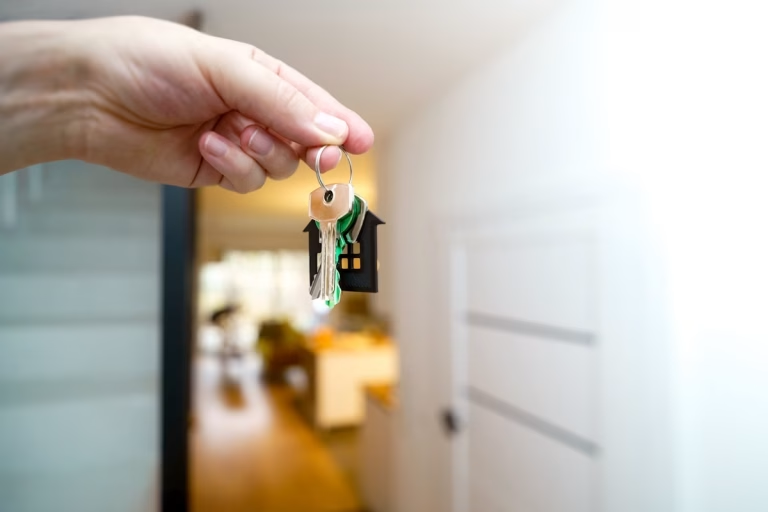

For someone buying their first property, there’s an almost universal moment: the key turns, the door opens, and the apartment seems smaller, more basic, and more raw than the rental left behind. It’s common to interpret this as a decision error. In most cases, it’s just the first chapter of a process that hasn’t yet ended.
This strangeness has a name and a cause. Santa Catarina data helps explain why it’s expected, and why it’s rarely a reason to back out.
The myth of the house for life
Many people treat the first purchase as if it were the last. This expectation creates an unfair comparison pattern: the new property, still without a history, against the rental that has already been adjusted year after year to the taste of whoever lives in it.
There is no single financial answer about buying or renting. It depends on the time horizon and life stage of each buyer. But one data point helps calibrate the decision: residential rent in Brazil historically rises much faster than inflation. In 2025, the cumulative increase was 9.44% in rent versus 4.26% IPCAIPCAVer tudo →, according to the FipeZap (2026). In Florianópolis, isolated points in 2024 showed monthly increases between 1.66% and 4.49%, above any monthly IPCA or IGP-M reading in that period. ⚠️ Confirm the series before using this number as a closed trend: these are isolated data points, not a complete historical series for the city.
The first property doesn’t need to solve your entire life. It just needs to be better than continuing to pay rent that rises every year without building any equity in your name.
The analogy of college entrance exams and the first car
No one expects the first car to be the definitive car. It’s the car that fits the budget of someone who is just starting out: functional, sometimes with scratches on the paint, but enough to get moving. The same logic applies to college entrance exams. The first college, or the first course, is rarely the endpoint of a professional trajectory. It’s the step that opens the next one.
The first property works by the same logic. It’s the step, not the top. The direct comparison with the rental, which often has already been carefully chosen, in a specific neighborhood, with square footage planned for the life moment of whoever rents, ignores that the owned property will still go through renovations, furniture changes, and at some point, a sale or a second purchase.
Treating the first purchase as a final decision is what transforms a property “smaller than ideal” into a reason for regret. Treating it as a stage changes the emotional outcome, even with the same property.
The SAC and the payment that squeezes at the beginning
Part of the discomfort of the first property is also financial, not just psychological. In the Constant Amortization System (SACSACVer tudo →), the most common in Brazilian real estate financing, the payment starts higher and decreases over time. This happens because the amortization value is fixed, but interest accrues on the remaining balance, which decreases with each payment.
In practice, this means that the tightest moment of financing usually occurs at the beginning: the first year or two, when the buyer is still adjusting to a new payment, moving expenses, and sometimes a pending renovation. This squeeze tends to ease over time, because the mechanics of SAC were designed this way.
⚠️ [Verify] The exact value of a payment for a specific financing requires simulation. It’s not possible to point to a fixed number without considering the current interest rate, term, and buyer’s income. What is factual, and does not depend on simulation, is the decreasing curve of the payment in SAC.
This data changes the reading of “losing standard of living”: the initial squeeze is real, but it’s not permanent. Confusing the most difficult moment of financing with the final result of the purchase is another effect of the same myth of the house for life.
The real cost of waiting
Waiting for “the ideal house” has a price, even if it doesn’t appear in the monthly bill. In Santa Catarina, 25.6% of households are renting, the 4th largest proportion in Brazil, and only 3.8% are in borrowed housing, the smallest share in the country, according to the 2022 Census (IBGE/CRECI-SC). In other words: for most people deciding, the real alternative to rising rent is to buy, not to wait living rent-free until they gather the ideal amount.
Appreciation doesn’t wait either. On average for the city, the FipeZap index showed approximately 8.65% appreciation in 2025 for Florianópolis. ⚠️ In high-demand neighborhoods, however, appreciation has skyrocketed well above average in short windows: Santo Antônio de Lisboa (+118%), Praia Brava (+106%), and Vargem do Bom Jesus (+102%), just in the first five months of 2025, according to a Loft survey cited by NSC Total (2025). Confirm the validity of this number before using it as a reference: these are localized exceptions, not city average, and the time window is short.
There is no published study that calculates exactly how much waiting for a larger down payment costs in lost appreciation. This is a logical reasoning based on the data above, not a closed fact. But the direction is clear: the longer someone waits to buy the “perfect” property, the greater the chance that the target price has risen in that time, especially in the most sought-after neighborhoods.
When the first property really pays off
Applying this to the local picture helps close the reasoning. There are concrete signs that waiting has a deadline, it is not a neutral choice. The triplication of highway SC-401 (not to be confused with duplication, it’s a third lane) was 60% complete in March 2026, with expected completion in September 2026, within the state program “Good Road” and an investment of R$ 73 million, according to ND+ (2026) and the SECOM-SC Agency (2026). ⚠️ Confirm the status of the work before citing this deadline: it’s data with a short shelf life, subject to update.
This type of signal (infrastructure with a defined completion date, rent rising faster than inflation, availability of borrowed housing becoming increasingly rare) is what separates “waiting by strategy” from “waiting out of fear of the first property seeming small”. The first property that seems worse than the rental is not a sign of a wrong purchase. It is, in most cases, the normal price of trading a rental adjusted to someone else’s taste for a property that is still at the beginning of its own history.
Each financial situation and each life stage weigh differently in this calculation. What works for one buyer may not work for another. That’s why, before deciding based solely on these numbers, it’s worth talking to someone who closely follows the real estate market in Florianópolis.
Want to understand if it makes sense to buy now or wait a little longer? Also check our guide on learn more to deepen the full comparison between the two options.
Frequently Asked Questions
Does the first property need to be the house of your dreams?
No. The idea that the first purchase needs to be final is one of the main reasons for regret when closing a deal. Waiting too long for the “ideal house” has a real cost: rent in Santa Catarina historically rises faster than inflation, so each year of waiting usually means more money paid without building equity. A simpler first property is still equity in the making. It’s a stage, not a failure.
Buying a simpler property now means losing standard of living forever?
Not necessarily. In financing through the Constant Amortization System (SAC), the most common in Brazil, the payment is decreasing: it starts higher and drops over the years, because interest accrues on a remaining balance that decreases with each payment. The initial squeeze exists, but tends to ease over time.
Is it better to keep renting until I save up for the ideal property?
It depends, but the numbers weigh against this strategy in most cases. In Santa Catarina, rent is already the reality for 1 in 4 households, and only 3.8% of households are in borrowed housing, the smallest proportion in the country, according to the 2022 Census. For most people deciding, the real alternative to growing rent is to buy, not to wait indefinitely.
Is appreciation in Florianópolis the same across the whole city?
No. On average for the city, the FipeZap index showed approximately 8.65% appreciation in 2025, a relatively predictable pace. But in high-demand neighborhoods, appreciation can skyrocket well above average in short windows, like Santo Antônio de Lisboa, Praia Brava, and Vargem do Bom Jesus just in the first five months of 2025. This is not the rule for the whole city, but shows that waiting “just a little longer” can cost more in certain addresses.
Does waiting to save for the down payment have any cost?
Yes, even if indirect. The longer it takes to save the down payment, the more the price of the target property may have risen in that period, especially in neighborhoods of high appreciation. There is no study that calculates this “gap” with accuracy. It’s a logical reasoning based on appreciation data by neighborhood, but the direction is consistent: waiting without reviewing strategy is rarely neutral.
Is it worth waiting for infrastructure improvements before buying?
It depends on the work deadline and the region. In Florianópolis, the triplication of highway SC-401 was 60% complete in March 2026, with expected completion in September 2026, a verifiable deadline, not a vague promise. This type of signal helps you decide whether it’s worth waiting for a specific window or if the time to buy is already here.