Parque Marina da Beira Mar appears in promotional materials for real estate developments in downtown Florianópolis as if it were a novelty. It is not. The project has existed for decades — what changed is that, this time, there is real infrastructure to make it happen.
This guide explains what it actually is, why it stalled for so long, what the public-private partnership changes, and what this means for those living or investing near the central waterfront.
What is Marina da Beira Mar — and why it took so long
Marina da Beira Mar is an old project. The idea of using South Bay’s waterfront for organized nautical infrastructure has been circulating in Florianópolis for decades, but it never left the drawing board: the combination of conflicting political interests, jurisdictional disputes between municipal, state, and federal authorities (maritime waterfront has specific federal legislation), and lack of a viable financing model kept the project shelved for years.
What changed now is the format: the project is being structured as a Public-Private Partnership (PPP) — the public sector contributes the concession of the area and the private initiative contributes investment and operation. This model eliminates dependence on public budget and has a more predictable execution timeline.
What it will serve — beyond the name “park”
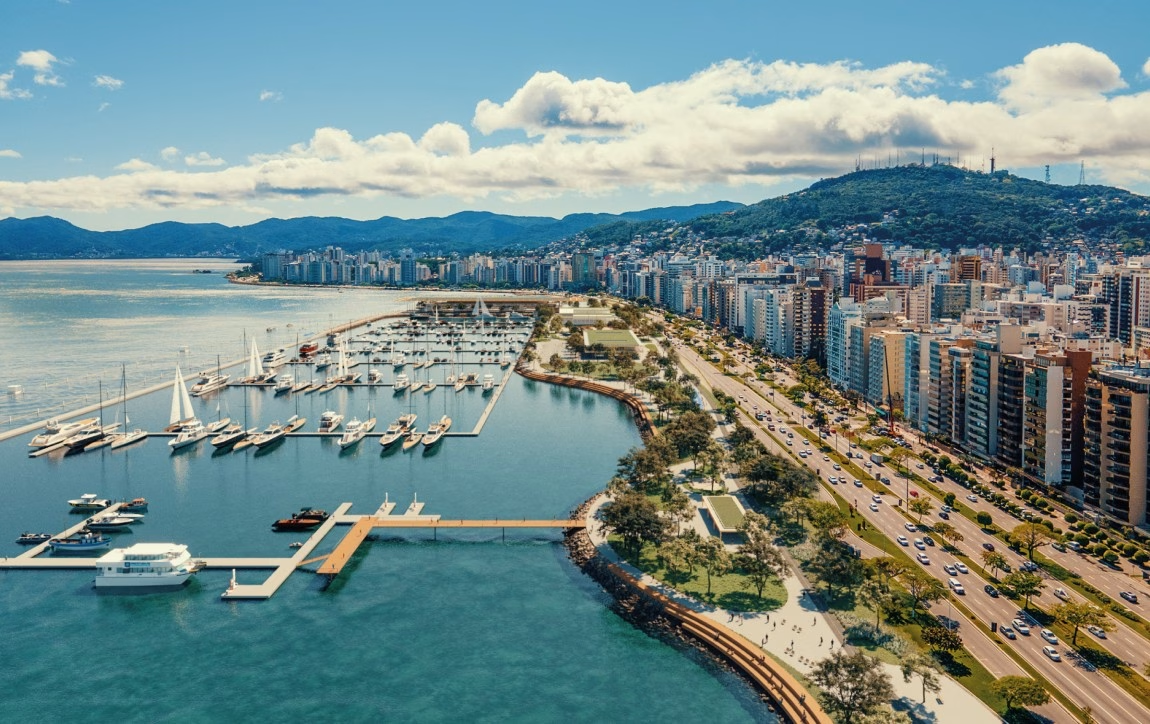
The name “Marina Park” might suggest only green space, but the project has a distinct central function: boat moorings. The marina will offer berths for boats, speedboats, and sailboats — a real demand in Florianópolis, which has strong nautical culture and a history of lacking organized infrastructure for medium-sized vessels in the island’s mainland area.
Around this main function, the project foresees public facilities aimed at residents and city population:
- Beach tennis courts
- Skate park
- Running track
- Multi-sport courts
- Open-air gathering and recreation spaces
The PPP model requires that the concession generate return to the concessionaire — marina berths pay the bill — while public facilities are part of the mandatory social counterpart of the contract.
Where it is located
The area is on South Bay’s waterfront, in downtown Florianópolis, in the region of the old Marina da Beira-Mar Norte — between Av. Mauro Ramos and Av. Rio Branco. It is the waterfront strip facing the mainland, along the bay’s edge.
Distances from the project area
- Mercado Público (Public Market): 5 minutes on foot
- Praça XV de Novembro (XV November Square): 4 minutes on foot
- Av. Rio Branco: edge of the area
- Shopping Beira Mar: 2 km (15 min on foot / 5 min by bike)
- Parkside Rio Branco: 3 minutes on foot
The waterway project — the long-term bet
One of the most relevant auxiliary projects is the use of the sea as a waterway for public transport. The idea is to create a new access route to the island using regular vessels — an alternative to the bridges for those coming from the mainland, easing the bottleneck of the Pedro Ivo and Colombo Salles bridges during rush hours.
For Florianópolis, which is growing demographically but has limited road infrastructure due to geography, the waterway is a long-term structural solution — not just a recreation project. Marina da Beira Mar would be the natural arrival point of this route on the island, given that it sits on the central waterfront.
This component is still in the feasibility studies and planning phase, but the convergence between the marina PPP and public interest in the waterway is the strongest argument for the project’s viability — there is private interest (revenue from vessels) and public interest (new transport route) in the same space.
Why this project matters for those living downtown
Quality public facilities are scarce downtown. Florianópolis has good beach infrastructure at the island’s points, but the historic downtown lacks active recreation spaces — a skate park, beach tennis courts, and running track on the central waterfront would be an offering that does not exist today.
An organized marina changes the city’s nautical dynamic. Today, those with vessels use dispersed and precarious infrastructure. A formal marina with organized berths attracts a resident and visitor profile with higher purchasing power — which affects commerce in the surrounding area and demand for mid- and high-end properties in the region.
The waterway as an alternative to bridges. If the aquatic transport project advances, downtown gains a second entrance that does not depend on pavement. For properties in the marina’s surroundings, this represents reduced dependence on traffic — one of the main negative factors of living downtown today.
The PPP removes the project from political dependence. Projects that depend on political will to advance have historically high risk of not happening. With the PPP model, the private concessionaire’s incentive guarantees execution — provided the contract is signed.
The surrounding area in 2026
Marina da Beira Mar is not the only project converging in this area:
- Restoration of Hercílio Luz Bridge — reopening for pedestrians and cyclists in 2026, connecting downtown to the mainland with new traffic flow
- Revitalization of Esteves Júnior (Jan Gehl Architects) — street redesign prioritizing pedestrians and cyclists
- New residential developments on the Av. Rio Branco corridor — Parkside Rio Branco is the main launch expected in this corridor
- Waterway project — under study as a complementary public transport route between mainland and island
Frequently asked questions about Marina da Beira Mar
Why did the project stall for so long?
Combination of political obstacles, jurisdictional disputes between municipal, state, and federal authorities over the area, and lack of a viable financing model. The PPP format solves the financing question — the private initiative invests and operates in exchange for the area concession and revenue from marina berths.
When will construction begin?
The project is in the PPP structuring phase. The construction schedule depends on signing the concession contract and processing in the Municipal Council. Follow the official channels of Florianópolis City Hall for updates.
Will the marina be public or private?
The model is PPP: the area is public, operation is private. The concessionaire operates the vessel berths for commercial purposes; in return, public facilities (courts, skate park, running track) are free for the population to access.
Does the waterway project already have a timeline?
Not yet. Aquatic transport is in the feasibility studies phase. The marina would be the natural terminal on the island for this route, but the two projects have independent trajectories — the marina PPP can advance before the waterway model is defined.
Will it appreciate nearby properties?
The combination of quality public facilities, organized nautical infrastructure, and eventual waterway route represents a set of urban improvements with positive impact on the surrounding area. Properties purchased before the project’s execution tend to capture part of this appreciation — as has happened in other waterfront revitalization projects in Brazil.
Parkside Rio Branco is 3 minutes from the Marina
Parkside Rio Branco is on Av. Rio Branco — at the edge of the Marina da Beira Mar project’s direct area of influence. The walking distance to the waterfront is approximately 3 minutes.
For residents: immediate access to beach tennis courts, skate park, and waterfront when the project is complete. For investors: the marina’s surroundings combine growing rental demand with documented appreciation in equivalent waterfront revitalization projects.
The Parkside Rio Branco launch happens at a closed event on May 28th. The price list is not public — access is exclusive for leads previously registered.