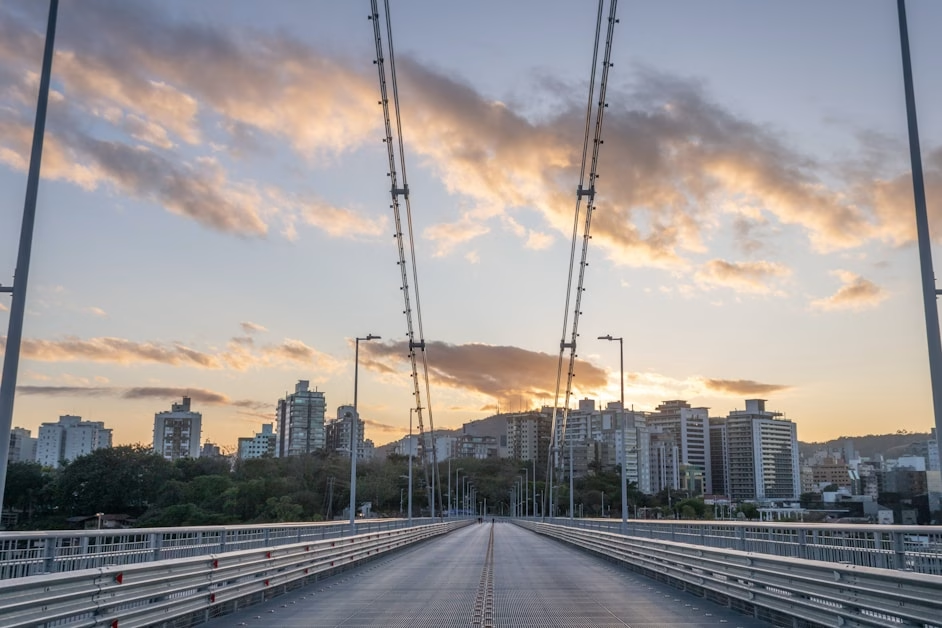
It was January 22, 1982. An inspector climbed the central tower of the Hercílio Luz Bridge for a routine inspection when he heard the crack.
A dry, metallic sound, no warning. He stopped. He looked down. Beneath his feet, 56 meters of span over the Strait. Around him, the structure that carried 27,000 vehicles per day — 43.8% of everything entering and leaving Florianópolis.
He thought the bridge would fall.
It didn’t fall. But what inspectors found that day — a 60-centimeter crack in a suspension bar — closed the bridge immediately and triggered 28 years of interdiction that reorganized every real estate map of this city.
That moment of panic in 1982 explains why the square meter in Florianópolis is worth R$ 13,208 today. But to understand the connection, we need to go back to the beginning.
The bet of a man who didn’t see the result: 1922–1926
In 1922, Florianópolis was an island of 40,000 inhabitants that depended on ferries for any contact with the world. The journey across the Strait to the Center: 20 to 40 minutes by vessel, longer if the sea was rough.
And there was a real threat in the air: transferring the capital of Santa Catarina to Lages or another city inland. Florianópolis was expensive to access and difficult to govern.
Governor Hercílio Luz responded with the only bet that could change the game. He hired American engineers, signed contracts with bankers in New York — US$ 10 million total — and began construction in November 1922. He was already weakened by cancer when he signed the papers.
In October 1924, he crossed a wooden replica in a symbolic ceremony. Twelve days later, he died. The real bridge opened on May 13, 1926, 570 days later, on a Thursday with heavy rain.
Hercílio Luz never set foot on the bridge that bore his name.
What he did was bet the future of a city on a long-term infrastructure decision — and win. The loan that financed this bet took 52 years to pay off, paid in full in 1978. Florianópolis is worth today, by any metric, far more than any financial calculation from 1926 could have predicted.
What the bridge created, neighborhood by neighborhood
The 1926 inauguration was not the end of the story. It was the beginning of an experiment that the real estate market took decades to absorb.
The government implemented an immediate toll — 100 réis per crossing, including pedestrians. For almost nine years, the infrastructure existed without generating the integration potential it promised. The Estreito was still practically empty land.
In 1935, the toll was eliminated. The flow changed scale.
The historic Center began receiving families from across the State. The Estreito started to densify — houses, commerce, services, the urban logic of those who cross the bridge every day and want to live near the head of the crossing. Over the following four decades, Florianópolis stopped being a provincial capital and became a regional hub.
The foundation of the real estate market we know today was built between 1935 and 1975 — and the Hercílio Luz was the only land connection between the island and the rest of Brazil.
The crack of 1982: when crisis reconfigured the map
Let’s return to that inspector on top of the tower.
The 60-centimeter crack he found was irreparable in the short term. The bridge was immediately closed. But Florianópolis couldn’t simply stop: the Colombo Salles Bridge, opened in 1975, and the Pedro Ivo Campos Bridge, which would open in 1991, absorbed the traffic — but with a profound side effect.
The Center-Estreito axis lost fluidity. And the market sought alternatives.
The North of the Island — Jurerê Internacional, Ingleses, Canasvieiras, Cachoeira do Bom Jesus — grew rapidly in the decades that followed. The new bridges pointed to different routes. Who identified this growth vector in the 1990s, when the Hercílio Luz axis was dead, captured entire decades of appreciation.
The lesson is direct: mobility is the most silent and most powerful factor in real estate pricing in an island city.
The 28 years that nearly ended in demolition
From 1991 to 2019, the bridge was permanently closed. During this period, demolition was a real option in political debate. Groups of residents and cultural entities fought for landmark designation — which came in stages: municipal in 1992, state in 1997, federal by IPHAN in 1998.
Federal landmark status legally ended the possibility of demolition. And it bought time for the narrative to change.
What happened next explains the most recent real estate cycle of the city.
The 2019 reopening and the new Center-Estreito cycle
On December 30, 2019, 200,000 people took to the streets on New Year’s Eve to see the bridge illuminated and operating again.
The restoration had been surgical: the Portuguese company Teixeira Duarte applied 210,000 new rivets by the same original method — temperatures above 1,100°C, required by IPHAN. It replaced 360 eyebar links, 28 suspension cables, and more than 5,500 m³ of platform. It delivered six months ahead of schedule.
For the market, the signal was clear.
The Estreito returned to investors’ radar who prefer consolidated neighborhoods with direct access to the Center. The axis that the bridge had created in 1926, weakened in 1982 and abandoned in 1991, returned to functioning as a value driver. In 2025, the square meter in Estreito reached R$ 11,451 — with appreciation of 12% in the year, above the city average.
Infrastructure reopening events generate cycles that take time to mature. Those who enter before the recognition curve captures the best of the appreciation.
What the 2025 and 2026 data confirm
Florianópolis is today the real estate capital of southern Brazil. The numbers are consistent and leave no room for interpretation:
- R$ 13,208 — average square meter value in Florianópolis in April 2026
- 9.44% — annual appreciation in 2025, versus 5.2% of the national average (FipeZAP)
- 1,942 units sold in the first quarter of 2025, up 97% from the same period in 2024
- R$ 1.6 billion in VGV in Q1 2025 — up 67.2%
These numbers were not born by chance. They are the result of a combination that the bridge helped build over a century: scarcity of land on an island with physical limits, a unique identity that attracts qualified migration, and accumulated historical infrastructure that no other southern capital replicates.
Which neighborhoods grew most with the bridge’s story?
The trajectory of the Hercílio Luz leaves clear marks on Florianópolis’s real estate map. The neighborhoods most directly affected are exactly those showing the most consistent demand.
Estreito — the neighborhood born with the bridge
Before 1926, empty land. After the bridge and toll elimination, the first mainland neighborhood to densify. Today combines complete infrastructure with direct access to all three bridges and the historic Center. Average m² in 2025: R$ 11,451.
Historic Center — the island head
The island head of the Hercílio Luz is in the Center. The neighborhood was the first beneficiary of the 1926 land flow — and has never stopped being the nucleus of services and commerce on the island.
North of the Island — grew during closure decades
Jurerê Internacional, Ingleses, Canasvieiras, and Cachoeira do Bom Jesus grew rapidly between 1982 and 2019, exactly when the Center-Estreito axis was compromised. Mobility reconfigured the market — and these neighborhoods benefited. For high-end profile and international liquidity, Jurerê and Lagoa da Conceição dominate.
For a detailed analysis by neighborhood, consult our analysis of Florianópolis’s real estate market.
FAQ — Frequently Asked Questions about Real Estate Appreciation in Florianópolis
Why is real estate appreciation in Florianópolis so consistent?
Florianópolis combines three rare factors: physical scarcity of land (an island with geographic limits that prevent unlimited horizontal expansion), continuous demand from qualified migration (technology professionals, entrepreneurs, and high-income retirees), and accumulated historical infrastructure over 100 years. The result is appreciation above the national average consistently. In 2025, the city recorded 9.44% appreciation versus 5.2% of the Brazilian average (FipeZAP).
What is the relationship between the Hercílio Luz Bridge and Florianópolis’s real estate market?
The Hercílio Luz Bridge, opened in 1926, was the first land connection between Santa Catarina Island and the mainland. It created conditions for Estreito to densify, consolidated the Center as a services hub, and ensured Florianópolis remained capital — saving the city from a real threat of government relocation. Every major real estate cycle of the city has a direct relationship with the bridge’s phases: opening (1926), toll eliminated (1935), closure (1982), landmark designation (1992–1998), and reopening (2019).
What is the average square meter in Florianópolis in 2026?
In April 2026, the average square meter in Florianópolis was R$ 13,208, according to local market data. The value varies by neighborhood: in Estreito, the average m² was around R$ 11,451 (FipeZAP, December 2025); in Jurerê Internacional, the value exceeds R$ 20,000. The historic Center and neighborhoods around Lagoa da Conceição fall between R$ 9,000 and R$ 14,000.
Is Florianópolis a good city for real estate investment in 2026?
Yes, with profile caveats. For those seeking capital appreciation in the medium to long term, Florianópolis presents solid fundamentals: consistent demand, restricted supply, and historical appreciation above inflation. For those seeking rental income, neighborhoods with the highest liquidity are the Center, Trindade (near UFSC), and Estreito. For high-end profile and international liquidity, Jurerê and Lagoa da Conceição dominate. The investment profile should guide neighborhood choice.
What did the Hercílio Luz Bridge’s reopening in 2019 change in the real estate market?
The reopening reactivated the Center-Estreito axis after 28 years of partial closure. Estreito, already valued, returned to attract investors who prefer consolidated neighborhoods with direct access to the historic Center. The 12% appreciation in the neighborhood in 2025 (FipeZAP) is partially associated with the resumption of this historic flow. Beyond direct impact on specific neighborhoods, the reopening signaled the city’s institutional maturity — the ability to preserve and restore its historical structural heritage.