
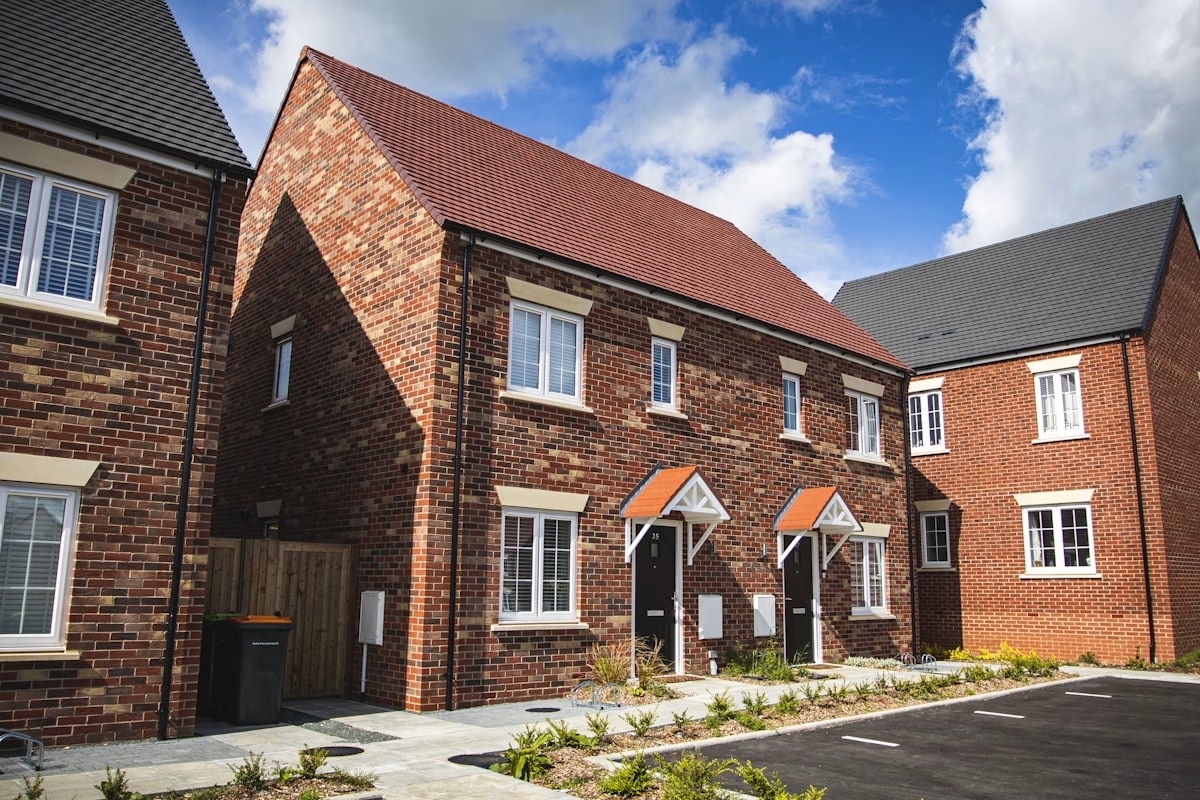
Minha Casa Minha Vida 2026 underwent its largest update since the program was restructured in 2023. The main change is not technical—it is one of scope. For the first time, families with household income up to R$13,000 per month have formal access to a program tier. This significantly expands the pool of beneficiaries, especially in Tier 4, aimed at the middle class.
The Governing Council of the Severance Indemnity Fund for Employees (FGTS) approved the changes on March 24, 2026. MCID Ordinance No. 333, published on April 1 in the Federal Official Gazette, formalized the new limits. Caixa Econômica Federal began operating the new rules on April 22, 2026. According to the Ministry of Cities, the changes benefit approximately 87,500 families—with 31,300 of them migrating to tiers with lower interest rates than they paid before.
If you want to know which tier you qualify for, what the corresponding interest rate is, and what each tier allows in terms of property, this guide answers with official 2026 data.
What Changed in MCMV in 2026: The Four Updated Tiers
Minha Casa Minha Vida 2026 operates with four tiers, and all had their income limits expanded simultaneously. The table uses data from MCID Ordinance No. 333 (April 1, 2026):
| Tier | Household Gross Income | Interest Rate | Property Ceiling |
|---|---|---|---|
| Tier 1 | Up to R$3,200/month | 4.25% p.a. (South/Southeast/Midwest) · 4.00% p.a. (North/Northeast) | R$255k–270k (by region) |
| Tier 2 | Up to R$5,000/month | ~6.5% p.a. | R$270k–350k (by region) |
| Tier 3 | Up to R$9,600/month | 7.66% p.a. | R$400,000 |
| Tier 4—Middle Class | Up to R$13,000/month | 10% p.a. | R$600,000 |
Previous limits (before March 2026) were: Tier 1 up to R$2,640, Tier 2 up to R$4,700, Tier 3 up to R$8,600, and Tier 4 up to R$12,000 with a property ceiling of R$500,000. The Tier 3 update already includes the increase in property ceiling from R$350,000 to R$400,000.
Beyond the four tiers, 2026 brought the Home Reform Brazil Program: families with income up to R$3,200 have access to subsidies for renovations of existing housing; families with income between R$3,200 and R$9,600 access reform financing with a subsidized rate. The focus is habitability—bathroom, roof, basic installations.
Tiers 1 and 2: Maximum Subsidy for Those Most in Need
In MCMV Tiers 1 and 2, the government subsidizes part of the property value directly—the beneficiary pays an installment below what conventional financing would require. In Tier 1, the subsidy can reach 95% of the property value, making monthly payments between R$80 and R$300.
For Tier 1, the process works differently from the others: the beneficiary does not choose the property directly. Registration is done through the municipality or Caixa Econômica Federal, and selection follows priority criteria—female heads of household, seniors over 60 years old, persons with disabilities, and families displaced by disasters have preference. The property is delivered move-in ready, within developments selected by the government.
For Tier 2, the beneficiary chooses the property within the value limit of the region—R$270,000 to R$350,000, depending on the state—and finances directly through Caixa with a subsidized rate. FGTS can be used as a down payment or to amortize installments. Learn how to calculate how much your FGTS earns and when it is worth using it on a purchase in FGTS in property purchase: how much it earns and why to use it as a down payment.
Criteria that remain the same in 2026:
- The beneficiary cannot own property registered in the municipality
- Cannot have received prior federal housing benefit
- Maximum income commitment: 30% of household gross income
- Requirement of 3 years of FGTS contributions to use the fund
Tier 3: Financing with Subsidized Rate for Those Earning Up to R$9,600
Minha Casa Minha Vida 2026 Tier 3 covers household gross income from R$5,000.01 to R$9,600 per month, with interest rate up to 7.66% per year and property ceiling of R$400,000.
This tier operates as conventional financing—the beneficiary chooses the property, goes through credit analysis, and contracts directly with Caixa Econômica Federal. The difference from the free market is the rate: a loan through the Brazilian Savings and Loan System (SBPE) for the same profile can reach 10–12% per year.
In Tier 3, it is possible to finance new, used, or off-plan property (for used property, the requirement is that the municipality has fewer than 50,000 inhabitants—for larger municipalities, only new or off-plan). To understand all available financing systems, see the complete guide on how real estate financing works in Brazil: SFH, SBPE, and FGTS.
The official example from the Ministry of Cities illustrates the impact of 2026 changes: a family with income of R$4,900 that previously fit Tier 3 (7.66% p.a.) migrated to Tier 2 (~6.5% p.a.) with the update of income limits. Financing capacity increased from R$178,000 to R$202,000.
Tier 4—Middle Class: How It Works for Those Earning Up to R$13,000
Tier 4 of MCMV 2026—the Middle Class tier—covers household gross income from R$9,600.01 to R$13,000 per month, with rate of 10% per year nominal and property ceiling of R$600,000.
According to Caixa Econômica Federal, the conditions of this tier are:
- Minimum down payment of 20% of property value (there is no direct government subsidy)
- Maximum term of 35 years
- FGTS can be used as down payment or to amortize future installments (minimum 3 years of contributions)
- Accepts new, used, or off-plan property—for off-plan property, construction must be financed by Caixa
- Index: Reference Rate (TR)
- Contracting through Caixa or Caixa Aqui banking correspondent
The benefit of Tier 4 is not subsidy—it is access to the Housing Finance System (SFHSFHVer tudo →) with maximum rate of 10% per year. On the free market (SBPE), the same profile typically pays between 11% and 13% per year. For a family buying a R$600,000 property with R$480,000 financing, the difference of 2 percentage points in the rate represents significant savings over 35 years.
New, Used, or Off-Plan Property: What Each Tier Really Allows
The choice of property type does not depend only on the buyer—each MCMV tier has its own rules:
- Tier 1: new property only in a development selected by the government
- Tier 2: new property in large municipalities; used only in municipalities with up to 50,000 inhabitants
- Tier 3: new, used (municipalities ≤50,000 pop.) or off-plan
- Tier 4—Middle Class: new, used (any municipality) or off-plan (financed by Caixa)
For those buying in Florianópolis, this detail matters: the local market operates mostly outside MCMV tiers. The average price per square meter in neighborhoods like Trindade, Córrego Grande, and Campeche puts many properties above the ceilings of Tiers 1, 2, and 3. Only Tier 4 can cover typical properties in the Santa Catarina capital—and even then with a ceiling restriction of R$600,000.
For income and average ticket compatible with Tiers 1 to 3, neighboring municipalities offer more options: São José, Palhoça, and Biguaçu have inventory of properties aligned with the program ceilings. For those seeking affordable housing specifically in Florianópolis, the local scenario has particularities—ongoing public developments and the municipal Floripa for Everyone program. See the complete guide on MCMV and affordable housing in Florianópolis.
Frequently Asked Questions—MCMV 2026
Can someone with R$10,000 monthly income use MCMV?
Yes. With the March 2026 update, Tier 4—Middle Class covers household gross income up to R$13,000 per month. The rate is 10% per year, the minimum down payment is 20%, and the property ceiling is R$600,000. There is no direct subsidy—the benefit is access to financing through SFH with controlled rate.
Can I use FGTS in Tier 4?
Yes. FGTS can be used as part of the down payment or to amortize future installments in Tier 4, provided the beneficiary has at least 3 years of contributions to the fund.
Does the property ceiling apply to Florianópolis?
The R$600,000 ceiling of Tier 4 applies throughout Brazil, including Florianópolis. For Tiers 1 and 2, the ceiling varies by region. Consult the updated table at Caixa Econômica Federal for the exact value in your location.
Can I buy used property through Tier 4?
Yes. Tier 4 accepts new, used, or off-plan property. For off-plan property, construction must be financed by Caixa Econômica Federal.
What is the difference between MCMV and conventional financing for the middle class?
In conventional SBPE financing, the rate for properties above the SFH limit typically is 11% to 13% per year. In MCMV Tier 4, the maximum rate is 10% per year, with access to FGTS. For properties within the R$600,000 ceiling, Middle Class MCMV is more advantageous for those who qualify by income.
Which Tier Do You Qualify For?
Qualification for MCMV depends on declared household gross income, the property value you seek, and the municipality where you will buy. In Florianópolis, most purchases escape the ceilings of Tiers 1 to 3. In Greater Florianópolis, the scenario is different.
Regente Imóveis performs the qualification analysis before you move forward with any bureaucratic step. A free simulation confirms the tier, the applicable rate, and the maximum property value for your profile. To learn what to prepare before the consultation, see the documentation required for real estate financing.

Looking for professional guidance?
ADVICE BEFORE YOU BUY
Fill in your details and click the button to get everything you need about the best investments.