
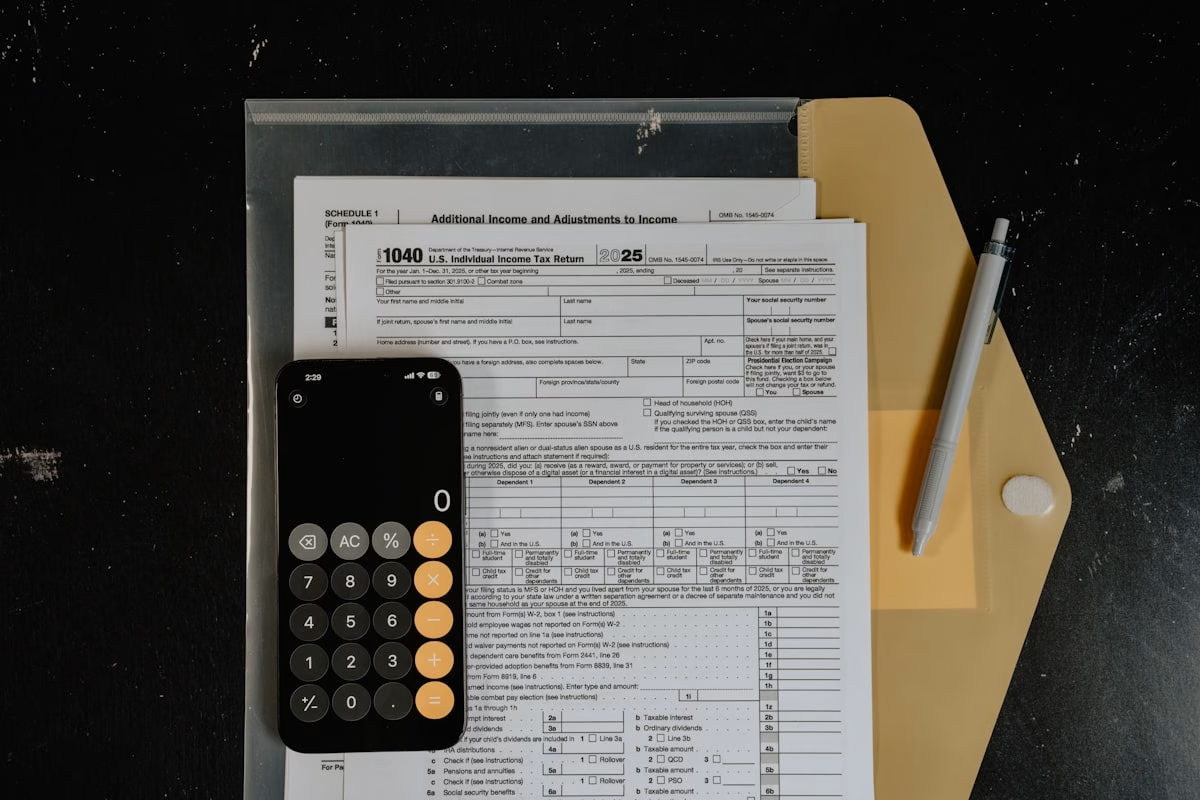
Most individual property owners will not pay IBS or CBS. This is the starting point—and it’s what has been most distorted in conversations about tax reform and the rental market.
What changes for every property owner receiving rent above R$ 2,428.80 per month? The withholding tax (carne-leão) and the CIB. These two points affect nearly everyone who rents, regardless of whether they own one property or ten.
What isn’t fully defined yet? Much of the procedural detail. The law was drafted as an organic complementary law—designed to be altered quickly. Tax attorneys, auditors, and specialized judges still lack full clarity on certain regulatory aspects of implementation. Anyone claiming certainty about what will happen in 2028 is guessing.
Most property owners don’t fall under IBS/CBS
Complementary Law 214/2025 defines two criteria for an individual property owner to become liable for IBS and CBS. Both must be present at the same time:
- Own more than 3 properties being rented simultaneously AND
- Have gross annual rental income above R$ 240,000
Anyone with 1 or 2 rental properties is not subject to IBS/CBS—regardless of rental amount. Anyone with 4 properties but receiving less than R$ 240,000 per year also doesn’t qualify. Both criteria must be met together.
This already eliminates the vast majority of individual property owners in Brazil, including most who rent properties in Florianópolis.
When you fall under IBS/CBS: For those meeting both criteria, residential rental income receives a 70% reduction in the tax base. The effective rate ends up around 8% to 10%. There is also a deduction of R$ 600 per residential property rented.
The transition: the next 3 years have very low rates
Even those who fall under the regime won’t feel the full impact in the coming years. Implementation is gradual, with rates increasing from 2026 until full phase-in in 2033.
In 2026, contributors to IBS/CBS who declare correctly will pay the equivalent of 1% combined CBS and IBS—and this amount will be refunded at year-end. In practice, it’s an exercise in tax compliance: you declare, pay nearly nothing, and receive it back. The purpose is to put the system in operation before it has real financial weight.
Real financial impact begins to be felt from 2029 onward, with full implementation planned for 2033—and even in 2033, with the 70% reduction applied to residential rental income.
What changes for every property owner receiving rent: withholding tax and CIB
These two points don’t depend on how many properties you own.
Withholding tax (carne-leão)
Anyone receiving rent from an individual above R$ 2,428.80 per month has the obligation to remit income tax monthly via withholding tax. This isn’t new—it already exists. What changes is that the CIB (below) will facilitate cross-checking by the Federal Revenue Service, making non-compliance riskier.
The progressive 2026 tax table:
Those using a real estate agency have the reporting document (DIMOB) generated automatically, which regularizes the property owner’s tax situation. Those renting independently need to track and remit on their own.
CIB—Brazilian Real Estate Registry
The CIB is a 7-character alphanumeric code assigned to each property—created by LC 214/2025, already being called the "CPF of properties". It’s not something the property owner needs to request: it’s generated automatically.
The requirement begins in 2026 for urban properties in state capitals and the Federal District. It reaches other municipalities in 2027.
What makes the CIB relevant to property owners: it allows automatic data cross-checking between property registration, property tax (IPTUIPTUVer tudo →), banking information, and tax returns. If rental income received doesn’t appear in your return but the property is on the property tax roll and the money hits your account every month, this cross-check will flag the discrepancy.
The penalty for non-disclosure ranges from 20% to 75% of the tax owed, plus SELIC interest retroactively.
What no specialist yet guarantees with certainty
Tax reform was drafted as an organic complementary law—by design, it’s an instrument meant to be altered with more agility than an ordinary law. The stated objective is to allow adjustments during the transition without requiring the full legislative approval process for every modification.
The practical result: tax attorneys, auditors, and specialized judges still lack uniform understanding of certain regulatory and procedural aspects of the law. What holds in 2028 may differ from what’s in effect in 2026. Constant updates are expected.
This isn’t a reason to ignore the topic—it’s a reason to stay informed. Anyone declaring correctly from 2026 onward has less risk of being caught by a retroactive change. Anyone waiting until they’re “ready” to understand may face accumulated liability.
Regente’s ebook: tax reform for rental income with recurring updates
Precisely because of this instability, Regente launched the ebook “Tax Reform for Rental Income—Individual Property Owners”—with recurring updates as the law is regulated and amended.
The material covers:
- The exact criteria for falling under or outside the IBS/CBS regime
- How to handle withholding tax correctly
- What the CIB is and what to do about it
- Transition tax rates by year
- What professional property management automatically resolves for the owner
You don’t need to become a tax law specialist to protect your assets. You need to understand what applies to your situation—and know when the law changes something relevant to you.
Download the ebook free—and receive updates automatically when regulations change.
If you’re evaluating purchasing a property for rental, also understand how real estate financing works, when it makes sense to use FGTS on the purchase, what the current Minha Casa Minha Vida brackets are, and what documentation is required for financing.
FAQ—Tax Reform and Rental Income
I own 2 rental properties in Florianópolis. Will I pay IBS/CBS?
No. To fall under IBS/CBS, you need to own more than 3 rental properties at the same time AND have annual income above R$ 240,000. With 2 properties, regardless of rental amount, you are not an IBS/CBS contributor.
Will I pay anything extra in 2026 because of the reform?
If you meet both criteria (3+ properties and R$ 240k+/year), you will declare and pay around 1% combined CBS and IBS—which will be refunded at year-end. For most individual property owners, 2026 has no new financial impact.
What is the CIB and do I need to do anything?
The CIB is generated automatically by the Federal Revenue Service—you don’t need to request it. What matters is that starting in 2026 it allows data cross-checking between your property and your tax return. If you’re receiving rent and not declaring it, the risk of being identified increases.
Does property management by a real estate agency protect the owner fiscally?
Yes, in a relevant way. The agency generates the reporting document automatically, which satisfies your obligation to report rentals to the Federal Revenue Service. This doesn’t replace withholding tax when it’s required, but it eliminates the risk of unintentional non-disclosure.
When will the reform be 100% defined?
There’s no clear timeline. The law was built to be altered during the transition. Tax attorneys and auditors still disagree on implementation aspects. The safest path is to declare correctly from 2026 onward and stay current with updates—Regente’s ebook was created precisely for this.
*Legislation: Complementary Law 214/2025. Taxation: FENACON and Federal Revenue Service. CIB: CRECI-SC. Editorial contribution: Regente Imóveis, March 2026.*
| Slug | |
|---|---|
| Title | Tax Reform and Rental Income 2026: What Changes for Individual Property Owners |
| Description | Tax reform and rental income in 2026: most individual property owners don’t pay IBS/CBS. See who’s affected and what changes. |
| Categoria | Real Estate Market |
| Monthly range | Status |
|---|---|
| Up to R$ 2,428.80 | Exempt |
| R$ 2,428.81 to R$ 3,036.00 | Exempt in practice (simplified deduction of R$ 607.20) |
| Above R$ 5,000 | Tax rates of 7.5% to 27.5% |