Expensive rent in Florianópolis does not have a single cause. Anyone living in the city knows that finding an apartment at a reasonable price requires time, patience, and frequently, trade-offs in location or standard. The explanation lies in an overlapping of nine structural and cyclical factors operating at the same time — and that no isolated policy resolves quickly.
This text breaks down each of these factors with the clarity of someone who has worked in Florianópolis’s real estate market for decades. Understanding the mechanism behind the price is the first step to making better decisions — whether as a renter, as a property owner, or as someone evaluating whether it’s time to buy.
Expensive Rent in Florianópolis: What Are the Root Causes?
Rent in Florianópolis is expensive because nine distinct forces pressure the price in the same direction at the same time. When any one of them decreases, the others compensate. The analysis of each driver shows why the pressure tends to be structural.
1. Airbnb Drained the Long-Term Rental Stock
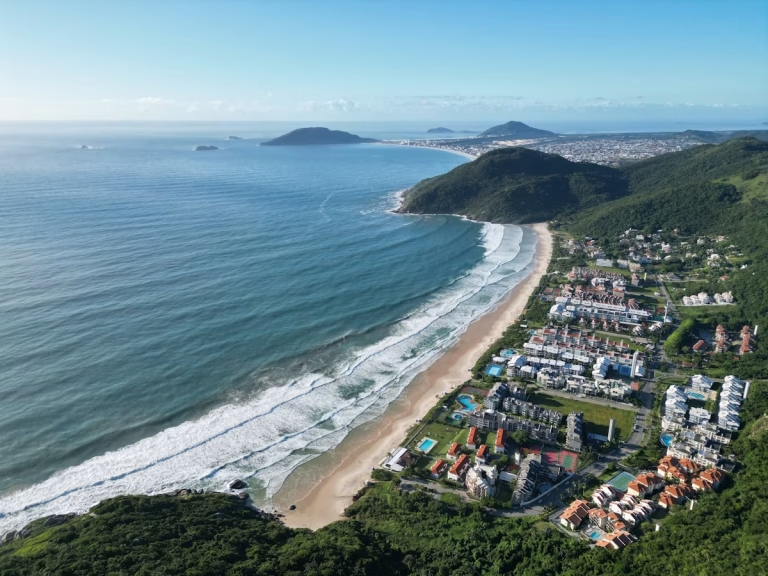
In beach neighborhoods — Ingleses, Jurerê Internacional, Canasvieiras, Lagoa da Conceição — an estimated 30 to 40% of available properties were migrated to short-term rental. The engine of this migration is the difference in profitability.
An R$ 500,000 apartment in Ingleses rented on a long-term basis generates approximately R$ 14,600 per year (net yield close to 2.9%). The same property on Airbnb, with 55% annual occupancy at R$ 180 per night, can generate between R$ 25,000 and R$ 30,000 per year. The difference is 70 to 100% in income — for the same property, without any additional long-term work.
The result for the long-term renter is direct: what the conventional market offers are properties that don’t work well for short-term rental — inland location, below-average standard, without infrastructure for tourists. Owners of this segment know they have little competition. And they price with that advantage.
2. New Supply Grows Much Slower Than Demand
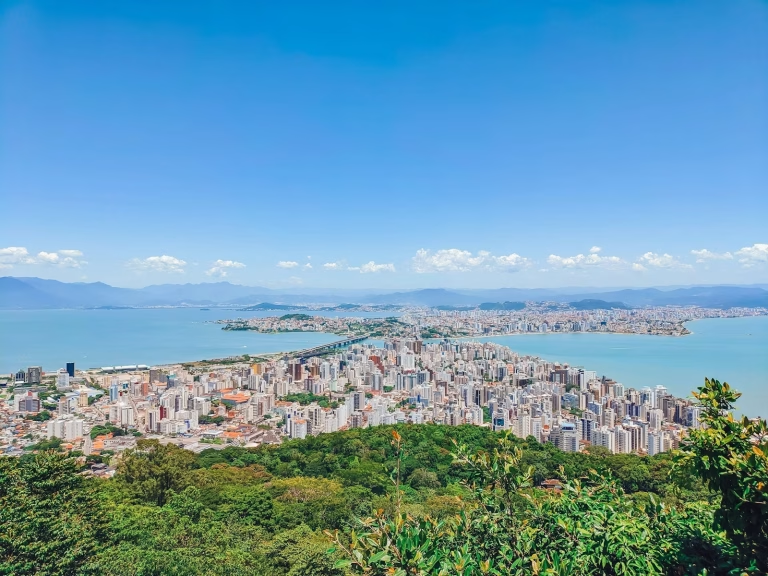
Florianópolis grows approximately 2% per year, according to IBGE — which represents about 10,700 new people per year. Greater Florianópolis grows even faster, around 2.5% per year, with approximately 3,000 to 5,000 new families needing housing each year.
On the supply side, the response is slow by definition. Approval of a development in Florianópolis takes between four and seven years, from land purchase to certificate of occupancy (habite-se) (SINDUSCON-SC). In that period, most properties launched go to sale — not to rental.
Structural vacancy in Florianópolis’s long-term rental market is estimated at 3 to 5% — while São Paulo presents about 6 to 8% and Rio de Janeiro, 7 to 9%. Vacancy below 6% characterizes a landlord’s market: he doesn’t need to negotiate discounts, and the renter accepts the conditions imposed.
The estimated annual deficit — families without adequate long-term rental property — sits between 2,000 and 4,500 units, considering that fewer than 500 to 800 new units enter the rental market each year. This deficit accumulates. #
3. Multiple Demand Sources Compete for the Same Stock
Demand for rental in Florianópolis does not come from a single profile. At least four distinct groups compete for the same restricted stock — and each group has high willingness to pay.
- Remote workers with high income: technology and finance professionals from São Paulo and Rio de Janeiro who relocated to Florianópolis. High income, willing to pay above average for quality property in a good neighborhood. Tend to rent for 12 to 24 months before deciding to buy.
- Second residence: families from Paraná, Rio Grande do Sul, and interior Santa Catarina seeking short-term or permanent relocation property. Very high willingness to pay, since primary income comes from another state.
- Foreign demand (mainly Argentine): Argentines rent for six to twelve months before buying to learn the market. Compared to cost of living in Buenos Aires, Florianópolis still seems affordable in dollars — which raises the negotiation ceiling.
- Tourism as a price externality: high demand for short-term stays does not compete directly with long-term renters, but creates a reference: owners compare what they could earn from short-term rental and charge annual rent as a “discount” against that potential.
4. Property Owner Operating Costs Are Structurally High
To understand why the asking price seems high, it’s necessary to see what the property owner actually receives. A R$ 500,000 property with gross rent of R$ 2,500 per month faces the following cost scenario:
- Real estate management fee (10%): R$ 250 per month
- IPTUIPTUVer tudo → (~1% per year of value): R$ 417 per month
- Maintenance (~1% per year of value): R$ 417 per month
- Insurance and guarantee: R$ 100 per month
- Estimated vacancy (~6% of time): R$ 150 per month
Total monthly costs: approximately R$ 1,334. The property owner retains about R$ 1,166 per month — net yield of 2.8% per year.
To achieve net yield of 4% — minimum competitive with low-risk fixed-income instruments — he would need to charge between R$ 3,500 and R$ 3,800 per month, not R$ 2,500. In beach neighborhoods, condominium fees elevate this floor even further: maintenance in maritime environment (corrosion, infiltration, salt spray) and premium common areas result in fees of R$ 600 to R$ 3,500 per month. #
5. Summer Anchors the Price for the Entire Year
Florianópolis’s seasonality creates a specific and little-discussed phenomenon: peak summer price anchors psychologically the price for the rest of the year.
The cycle works like this. In January and February, Airbnb operates with occupancy rate above 85%. A property owner who charges R$ 5,000 per month at peak places the same property on the long-term rental market in May at R$ 3,800 — and announces this as a “great discount”. In a city without seasonality, this property would be worth R$ 2,200 per month.
A two-bedroom apartment in Ingleses, in equivalent neighborhood, costs around R$ 1,800 to R$ 2,200 monthly in Curitiba outside peak season. In Florianópolis, the same standard costs R$ 2,800 to R$ 3,500 outside peak season — which represents a premium of 40 to 60% that the long-term renter pays without necessarily using the summer the same way a tourist would.
6. Property Owners Speculate on Purchase Appreciation
This is the most counterintuitive factor: rent in Florianópolis is expensive in part because the property appreciated a lot. The mechanism is as follows.
Net yield on long-term rental in Florianópolis sits between 3.0% and 4.5% per year. For comparison, the Central Bank Selic rate paid approximately 13.5% per year in May 2026. Why would the property owner accept 3.5% on rent when he could have 13% on fixed income?
Because he is betting on purchase appreciation of 8% to 15% per year — which has historically held true in Florianópolis. The expected total return is: 3.5% (rental) + 10% (appreciation) = approximately 13.5% per year. Rent ceases to be the primary source of return and becomes auxiliary income while the property appreciates.
The price-to-rent ratio of Florianópolis — ratio between property price and annual rent — sits between 20 and 27 times depending on neighborhood (Jurerê Internacional reaches 25). Above 20 times, the indicator signals that the purchase price incorporates expectation of future appreciation. The renter pays rent that reflects this speculated value. #
7. The Balance Between Airbnb and Long-Term Rental Is Unstable — and Favors Short-Term Stays
The break-even point between the two modalities is the minimum annual occupancy at which Airbnb ceases to be more profitable than long-term rental. For a R$ 600,000 property in Ingleses, rented on a long-term basis at R$ 2,800 per month, this break-even occupancy point is approximately 62.4% per year.
Average annual occupancy rate on Airbnb in Florianópolis sits between 55% and 65% — exactly at the frontier. In high-seasonality neighborhoods, occupancy frequently exceeds this limit during the summer period, which pulls annual average above the break-even. The result: property owners remain in short-term stays, long-term rental stock remains restricted, and rent price rises.
Only changes that alter this balance — regulation of Airbnb as occurred in Lisbon and Barcelona, significant drop in tourism, or elevation of platform commissions — would force a meaningful return of properties to long-term rental. None of these factors are on the near horizon in Florianópolis.
8. Tax Burden on Rent Is Passed to the Renter
The property owner who rents pays income tax on rental income. On the IRPF progressive table, the rate can reach 27.5% for those with high income. To have net yield of 4% after tax on a R$ 600,000 property, this property owner needs to charge R$ 3,660 monthly gross — not R$ 3,000.
Economic theory establishes that tax burden rarely falls only on the person who receives the legal charge. It is distributed according to elasticity: those with fewer alternatives bear more. In Florianópolis, demand for rental is inelastic — the renter who needs to live in the city doesn’t have many exits other than accepting the asking price, moving to a farther neighborhood, or leaving the city. The property owner, on the other hand, can choose Airbnb, can leave the property vacant, or can sell.
The result is that most of the property owner’s tax burden is passed to the renter via higher price. Restricted supply in Florianópolis amplifies this mechanism: with little competition among property owners, the margin for pass-through is nearly total.
9. High Interest Rates Keep Potential Buyers in the Rental Market
With the SBPE rate around 11% per year plus TR (resulting in effective cost of 12 to 13% per year), the installment on an average property in Florianópolis is out of reach for much of the population. The average price per square meter in Florianópolis was R$ 13,208 (FipeZAP, April 2026). A 60m² apartment costs approximately R$ 792,000. With 80% financed via SBPE, the initial installment in SACSACVer tudo → is about R$ 8,800 per month.
To finance with income commitment of 30%, the family needs gross income of approximately R$ 29,300 per month. Median family income in Florianópolis is estimated between R$ 8,000 and R$ 12,000 monthly — well below what’s needed for the city’s average property.
These families need to live in Florianópolis. As they can’t buy, they rent. More renters competing for fewer properties results in higher rent. Each percentage point increase in Selic expels a group of marginal buyers to the rental market — and each family that moves from renting to buying frees a unit from the market and reduces pressure. Rent in Florianópolis tracks the Selic cycle with a lag of 12 to 18 months.
When Does Buying Become Better Than Renting in Florianópolis?
The price-to-rent ratio of 20 to 25 times in Florianópolis implies that, with historical appreciation of 8 to 12% per year, buying with financing tends to be more advantageous than renting indefinitely — for those with a horizon of at least five years.
Comparing a R$ 3,000 monthly rent with the financing installment on a R$ 500,000 property (20% down, SBPE at 11% per year, 30 years): the monthly difference is about R$ 1,150 more on the installment. But in ten years, the property that cost R$ 500,000 can be worth R$ 1.3 million with 10% annual appreciation. The net worth generated by the purchase far exceeds the extra installment cost versus rent.
Viability analysis requires concrete numbers — transaction costs, financing rate available, time horizon in the city, and chosen neighborhood. # | #
Frequently Asked Questions About Expensive Rent in Florianópolis
Why is rent in Florianópolis more expensive than in Curitiba?
Curitiba has a price-to-rent ratio of 14 to 18 times and net rental yield of 5% to 7% per year — much above Florianópolis (3% to 4.5%). The purchase price in Curitiba is 20 to 30% lower than Florianópolis for equivalent standard, and the city does not have significant tourist seasonality. In Florianópolis, rent is influenced by the summer price (price anchor), by Airbnb that drains the stock, by accelerated population growth, and by appreciation expectations embedded in the purchase price. These factors don’t exist in Curitiba with the same intensity.
Will rent in Florianópolis fall?
A significant and structural decline would require the combination of at least two or three of these events: significant Selic decrease (which would stimulate purchases and reduce renters in the market), regulation of Airbnb forcing return of properties to long-term rental, or revision of the Master Plan that enabled more verticalization. None of these factors are on the immediate horizon. The most likely outcome for 2026-2028 is maintenance or slight growth of rents in real terms, especially in north island neighborhoods that benefit from the Northern Ring Road.
Which neighborhoods have cheaper rent in Florianópolis?
Continental neighborhoods — Coqueiros, Estreito, Capoeiras, Campinas, and surroundings — usually have rent prices 20 to 40% lower than equivalent island neighborhoods, with less impact from seasonality. Neighborhoods like Trindade and Downtown have elevated rent due to demand from UFSC students and central location. For those who don’t depend on beach daily, the continental area offers better value and, with the improvement of the Northern Ring Road, accessibility to the island tends to increase.
Is it worth buying a property in Florianópolis to rent?
Net yield on long-term rental of 3% to 4.5% per year is below Selic. The investment return only exceeds fixed income when combined with historical appreciation of 8% to 12% per year. The IRR on the financed property in base scenario (10% annual appreciation, five-year horizon, 20% down) sits around 21% per year on equity. For short-term rental via Airbnb in tourist neighborhoods, net yield can reach 6% to 12% per year, approaching break-even even without counting appreciation.
What to do if the rent I want is above my budget?
Three strategies have shown results in Florianópolis: expand search perimeter to equivalent continental neighborhoods, seek properties that have been on the rental market for more than 60 days (property owner more flexible for negotiation), and consider properties with owner-provided furnishings (property owner reduces management fee). Another valid analysis is calculating whether, with the same income commitment, it makes more sense to finance than rent — especially for those with a five-year or longer horizon in the city.
The nine causes of expensive rent in Florianópolis operate in an interdependent manner: Airbnb reduces the stock, growing demand pressures what remains, high costs elevate the floor, seasonality anchors the price, speculation embedded in purchase price transfers cost to the renter, taxation is passed via inelastic demand, and high interest rates keep potential buyers in the rental market. To understand which strategy is best for your specific situation — rent, buy, or invest — speak with Regente’s team.