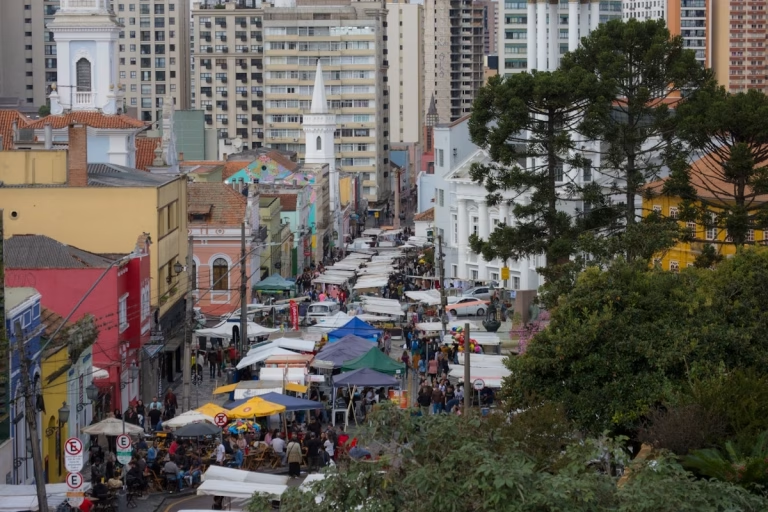

For those who grew up hearing that downtown Florianópolis is “for grandparents,” it’s worth reviewing the map. If you’re between 20 and 35 years old and thinking about living near everything, the traditional core of Santa Catarina’s capital has become a different bet than it was a decade ago.
For years, downtown carried two simultaneous images: traditional commerce with decades-old shops and shuttered buildings, and the perceived unsafety in late afternoon when streets emptied out. That’s the “before” snapshot. The “after” is being built now, with private investment and projects aimed directly at younger residents.
The Downtown That Grandparents Knew
The most direct portrait of that “before” sits in the numbers of vacant properties. Around 120 properties stand empty downtown, and approximately 30% of them are protected as historical heritage, meaning renovation follows specific rules, not just any remodel Source (2026).
Add to that the perception of unsafety that solidified over decades, tied to the emptying out of traditional commerce at night. In recent years, facial recognition cameras and e-bike patrols—the “diciclos”—have begun operating in the central region Source (2026). It’s worth confirming official crime data before treating this as proven decline: what exists on record are the measures underway, not a closed verdict on safety.
Studios Designed for a Different Lifestyle
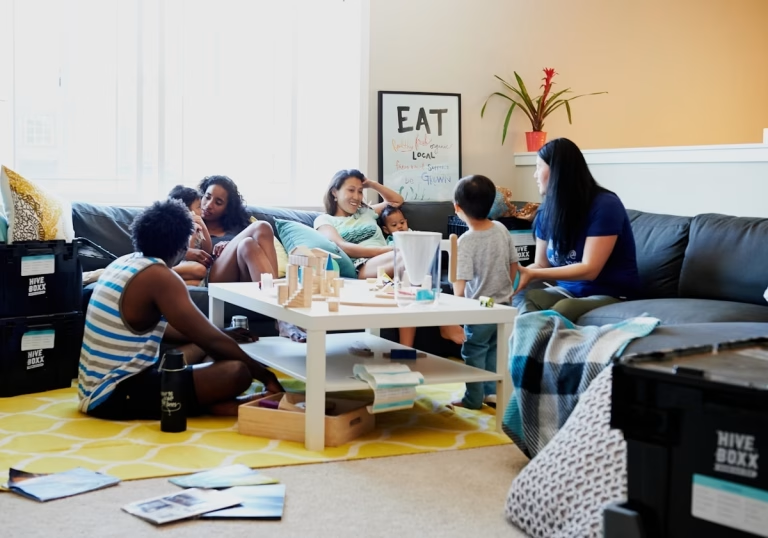
The most concrete answer to “downtown is for grandparents” comes from recent residential launches, designed for someone who works from home, walks everywhere, and doesn’t want a three-bedroom apartment.
ZENN Living Residence offers studios from 30 to 180 m², with coworking space, recording studio, and pet area—a layout that speaks directly to remote workers or content creators. Meanwhile, Armínio 77 bets on even more compact studios, 24 to 43 m², aimed at those who prioritize location over square footage Source (2026).
This is the kind of product that simply didn’t exist downtown until recently, when the residential supply in the region was dominated by old buildings and large floor plans, designed for families who had lived there for generations.
A Street That Became the Symbol of the Shift
If there’s one place to see this transition happening, it’s Rua Bocaiúva. The Bocaiúva Movement brings together more than 15 years of organizing by merchants and residents, mixing traditional commerce with a new food scene—a principle similar to what urban design calls “New Urbanism”: mixing different uses on the same block instead of separating everything by zone.
The most recent symbol of this mix is Casa Hurbana, a space that brings new gastronomy within the same logic of revitalizing the street Source (2026). It’s worth noting that Hurbana’s institutional website is marketing material and should be read with that caveat when used alone, without cross-referencing another source.
The Historic Promenade Is Changing Too
Along with the streets and launches, the most symbolic public space in downtown undergoes retrofit. Rua Felipe Schmidt and Rua Trajano, the city’s historic promenade, are being requalified under CDL Florianópolis leadership, with a symbolic completion target of 2027, marking 50 years of the promenade’s history Source (2026).
The foot traffic cited is 412,000 people per month on Felipe Schmidt, but that number deserves caution: the source doesn’t detail the counting methodology, so treat it as a reference, not hard data.
This retrofit is part of a larger plan: the Masterplan Floripa Centro, developed by Gehl Architects, the Danish firm that’s a global reference in urban design built for people, not cars. The study brings together more than 70 requalification proposals, with R$ 1.2 million in investment coming from private capital, via CDL Florianópolis and ACIF, with no public funds. The plan’s five pillars are sustainable mobility, public spaces and climate resilience, design for children, complete neighborhoods, and balanced tourism throughout the year Source (2026). Final delivery was scheduled for March 2026—it’s worth confirming whether the project has been delivered or updated by the time you read this.
What It Costs Today
For those thinking about living there, prices vary significantly by street. On Beira-Mar Norte, premium products exceed R$ 15,000/m². In the historic core downtown, without renovation, the range sits between R$ 10,000 and R$ 11,000/m², according to Regente Imóveis’ own survey, which is worth cross-checking with another source before treating it as a definitive market reference.
As a backdrop for the city, the FipeZap Index doesn’t break down by neighborhood, but shows Florianópolis with appreciation of roughly 8.65% in 2025 and an average of R$ 12,773/m² in January 2026 Source (2026).
A Parallel That Helps Make Sense of the Movement
It’s worth looking outside Brazil to understand the kind of transformation at play. In Baltimore, United States, the city center went through a similar revitalization process: today, 65% of downtown residents are under 40 years old, property vacancy fell 25%, from 16,000 to 11,871 units, and the city registers the lowest homicide rate in 50 years, with tourism up and US$ 4.3 billion moved by 28.5 million visitors Source (2026).
Baltimore is not Florianópolis, and nothing guarantees downtown will follow the same path. But the case shows that a historic center with a worn reputation can attract a younger crowd when investment, public space, and residential supply shift at the same time.
A Trend, Not a Closed Statistic
It’s tempting to say “young people are moving back to downtown” as if it were proven fact. There is no census research, from IBGE or any other official agency, confirming this shift in age profile downtown Florianópolis.
What exists are qualitative signals pointing the same direction: compact residential launches designed for this crowd, an entire street reorganized around gastronomy and socializing, and news stories documenting the movement. It’s an observed trend, not a closed conclusion, and that’s how it’s worth treating it before deciding to move there.
For those already living in Florianópolis, learn more brings together the full picture of the neighborhood, from cost of living to day-to-day routine.
Frequently Asked Questions
Is Downtown Florianópolis Safe?
Downtown has carried, for decades, a reputation for unsafety tied to the emptying out of commerce at night and degradation of part of the historic region. This perception is shifting as concrete measures are implemented: facial recognition cameras and e-bike patrols now operate in the central area. There are no public statistics yet that prove a drop in crime; what exists, up to now, are actions underway, not a closed verdict.
What Is It Like to Live Downtown Florianópolis Today, Compared to Before?
Before: downtown with unoccupied buildings, around 120 properties, nearly a third of them protected as historical heritage, and traditional commerce in deceleration. Today: a revitalization movement with substantial private investment, including Masterplan Floripa Centro developed by Gehl Architects, and new compact residential launches aimed at those who want to live near everything.
Who Is Paying for Downtown Revitalization, Is It Public Money?
No, at least not in the initiatives mapped here. Masterplan Floripa Centro was financed with R$ 1.2 million in private capital, via CDL Florianópolis and ACIF, with no public funds. The promenade retrofit on Felipe Schmidt follows the same logic, led by CDL. It’s worth confirming whether the project, scheduled to be delivered in March 2026, has actually been completed by the time you read this.
Are There Specific Buildings and Streets Going Through This Transformation?
Yes. One example is the Rua Bocaiúva movement, with more than 15 years of organizing and the Casa Hurbana project, which combines traditional commerce with new gastronomy. There’s also the retrofit of around 120 vacant buildings downtown, with the symbolic target for the revamped promenade in 2027, marking 50 years of Felipe Schmidt as a promenade.
Is It True That Young People Are Moving Back to Live Downtown?
It’s an observed trend, not a proven statistical fact. There is no census research confirming this shift in age profile in downtown Florianópolis. What exists are qualitative signals: compact residential launches designed for this crowd, such as studios with coworking and recording studios, and news reports about a revitalization movement attracting a more diverse crowd. It’s an indicator, not a closed conclusion.
Is There a Similar Case in Other Cities Around the World?
Yes. An interesting parallel—not a promise that it will repeat here—is Baltimore, United States: today, 65% of downtown residents are under 40 years old, property vacancy fell 25% in just a few years, and the city registers the lowest homicide rate in 50 years, with tourism thriving. It’s an example that well-conducted urban revitalization can change the profile and perception of a historic center, but each city has its own trajectory.