Moving from São Paulo to Florianópolis: What Nobody Tells You Before You Go
There is a predictable cycle in conversations about living in Florianópolis. It starts with someone from São Paulo who is exhausted — traffic, noise, cost of living, the feeling that the city is consuming more than it gives back. Someone then suggests Florianópolis. The photos arrive. The WhatsApp group approves. And the decision begins to form around an image: beaches, nature, quality of life, “simpler living.”
Part of that image is real. But there is a difference between what you imagine before you go and what you will find after three months of everyday life. This guide exists to bridge that gap — with respect for your intelligence and without the romanticism of someone selling a destination.
What actually changes — not what you imagine
What improves concretely:
- Commute time drops if you live close to work or work remotely.
- The sensation of urban confinement — that physical and sonic pressure of São Paulo — disappears.
- You have access to quality nature within less than 30 minutes from any point on the island.
- The air is clean. Night noise is lower. The sky is visible.
- The city’s human scale — you can know the bakery owner, recognize the faces of your neighborhood, feel you belong to a specific place.
What worsens concretely:
- You will miss things that São Paulo offers by default — things that are scarce or nonexistent in Florianópolis.
- The cost of living does not drop proportionally to what you expected.
- The job market is smaller, and in many areas, salaries are lower.
- The island has bad traffic days that, because they are unexpected (you were not counting on them), frustrate more than in São Paulo, where bad traffic was part of the normalized routine.
What does not change:
- You will still need money. Florianópolis is not cheap.
- You will still have stress. It changes form, it does not disappear.
- You will still feel professional and financial pressures that you felt before — only now in a smaller city, with fewer urban escape valves.
The traffic nobody mentions
The narrative that “Florianópolis traffic is great compared to São Paulo” is true in absolute terms and misleading in practical terms.
In São Paulo, traffic is bad during practically all hours. You learn to organize your life around it — remote work, alternative schedules, subway. The badness is constant and predictable.
In Florianópolis, traffic is smooth most of the time — and horrible at specific moments. The SC-401 heading north at 8 a.m. can be one of the most frustrating driving experiences in a Brazilian capital of 500,000 people. The bridges connecting to the mainland at 6 p.m. on a rainy day also.
The problem is structural: the island has one exit. When that exit clogs — due to accident, construction, rain, or a beach event — there is no alternative. And in São Paulo, even in the worst traffic, you have the subway as an option.
The most critical hours:
- SC-401 north: 7:30 a.m.–9 a.m. and 5:30 p.m.–7:30 p.m.
- Bridges: 7 a.m.–9 a.m. and 5 p.m.–7 p.m.
- High season (Dec.–Feb.): widespread worsening, especially for northern and eastern beaches
What is changing: The SC-401 is being expanded (60% complete as of May 2026). A bus rapid transit (BRT) line between Trindade and downtown is set to begin implementation in 2026. These are relevant measures, but the structural problem of an island with a single exit cannot be solved by isolated projects.
The practical advice: If you are going to live in Florianópolis and depend on daily commute along these routes, factor in the extra time. Live close to work whenever possible. Consider a bike or motorcycle for short trips within your neighborhood.
Job market: real opportunity vs. romance
This is the most important conversation nobody wants to have.
What is real:
Florianópolis has a genuinely relevant technology ecosystem. There are 6,100 tech companies, 38,000 jobs in the sector, 25% of local GDP — and the city was recognized by federal law as the National Capital of Startups (Law 14.955/2024). ACATE and Sebrae project 100,000 jobs in Santa Catarina’s technology sector by 2027. If you are a developer, product designer, digital marketing professional, data engineer, or startup manager, the local market is growing and has real demand.
What is romance:
Outside of technology and related services, Florianópolis’s job market is significantly smaller than São Paulo’s. If your career is in corporate finance, large-scale business law, manufacturing, high-complexity healthcare, fashion, large agency advertising, or any sector that depends on a metropolis to exist — Florianópolis will have fewer positions, less senior talent available, and often lower salaries for the same experience level.
What the numbers say:
The average income in Florianópolis is R$3,797 per month (IBGE, 2025) — the highest among Brazilian capitals. But this figure includes high-income workers in tech and specialized services who skew the average. The market has income concentration in specific sectors.
The calculation you need to make before deciding:
- Does your career have real demand in Florianópolis?
- If yes: will you be able to find a job with compensation compatible with your background?
- If no: will you be able to get remote work with São Paulo-level income?
- If remote work: does your company allow this arrangement permanently?
An honest answer to these four questions is worth more than any lifestyle guide.
What São Paulo has that Florianópolis will never replicate
Said plainly, because people who make decisions with complete information regret less.
Critical mass of opportunities. São Paulo concentrates the majority of Brazilian large-company headquarters, multinational offices, top-tier law firms, investment banks, major advertising agencies, and innovation hubs with global scale. This is not romance — it is economic fact. Florianópolis can grow significantly and still not replicate this in 20 years.
Cultural agenda at scale. International shows happen first (or only) in São Paulo. Major museums (MASP, Pinacoteca, Museu do Ipiranga), municipal theaters, film festivals, art fairs — São Paulo’s cultural density is unique in Brazil. Florianópolis has a growing cultural scene, but on a different scale.
Complete urban convenience. Delivery in 30 minutes of any product, medical specialists in any sub-specialty with accessible appointments, niche specialty stores, 24-hour services — São Paulo provides this. In Florianópolis, many things arrive later, have fewer options, or simply do not exist.
Genuine ethnic and cultural diversity. São Paulo has communities from practically every culture in the world. Florianópolis is demographically more homogeneous. For those who value diversity as part of daily life, this difference is tangible.
Airport with full connectivity. Guarulhos connects São Paulo to any destination in the world with frequency. Hercílio Luz Airport has grown in flights — but with fewer direct destinations and greater dependence on connections.
What Florianópolis has that São Paulo cannot replicate
Human scale. You can know the bakery owner, recognize the faces of your neighborhood, feel you belong to a specific place. This is not nostalgia — it is genuine quality of life that São Paulo does not offer.
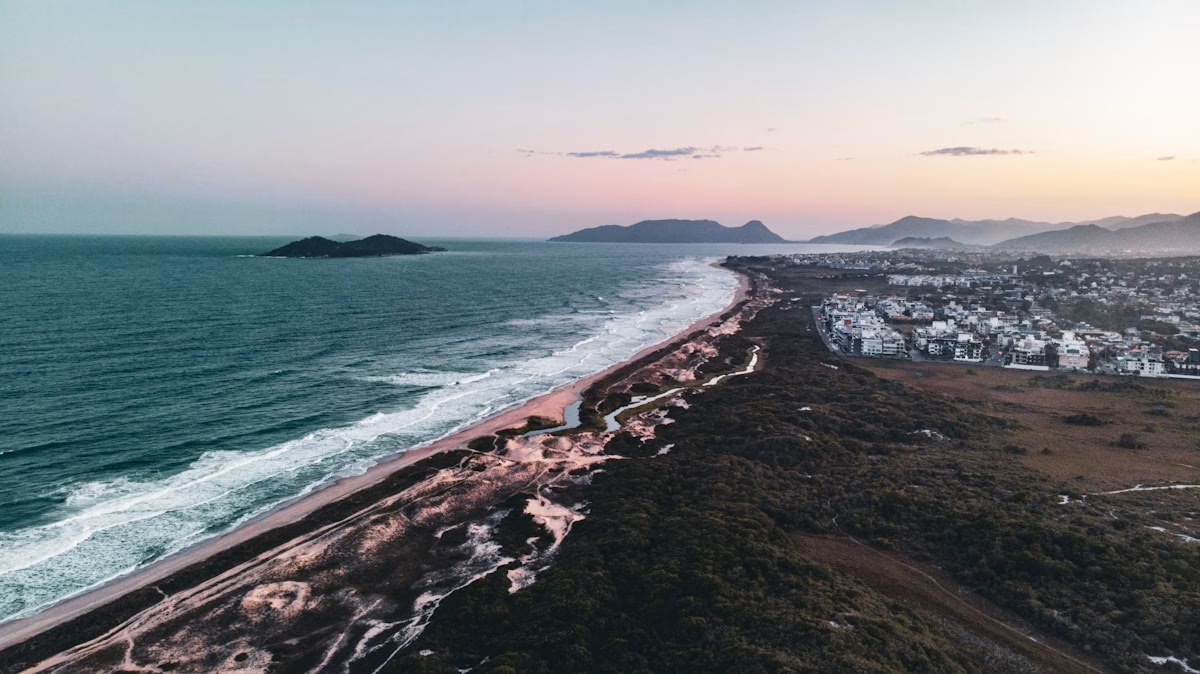
Nature in everyday life. 42 beaches, trails, lagoons, Peri Lagoon Municipal Park — everything is less than 40 minutes from any point on the island. Nature is not a weekend destination: it is part of the daily life of those who live here.
Relative safety. Florianópolis has a significantly lower homicide rate than São Paulo. It is not a crime-free city — there are incidents, especially theft — but the sense of safety in everyday life is genuinely different.
Clean air and quiet nights. The sounds of São Paulo at night are layers of noise: horns, brakes, restaurant air conditioning, construction. In Florianópolis, it is possible to sleep with the window open and hear wind. This seems trivial until you have it back.
Pace of life. Florianópolis has a different rhythm. It is not laziness — it is that people generally are not in a state of permanent urgency. For those coming from São Paulo, the adjustment takes time, but it tends to be positive.
How to plan the transition
What not to do:
- Do not quit everything without guaranteed income unless you have a 12+ month emergency fund.
- Do not rent the first house you find — most people take 3 months to understand which neighborhood fits their routine.
- Do not underestimate the cost of moving plus first month (security deposit, installation, first high grocery bill).
What to do:
- Test before committing. If possible, spend one or two months in Florianópolis before deciding — outside high season, preferably. January with sun is an unrealistic version of the city. July with cold and rain is closer to daily reality.
- Resolve income before resolving housing. If you depend on in-person employment, have at least a formal offer before you move. If you are going to work remotely, confirm with your employer that the arrangement is permanent and in writing.
- Choose school before choosing neighborhood. With children, school determines everything. Waiting lists at the best private schools are long — start this process at least six months in advance.
- Build a realistic budget with 20% margin. Installation costs — security deposit, moving freight, adaptations, equipment left in São Paulo — usually run 30% to 50% higher than people estimate.
- Plan a transition phase. Moving cities is not just logistics — it is social, routine, and identity adaptation. Having a six-month plan with clear milestones (stable income, school settled, definite neighborhood chosen) reduces process stress.
Frequently asked questions
Is it worth trading São Paulo for Florianópolis?
For those with compatible income, remote work or tech jobs, families that prioritize quality of life over career intensity, and who are willing to trade urban convenience for human scale and nature — yes. For those who depend on a conventional job market or cannot accept a pay cut, the math rarely works out.
Is the cost of living in Florianópolis lower than in São Paulo?
For the same standard of living, no. Rent may be lower in equivalent neighborhoods, but the basic groceries (3rd most expensive in Brazil) and bus fare (highest among capital cities) offset part of the difference. For those moving from a wealthy São Paulo neighborhood to a middle-class Florianópolis neighborhood, costs do drop — but so does the standard of living.
How long does it take to adjust?
Most people who make the move with guaranteed income report adjustment between 3 and 6 months. The first month is usually difficult — the neighborhood is wrong, routines don’t yet exist, friends are in São Paulo. Between the third and sixth month, those who will adapt do adapt. Those who want to return also know by then.
Is it possible to keep a São Paulo salary while living in Florianópolis?
Yes — if you work remotely for a São Paulo company, for an international client, or have a digital product or service with São Paulo customers. This is the profile of greatest success in the transition: São Paulo-level income with Florianópolis cost of living.
What if I regret the move?
Reversibility is real — you can go back. But planning the move carefully reduces the probability of regret. The biggest mistake reported by those who regretted the move is having based the decision on aesthetics (photos, vacations) without testing the actual routine.
Florianópolis grows a lot in summer — does that get in the way?
High season (December–February) triples the population of some areas. Service prices rise, traffic worsens, loud nightclubs appear. For families with children, high season is a period of caution around tourist beach areas. More residential neighborhoods far from popular tourist beaches (Agronômica, Córrego Grande, Coqueiros) suffer less.
What is the biggest regret of those who moved back to São Paulo?
According to recurring reports in forums and migration groups: underestimating the local job market and the network of contacts left behind. Florianópolis is a smaller city — the network of influence you built in São Paulo does not transfer automatically.