When people think of Florianópolis, corporate business and events typically don’t come to mind. Neither does religion, rowing, or a reserved seat at a UNESCO-branded gastronomy festival. The image that dominates the public imagination, and the majority of what Google returns for “tourism in Florianópolis,” is summer vacation: beaches, a three- to five-day itinerary, the most visited tourist landmark, the best time to visit. That itinerary exists and remains valid. But it’s just one slice of what the island offers.
This guide starts from a comparative lens: on one side, traditional beach tourism, which dominates searches and pre-packaged itineraries; on the other, six qualified niches that sustain Florianópolis year-round, each with its own audience, infrastructure, and calendar. Understanding this plurality matters even for those who will never hike a trail or row, because those who relocate to the island because of one of these niches tend to seek homes near what brought them here in the first place.
What Google Already Answers Well, and What It Doesn’t Cover
The most-searched questions about tourism in Florianópolis are predominantly practical itinerary-based: what to do in three, four, or five days, what the typical food is, which place is most beautiful, when is the best time to visit. Guides like Tripadvisor, Melhores Destinos, and Viator cover this territory well.
None of these guides, however, address business tourism, religious tourism, sports tourism, or cultural tourism as a distinct axis of the city. It’s not a research oversight—it’s a genuine content gap. The six niches below fill that space.
1. Business and Event Tourism
Florianópolis has solidified itself as a hub for corporate events and technology, hosting events such as DWX and the Startup Summit. The technology sector accounts for roughly 25% of the local economy, placing the city among the national leaders in this metric Floripa.com (2026).
⚠️ Worth confirming before repeating specific figures: corporate tourism in Brazil hit a record R$ 6.06 billion in spending between January and May 2026, 10% above the same period in 2025 Floripa.com (2026). ⚠️ Santa Catarina also received 565 thousand international tourists in 2025, surpassing the total from the prior year, representing 66% growth Floripa.com (2025). These figures have a short shelf life; check the source before reusing in other content.
The centerpiece of this machinery is CentroSul, built in 1999 and named by Embratur as Brazil’s best convention center. It houses a main auditorium for 2,560 attendees plus nine additional meeting rooms. Major events pass through here, such as Construsummit, Brazil’s largest construction industry management and technology event, which generates roughly three thousand business opportunities, and Encatho & Exprotel, reaching its 36th edition in 2026 CBIC (2025).
2. Gastronomy Tourism
Florianópolis has been part of UNESCO’s Creative Cities Network in the Gastronomy category since December 2014 UNESCO (2014). It’s worth being careful with the phrasing: it is not “World Heritage” (a term that refers to UNESCO’s World Heritage List, which the city does not belong to) and it is not the only Brazilian city with this designation. Paraty, Belém, and Belo Horizonte are also UNESCO Creative Cities for Gastronomy.
The concrete foundation of this recognition includes being Brazil’s largest oyster producer, with signature dishes like shrimp, mullet, and oyster. The culinary scene has also grown beyond seafood: Korean, Thai, Indian, and Asian cuisine restaurants are spread throughout the city NSC Total (2025). [verify] the existence of a dedicated German cuisine establishment in the city has no source confirming a specific restaurant.
3. Ecological Tourism
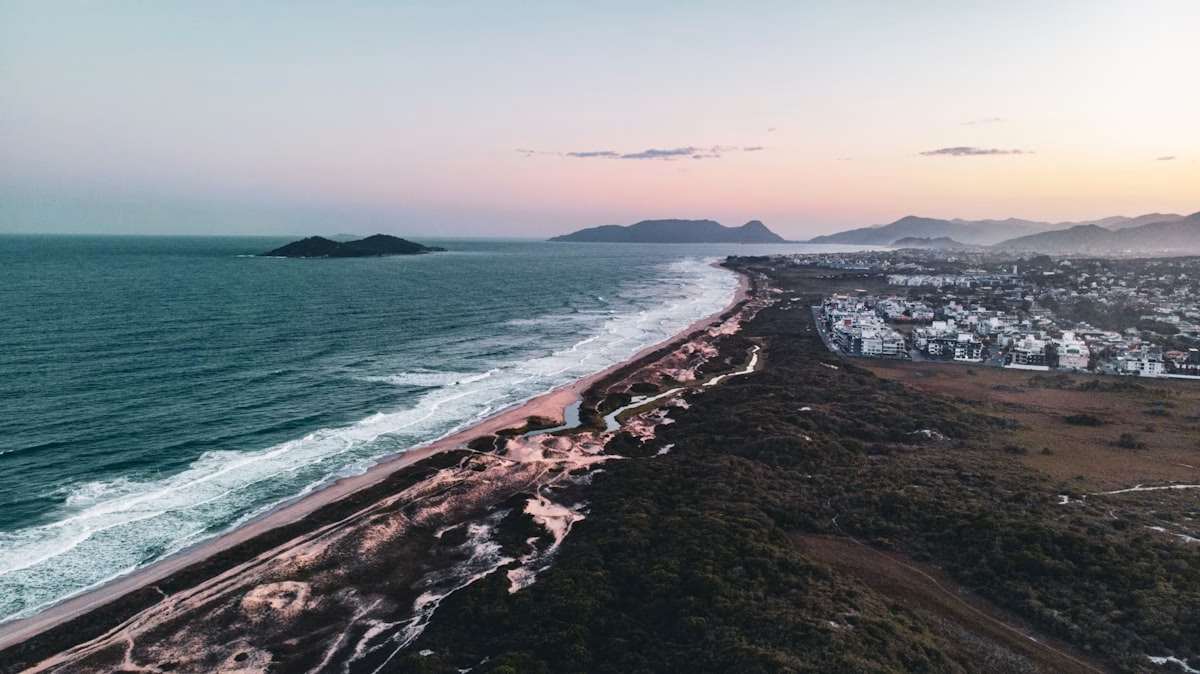
This is the niche closest to what traditional guides already cover, though rarely as its own category: trails, dunes, waterfalls, and more than 40 beaches distributed across the island form the physical foundation of ecotourism in Florianópolis. [verify] specific quantitative data, such as the number of conservation units or area of Atlantic Forest preserved, was not gathered in this research.
4. Religious Tourism
Two fronts sustain this niche. The first is the Catholic heritage from Azorean colonization: Paróquia Santíssima Trindade, with construction beginning in 1830, and Paróquia Santo Antônio de Lisboa, connected to the historic fishing communities of Cacupé, Sambaqui, and Barra do Sambaqui Archdiocese of Florianópolis.
The second is the Brazilian Way of St. James (Caminho Brasileiro de Santiago de Compostela), and here precision matters. It is not true that Florianópolis has “the only Way of St. James outside Spain”: well-established routes have existed in France and Portugal for centuries, some of them UNESCO World Heritage sites. What is true and documented is more specific: since February 7, 2017, the Florianópolis section—approximately 21 km between Canasvieiras and the Shrine of the Sacred Heart in Ingleses, passing through four churches—is the only stretch in Latin America officially recognized by the Cathedral of Santiago de Compostela as an extension of the historic pilgrimage route NSC Total (2025), Gazeta do Povo (2025).
[verify] institutional presence and geolocation of international Christian movements such as Bethel SOZO or Hope Church specifically in Florianópolis; national presence is confirmed, but no local unit was identified in this research.
5. Sports Tourism
The 2025 Floripa International Marathon brought together between 19,100 and 19,200 athletes registered across 42 km, 21 km, and 5 km races, with 15,439 finishers, growth compared to the 16,500 registered in 2024. The event reinforces the city’s image as a national sports benchmark ND+ (2025).
The rowing tradition is also longstanding, though it deserves a correction: the founding and historically traditional clubs of the city are three, not four: Clube Náutico Riachuelo (1915), Clube Náutico Francisco Martinelli (1915), and Clube de Regatas Aldo Luz (1918), founders of the Santa Catarina Rowing Federation in 1919 ND+ (2025). A mention of “four clubs” in another report refers to the composition of the current state championship, not the historical founding clubs.
In wind and water sports, Floripa has roughly 250 days per year favorable to kitesurfing, around 70% of the year, with beginner spots at Lagoa da Conceição and advanced-level spots at Praia Mole Guia Floripa. Sandboarding, a variation of snowboarding, has documented origins in the city in the 1980s Litoral de Santa Catarina. [verify] presence of combat sports or board games, while plausible, lacks quantitative data gathered in this research.
6. Cultural Tourism
This is the least documented niche in this research. [verify]: the theme appears in the original thesis as part of the plurality of tourist profiles on the island, but the source report did not bring data on film festivals, event calendars, or architectural heritage. A complementary research round is necessary before any specific factual claims about this point.
What This Plurality Says About Living in Florianópolis
Each of these six niches attracts a different visitor profile, and often a different future resident profile. Those who come to CentroSul for work, those who walk the Way of St. James, those who train in rowing or kitesurfing, those who participate in the gastronomy scene: all tend to seek homes near what brought them to the island. Understanding this plurality of tourism forms is also understanding the plurality of those who choose to live here.
Frequently Asked Questions
What is there to do in Florianópolis beyond the beaches?
Florianópolis is known for summer vacation, but the city has far broader tourism profiles: business and corporate events, internationally recognized gastronomy, ecotourism, religious tourism, wind and water sports, and its own cultural agenda. Each of these niches has a concrete foundation in the city—it’s not just beaches.
What is the ideal itinerary for 3, 4, or 5 days in Floripa?
That varies with the profile of the visitor, but the most sought-after stops include the major viewpoints and beaches, local gastronomy, and boat tours. Since this is the area most covered by traditional tourism guides, the focus of this guide is precisely what those guides don’t tell you.
Does Florianópolis have UNESCO recognition?
Yes, since December 2014, Florianópolis is part of UNESCO’s Creative Cities Network in the Gastronomy category. It is not “World Heritage” (an incorrect term) and is not the only Brazilian city in this category: Paraty, Belém, and Belo Horizonte also hold the same title.
Is it true that Florianópolis has the only Way of St. James outside Spain?
Not exactly. Routes of the Way of St. James have been well established in France and Portugal for centuries. What is true is more specific: since 2017, the Florianópolis section, 21 km between Canasvieiras and Ingleses, passing through four churches, is the only stretch in Latin America officially recognized by the Cathedral of Santiago de Compostela as an extension of the historic pilgrimage route.
Does Florianópolis have relevant business tourism?
Yes. The city is a hub for corporate events and technology, hosting events such as DWX and Startup Summit, and houses at CentroSul, named by Embratur as Brazil’s best convention center, major events like Construsummit and Encatho & Exprotel.
Is there religious tourism in Florianópolis?
Yes, with two main fronts: historic parishes such as Santíssima Trindade, dating to 1830, and Santo Antônio de Lisboa, linked to Azorean colonization, and the Way of St. James, with official recognition since 2017.
Does Florianópolis have a strong sports scene for visitors?
Yes. The 2025 Floripa International Marathon brought together roughly 19,000 athletes. The city also has a strong rowing tradition with three founding clubs—Riachuelo, Martinelli, and Aldo Luz, founded between 1915 and 1918—and is a national hub for kitesurfing, windsurfing, and sandboarding, a sport said to have originated in the city in the 1980s.