
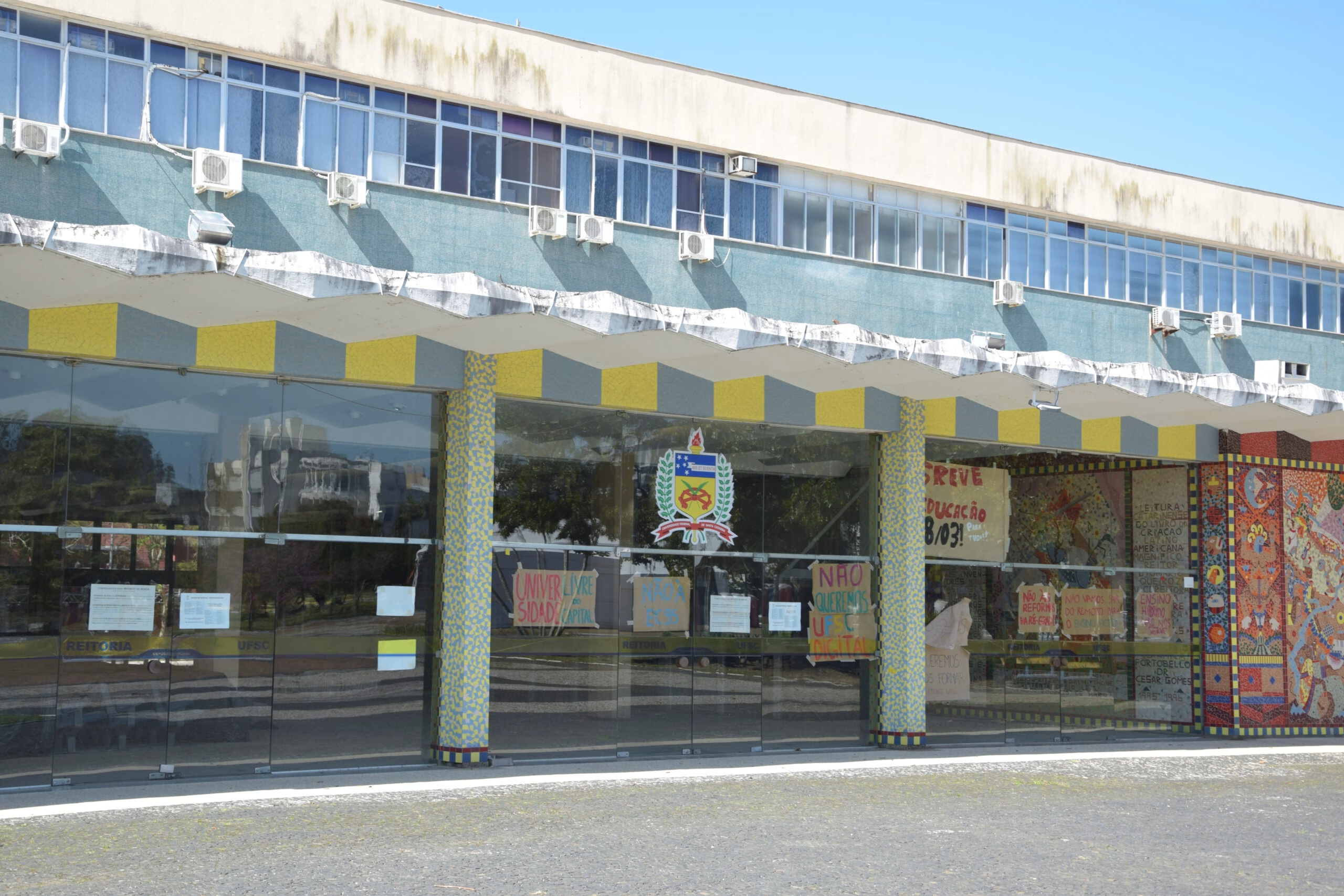

You passed the UFSC entrance exam — congratulations. Now comes another test, quiet and full of deadlines: enrollment. Between online registrations, document submissions, quota verification, and spot confirmation, the process can feel like a maze if you don’t know what to expect at each stage. This guide is designed to help you navigate each phase without missing deadlines or second-guessing what to send, when to send it, and what comes after official enrollment. It also covers what you need to know about housing, transportation, and university life in Florianópolis.
Stage 1 — Initial Registration at COPERVE
COPERVE (Comissão Permanente do Vestibular) is the UFSC office responsible for the entrance exam process and the first stages of enrollment. After your results are announced and you confirm you’re on the call list, you must complete your initial registration within the deadline specified in the official notice — typically between two and five business days after being called.
What to do at this stage
- Access the online enrollment system indicated in the official notice (usually available on the UFSC portal).
- Fill in your registration information: full name, CPF (Brazilian taxpayer ID), date of birth, address, phone number, and active email.
- Indicate your admission category — general admission, racial quotas, socioeconomic quotas, or person with disabilities (PwD).
- Confirm your major and enrollment campus.
- Generate and save your protocol number or registration receipt — you’ll need it for the next stages.
Pay close attention to your registered email: all official communications about deadlines, pending items, and enrollment confirmation arrive there. Use an address you check frequently and also check your spam folder.
Dates and deadlines
Dates vary with each entrance exam cycle. For the 2026 unified entrance exam, check the official calendar published at UFSC Entrance Exam Guide. Missing the initial registration deadline counts as declining your spot — there is no automatic reinstatement.
Stage 2 — Document Submission
After initial registration, you’ll have a deadline (typically between three and seven business days) to submit required documents. Submission is done through the same online system, in digital format (PDF or high-resolution image).
How to submit correctly
- Scan documents at high resolution — images with cut-off or illegible text will be rejected and require resubmission within the deadline.
- Name files clearly, following the system’s instructions (e.g., cpf_joaosilva.pdf).
- Upload each document in the correct category within the form — avoid attaching everything to one file if the system requires separation.
- After submission, save the receipt for each document the system confirms receiving.
Documents with specific requirements
High School Transcript: must be the original document issued by your school, signed and stamped by the responsible official. Simple digital copies may not be accepted — check the official notice to see if certification is required.
High School Completion Declaration: accepted for candidates still awaiting their official diploma, but with a deadline to replace it with the diploma once issued.
Stage 3 — Verification and Enrollment Confirmation
After document submission, COPERVE (or your program’s coordinating office, depending on the process stage) reviews your documentation. This can take between three and fifteen business days, depending on enrollment volume and document completeness.
Possible outcomes
- Enrollment confirmed: you receive an email or system notification with confirmation and instructions for class start.
- Document pending: the system identifies the problematic document and opens a resubmission window. Watch your registered email closely.
- Document rejected: in cases of serious inconsistency (altered documents, conflicting information), enrollment can be canceled and the case referred for investigation.
After confirmation, you’ll receive your UFSC enrollment number (MATR), which serves as your identifier across all institutional systems — from the student restaurant to the course registration portal.
Required documents by admission category
Required documentation varies by admission type. The list below consolidates the most common documents; the entrance exam official notice is the definitive source.
General admission
- ID (or driver’s license, passport, or other government-issued photo ID)
- CPF (Brazilian taxpayer ID)
- Birth or marriage certificate
- High school transcript (original or certified)
- High school diploma or completion declaration
- Recent passport-style photo (3×4, or digital upload per instructions)
Socioeconomic quotas (income-based)
In addition to general admission documents:
- Family gross income declaration (paycheck stubs, employer certification, self-employment declaration, CNIS transcript for retirees/pensioners)
- Family composition declaration signed by all adult members
- Proof of residence from the last three months
- For informal income: declaration prepared per UFSC template, requiring notarization
Racial quotas
In addition to general admission documents:
- Self-declaration of race/ethnicity, per UFSC form
- High-resolution photo for review by the verification committee (in-person or video interview, per official notice)
Person with disability (PwD)
In addition to general admission documents:
- Medical report (issued within the last two years) with diagnosis code (CID), disability description, and physician signature with medical license number (CRM)
- Report of specific educational needs, when applicable
Housing in Florianópolis — where to live near UFSC
UFSC is located in the Trindade neighborhood, in the central part of the island. The location is convenient from most parts of the city, but the rental market around campus is competitive and prices reflect that. Learning about nearby neighborhoods helps you find a balance between cost, distance, and quality of life.
Trindade — on campus
Living in Trindade means being ten minutes on foot from any building in the technology center or central campus. Convenience has a price: studios and rooms in shared student houses in Trindade typically rent between R$1,200 and R$2,200 per month (per-person rates for shared housing or individual studios), depending on quality and exact distance from campus. For those who will use the university intensively and prefer not to rely on public transit daily, it’s the most practical neighborhood.
Carvoeira and Pantanal
Adjacent to Trindade, Carvoeira and Pantanal offer slightly more affordable prices and a more residential feel. Distance to central campus ranges from fifteen to twenty-five minutes on foot or five to ten minutes by bike. A good option for those who value quiet surroundings without sacrificing proximity.
Córrego Grande
The Córrego Grande neighborhood is a calm residential area, less than two kilometers from campus. Student rental options are fewer than in Trindade, but the cost per square meter is typically lower and quality of life is high. Ideal for those preferring a quieter environment and comfortable with biking or bus commutes.
Itacorubi and Santa Mônica
Itacorubi borders Trindade along Avenida Madre Benvenuta and holds the part of academic life that does not fit on the main campus: UDESC (ESAG and CEART) sits on Madre Benvenuta itself, while UFSC’s CCA and SENAI-SC are on Rodovia Admar Gonzaga. If your program is at the CCA, or you plan to take courses at UDESC, the daily commute is shorter from here than from Trindade. The neighborhood is also an institutional hub — CELESC, EPAGRI, CEPON and FIESC — which keeps street-level business active through the week. Five bus lines connect directly to TICEN, and line 233 runs through Santa Mônica on its way to UFSC.
Santa Mônica suits a different profile than the incoming undergraduate: professors, university staff and graduate students with steady income, often arriving with family. It is a residential neighborhood with few studios or shared-house rooms on offer — what comes up for rent is usually a whole apartment, in far smaller numbers than in Trindade. If you are coming for a work contract at the university rather than for a semester, the math changes and the area is worth putting on your list.
Shared house or private apartment?
For most students arriving in Florianópolis without their own income, a shared student house is the most viable option: shared expenses, easier social adjustment, and typically includes internet, utilities, and common-area cleaning in the negotiated rent. A private apartment makes more sense for those with stable income, preference for privacy, or bringing a partner. Also factor in the initial setup cost: an empty studio requires investment in furniture and appliances that significantly increases your first month’s budget.
To see available options, check rental properties in Trindade on Regente’s updated portfolio.
First steps beyond enrollment
Enrollment confirms your spot. What comes next defines how you’ll make the most of your UFSC years.
University Student Restaurant (RU)
UFSC’s student restaurant offers subsidized meals for regularly enrolled students. The cost is significantly below market rates and nutritional quality is monitored. To access it, you’ll need registration at the Student Affairs Office (PRAE) — completed after enrollment confirmation. Student restaurants operate on the main campus (Trindade) and the Ararangua campus.
Email and institutional access
After enrollment confirmation, you’ll receive login credentials for the CAGR system (undergraduate portal) and your institutional email @grad.ufsc.br. Keep these credentials safe: they grant access to the course registration portal, academic transcripts, service requests, and library systems.
University Library (BU)
The Central University Library is on the Trindade campus with both physical and digital collections. Access to digital content (journals, e-books, databases like CAPES/Portal) is through institutional login. Activate your account in your first week — many instructors assign articles and books only available through institutional access.
DAAC — Academic Administration Office
DAAC handles formal academic matters: course credit recognition, course withdrawal, transcripts, and major changes. Before visiting in person, check whether services are in-person or available online — most requests can be submitted through the CAGR portal.
University transportation
UFSC operates an internal shuttle service between campuses and peripheral parking areas. For those coming from outside Trindade, the municipal public transit integration card (Floripa Bus Card) offers student discounts on bus routes after registering with proof of active enrollment.
Transportation — getting to UFSC from major neighborhoods
Florianópolis still relies heavily on buses for public transportation. For students, knowing the routes and rush-hour schedules makes a real difference in daily life.
From Downtown and Agronômica
Several bus lines serve the campus from Downtown and TICEN (Downtown Integration Terminal). Travel time is fifteen to twenty-five minutes outside rush hour. By bike, using the cycle path on Av. Madre Benvenuta, the time is similar with the advantage of not depending on schedules.
From the North Shore
From neighborhoods like Ingleses, Canasvieiras, or Jurerê, the bus ride to campus can take 45 minutes to an hour and a half, depending on transfers. For students living in the North with full schedules, daily commuting is a significant factor in your housing decision.
From the mainland (São José, Palhoça)
The Mainland Integration Terminal (TICEN) is the main connection point from São José or Florianópolis’s mainland. From there, direct buses reach campus in an additional fifteen to twenty minutes. Using ride-hailing apps during off-peak bus hours can be an economical option for those living farther away.
What’s happening in Trindade this week
Beyond academics, the neighborhood has active cultural and dining programming. See what’s happening in Trindade this week to discover markets, events, and leisure options in the campus area.
Frequently asked questions about enrollment and UFSC life
When does UFSC enrollment open?
The calendar varies by admission process (ENEM/SiSU, unified entrance exam, transfer). Generally, enrollment calls go out between January and February for the first semester, and June and July for the second. Dates are published in the official notice for each process and on the official COPERVE website. Always consult official sources — third-party information may be outdated.
What if I miss the enrollment deadline?
Missing the deadline typically counts as declining your spot. UFSC then calls the next candidate on the waitlist. There is no automatic appeal — you’d wait for the next call (if any) or try the entrance exam again. That’s why you need to monitor your registered email and the official portal daily during the enrollment period.
Does UFSC offer student housing?
Yes. UFSC maintains Student Housing, managed by PRAE, for students with documented financial hardship. Spots are limited and demand exceeds supply — selection considers family income, distance from your hometown, and other criteria set by official notice. To apply, you must be enrolled and submit socioeconomic documentation by the deadline. Detailed information is available on the PRAE website.
What documents are required for socioeconomic quotas?
For income-based quotas, you must prove your family’s gross monthly per-capita income does not exceed 1.5 times the minimum wage. Required documents include: income documentation for all household members with income (paycheck stubs, tax returns, CNIS transcripts for retirees/pensioners), a family composition declaration, and proof of residence. For informal income, UFSC accepts declarations signed and notarized at a notary office. The official template is available on the COPERVE portal or from your program office.
The time has come to turn your entrance exam success into a real presence at the university. If you’re looking for housing near UFSC, Regente has properties around campus — from rooms in shared student houses to apartments — with professional brokerage and no unnecessary bureaucracy. Check rental properties in Trindade and find the right option to start your university life well in Florianópolis.