Five hundred meters separate the Pantanal neighborhood from the south gate of UFSC campus. On foot. This is the data point the market was slow to price in — and now begins to appear in the spreadsheets of those looking for a property along the university corridor of Florianópolis. Pantanal doesn’t have the same fame as Trindade, it doesn’t have the same commercial offerings, and that’s exactly why an entry window still exists here.
Where Pantanal Is and What the Neighborhood Looks Like Today
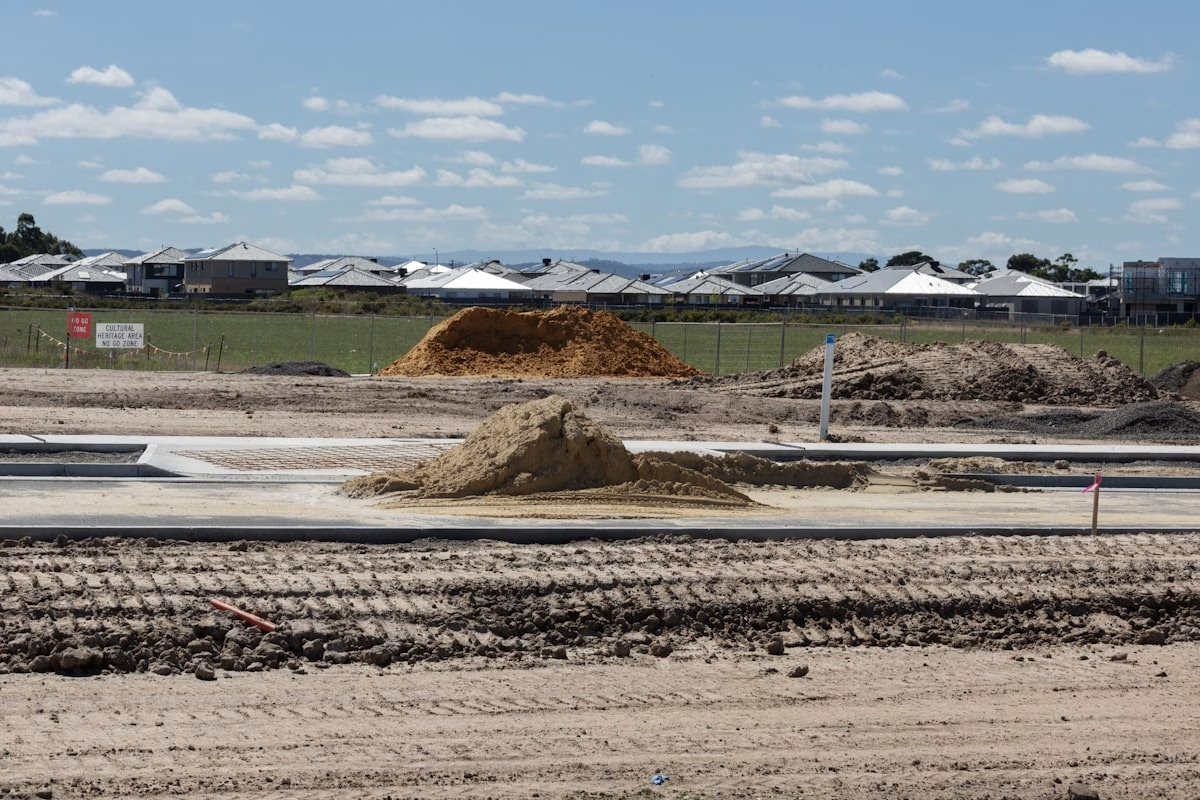
New residential construction in a neighborhood under development near a university
Photo by Troy Mortier on Unsplash
Pantanal is located on the central corridor of Florianópolis, between UFSC to the east, Itacorubi to the north, and Córrego Grande to the south. The location is quietly strategic: the neighborhood isn’t on a high-traffic expressway, doesn’t have the concentrated movement of a commercial avenue, but has direct access to the most important university campus in the South region of Brazil.
The neighborhood has the feel of a small interior town — one- and two-story homes coexisting with some older buildings, streets with reasonable tree cover, light traffic on internal roads. The density is low by university corridor standards. This low density is, at the same time, what keeps away those who want a sidewalk full of bars and what attracts those who want to sleep without noise.
The neighborhood’s historical profile is one of university professors, researchers, and graduate students. People who need quiet to work and who don’t want to depend on a car to reach UFSC. This DNA is still present on the streets, but is beginning to be challenged by new profiles as the neighborhood appears on the real estate market’s radar.
Distance to UFSC: Closer Than It Seems
Trindade has UFSC attached to its facade. That’s the argument that justifies the high price there. What most people don’t know is that Pantanal has access to the campus via the south gate, 0.5 to 1.5 kilometers away depending on the specific address within the neighborhood.
On foot, the shortest trip from Pantanal to the south gate of UFSC campus takes between 6 and 18 minutes. By bike, half that. For an undergraduate or graduate student, this distance is compatible with daily commuting at zero transport cost.
The most honest comparison isn’t Pantanal versus Trindade. It’s Pantanal versus other neighborhoods people consider “close to UFSC” and that are much farther away in practice. Pantanal delivers real access to campus at a price the market hasn’t yet corrected.
Why Pantanal Is on the Real Estate Market’s Radar
Florianópolis’s university corridor has an inventory shortage. Trindade is saturated — rent jumped 26% in 12 months and reached R$ 59/m², according to FipeZAP. Someone arriving in town looking for an apartment near UFSC with a budget of R$ 1,800 or R$ 2,000 won’t find what they want in Trindade. The market begins to look around.
Pantanal still doesn’t have consolidated data on FipeZAP. In practice, this means the price hasn’t yet been pushed up by speculative demand. The window exists precisely because the data isn’t yet on everyone’s spreadsheet.
The most concrete signal of this change is the Max 177, a development launched on Rua Frederico Veras, 177, in Pantanal. These are studios of 20 to 30 m², starting from R$ 349,000, with HOA fees below R$ 200/month. The project includes a rooftop pool, coworking space, 24-hour laundry, and 24-hour mini market — convenience infrastructure designed for those who work and study at an intense pace. When a development with this level of product appears in a neighborhood, it’s because whoever did the math already saw the demand coming before the broad market. Learn the details of Max 177.
Florianópolis has more than 6,100 technology companies and 38,000 direct jobs in the sector, according to ACATE. In 2024, the city was recognized as Brazil’s National Startup Capital. The tech hub has grown mainly along the corridor that runs through UFSC and expands into adjacent neighborhoods. Pantanal is on that corridor. Technology professionals working remotely, researchers, entrepreneurs — all need an address that combines quiet, connectivity, and quick access to campus. Pantanal meets all three criteria.
Profile of Who Lives in Pantanal
Panoramic view of a residential neighborhood with urban park and buildings around
Photo by Alex Reynolds on Unsplash
Pantanal has never been a first-year undergraduate neighborhood. The bar scene, the apartment shared with four people, the line for the copy shop at 7 a.m. — that’s Trindade. Pantanal has always attracted a different profile.
Professors who work at UFSC and want to walk to class. PhD researchers who need quiet to write. Childless couples who want to pay less than Trindade without sacrificing location. Technology professionals working from home who leave the house only a few times a week.
This profile is beginning to diversify. The new development in the neighborhood attracts investors who previously put money in Trindade and now seek lower entry price with greater appreciation potential. It also attracts first-time homebuyers who can no longer access Trindade within their budget. Pantanal is, in practice, undergoing a quiet transition from a consolidated neighborhood to one in expansion.
Infrastructure and Daily Life
Pantanal doesn’t have the same commercial offerings as Trindade. This is the most honest point that needs to be in this guide. The neighborhood has bakeries, small markets, pharmacies, and basic proximity services, but for dining out with variety or large supermarket shopping, displacement to neighboring areas is necessary.
The good news is the surrounding area solves this gap easily. Itacorubi, adjacent to the north, has infrastructure in expansion. Córrego Grande, to the south, has a more developed commercial profile. Trindade is just a few minutes away by car or bike for those who need broader options.
The neighborhood has public schools in the area and reasonable access to public transportation to the downtown and Downtown Terminal (TICEN). For those using a bike as their main transportation, the flat topography of the region facilitates daily commuting.
Pantanal vs. Trindade: What Changed in the Math
Trindade is still the reference. But the math is changing.
Rent in Trindade has reached R$ 59/m² with a 26% increase in 12 months. For a 45 m² apartment, that represents R$ 2,655/month. The purchase market in Trindade reflects the same pressure: high competition, low inventory, prices rising faster than most buyers’ income.
Pantanal offers an alternative with equivalent access to campus at a price that hasn’t yet been corrected. The nearest reference neighborhoods — Córrego Grande at R$ 51.60/m² and Itacorubi at R$ 52.60/m² — give an idea of the price level in the region. For purchase, Max 177 starts at R$ 349,000 with HOA fees below R$ 200/month, an entry price that today doesn’t exist in Trindade for equivalent product.
Market logic is simple: when the most sought-after destination saturates, the neighbor appreciates. It happened with Trindade relative to Pantanal, Itacorubi, and Córrego Grande. Now the wave reaches Pantanal with more force than the other two, because of the proximity to the south gate of the campus.
See also the Itacorubi neighborhood guide and the comparison of rental prices in Florianópolis to understand the complete map of the region.
FAQ
Is Pantanal close to UFSC?
Yes. The south gate of UFSC campus is 0.5 to 1.5 kilometers from Pantanal, depending on the address. On foot, the shortest trip takes 6 to 18 minutes. By bike, less than 10 minutes from any point in the neighborhood.
Is rent in Pantanal cheaper than in Trindade?
Pantanal’s data are still being consolidated on FipeZAP, which is an indicator that the price hasn’t risen at the same speed as Trindade. The adjacent neighborhoods, Córrego Grande and Itacorubi, range between R$ 51 and R$ 53/m² in rent, versus R$ 59/m² in Trindade. Pantanal tends to operate within that range.
Is Max 177 a good investment?
It depends on the goal. For rental income, the university demand and technology professionals along the UFSC corridor is consistent. The entry price starting from R$ 349,000 with HOA fees below R$ 200/month offers lower entry and maintenance costs than equivalent products in Trindade. For resale, future appreciation depends on how quickly the neighborhood consolidates new developments and commercial activity.
Is the neighborhood safe?
Florianópolis is Brazil’s safest capital, with a rate of 10.73 homicides per 100,000 inhabitants in 2025. Pantanal has a quiet residential profile, low nighttime traffic, and little bar movement. Residents’ perception of safety is positive.
Does Pantanal have public transportation to downtown?
Yes. There are bus lines connecting Pantanal to TICEN and downtown. For those using a bike, the flat region facilitates commuting. For UFSC campus, on foot or by bike is the most practical option.
Can families with school-age children live in Pantanal?
Yes, with planning. The neighborhood has public schools in the area. For more private school options, neighboring areas expand the offerings. The neighborhood’s quiet and the lower volume of internal traffic are advantages for families with children.
To understand the rental market near UFSC and see the complete guide to neighborhoods in Florianópolis, links are on the Regente blog.
Meet the Developments in Pantanal with Regente
Pantanal is in a position that Trindade was in ten years ago: good location, growing demand, price not yet corrected. For those who want to enter the university corridor with appreciation margin ahead, now is the time.
See the available apartments in Pantanal, learn about Max 177, and speak with a Regente consultant to analyze the best option for your profile.