You have built wealth with your family in mind. Now you face a decision unlike previous ones: where your parents will grow old, where your children will grow up, and how to keep three generations close without turning the house into a crisis when an emergency happens.
The real-estate market has a ready-made answer. It calls almost any large apartment with a ramp at the entrance and slightly wider doors “multi-generational.” The label sounds appropriate, but it hides a gap that only appears at the worst possible moment—when an elderly person needs to be carried down on a stretcher and the elevator cannot fit the stretcher.
This guide separates what the market sells under the name multi-generational from what actually solves the problem of a three-generation family. It is a technical checklist, with standards, numbers, and sources. By the end, you will have the exact questions to filter real property from marketing label.
The Myth: “Any Apartment with a Ramp Is Already Multi-Generational”
This is the starting point of the confusion: the idea that an access ramp, wide door, and any elevator are enough to house three generations.
An access ramp is a minimum requirement of ABNT NBR 9050, the accessibility standard that every multifamily residential building already must comply with by law. The same applies to the 0.80 m door, which is the minimum opening for wheelchair passage, and to the staircase handrail.
An apartment that presents these items as “multi-generational” is selling a legal obligation as a benefit. It is equivalent to selling a car by highlighting that it has a seatbelt.
Basic accessibility solves the everyday needs of someone with reduced mobility, but it does not cover a health emergency. And the emergency is precisely what defines whether a property works for three generations.
The Truth About the Elevator: Standard Residential Does Not Fit a Stretcher
Here the myth collapses with a tape measure.
The standard residential elevator has a cabin approximately 0.90 m × 1.20 m. It fits a wheelchair, but not a hospital stretcher, whose typical length is around 2 m (exact measurement to confirm with manufacturer). The stretcher simply does not fit.
For stretcher transport to be possible, ABNT NBR 14712, the standard for hospital stretcher and bed elevators, defines a minimum cabin of 1.20 m wide by 2.20 m long, with door opening of 1.10 m. For a hospital bed, dimensions increase to 1.50 m × 2.20 m.
The difference is concrete. In a cardiac or neurological crisis, the patient needs to descend lying down, monitored, without being moved abruptly. When the elevator cannot fit the stretcher, the alternative is the staircase, on a transport chair, and the family loses minutes that a heart attack or stroke’s therapeutic window does not give back.
The objective question to the developer is just one: “What is the internal dimension of the elevator cabin, in meters, and which standard does it meet?” Demand the number. The answer “it is accessible” is not enough.
The Truth About the Oxygen Point: Anticipating Work You Do Not Want to Do Later
Common diseases in old age require oxygen at home. COPD, heart failure, and post-operative recovery from major surgeries frequently require prolonged home oxygen therapy.
An oxygen point is the pre-installation of medical oxygen gas (GOM) tubing embedded in the wall, similar to a kitchen gas outlet, sized for medical use. With it, the doctor prescribes, the supplier connects the equipment, and the elderly person is treated the same day.
Without it, later installation means breaking walls, running tubing, and in many cases obtaining condominium approval. It is work in the house, with a sick elderly person inside.
The constructive pre-installation has no own NBR standard, but follows the standards for medical gas installation (ABNT NBR 12189 and NBR 13543). It is a differentiator of anticipation: it solves today, in the project, what would be expensive and stressful to solve later.
The Truth About the Concierge: What the Doorman Does and What Protocol Does
A condominium with a doorman has surveillance and access control. A cardiac emergency requires a different competency, and this distinction is critical.
A doorman without specific training can worsen a cardiopulmonary arrest by moving the patient incorrectly or by losing minutes before starting resuscitation. Good intention does not replace protocol.
The protocol is called BLS (Basic Life Support). It trains the professional to recognize a cardiac arrest, initiate CPR (cardiopulmonary resuscitation), and operate an AED (automated external defibrillator) while the ambulance does not arrive. Immediate CPR significantly increases survival chances.
A concierge with BLS certification is a health asset within the condominium. What you verify is objective: does the team have BLS certification and is an AED available in common areas?
The Truth About Location: Trindade Is the Only Residential Neighborhood in Florianópolis with a High-Complexity University Hospital Walking Distance Away
Proximity to a hospital is the geographic starting point, and in Florianópolis the geography of health has a clear address.
Trindade concentrates the densest health-care network in the city within a residential area. The neighborhood is home to HU-UFSC (Polydoro Ernani de São Thiago University Hospital), a high-complexity general hospital with ICU, surgery, and medical specialties, linked to UFSC and EBSERH, within the University Campus.
It is the only residential neighborhood in Florianópolis with a high-complexity university hospital integrated into the fabric of everyday living. For families with elderly in care, the CEPON (Oncology Research Center) and the Cardiology Institute are within accessible driving distance.
The comparison is direct. High-income neighborhoods such as Jurerê Internacional and Campeche have lifestyle, but require 30 to 50 minute drives to equivalent hospital infrastructure (distance to confirm by route). In a vascular emergency, that distance can be irreversible.
The Truth About Heritage: The Family Property Needs Legal Protection
For those who have built wealth with family in mind, the multi-generational property is usually the largest household asset. The legal protection of that asset matters as much as the elevator.
Patrimônio de Afetação (Fiduciary Fund Protection) is a legal regime (Federal Law 10.931/2004) by which the land and buildings of a development are legally separated from the developer’s assets. If the builder goes bankrupt during construction, the buyers’ money does not mix with the company’s debts, and the development can be completed with funds already raised.
For the family investing three generations’ wealth in a single property, this separation works as insurance on the main asset. The verification is simple: ask for the property registration certificate at the Real Estate Registry. The Patrimônio de Afetação regime must be recorded there.
The Financial Truth: A Nursing Home Consumes Wealth Without Building Any
The argument that multi-generational “has no return” reverses the math.
A family maintaining two separate homes in Florianópolis, one for elderly parents and one for adult children, spends on average R$ 5,000 to R$ 8,000 per month in rent alone, figures to confirm according to neighborhood range. That is R$ 60,000 to R$ 96,000 per year without building any wealth.
The nursing home bill is harsher. A private nursing home in Florianópolis costs between R$ 5,000 and R$ 12,000 per month (range to confirm). In ten years, that is R$ 600,000 to R$ 1.44 million spent, also without building any wealth. The same budget applied to a multi-generational property converts operational cost into a real-estate asset that stays with the children.
The aging of Brazil’s population reinforces the logic. International research links multi-generational housing to lower poverty risk in old age (percentage and source to confirm). In Brazil, the IBGE, Census 2022 recorded that households with more than one family add up to millions of homes, in a country where the 60-and-over population rose from 8.7% in 2000 to 15.6% in 2023 (range to confirm in the IBGE series). The demand profile is forming now.
The Real Technical Checklist: Parko in Trindade, Point by Point
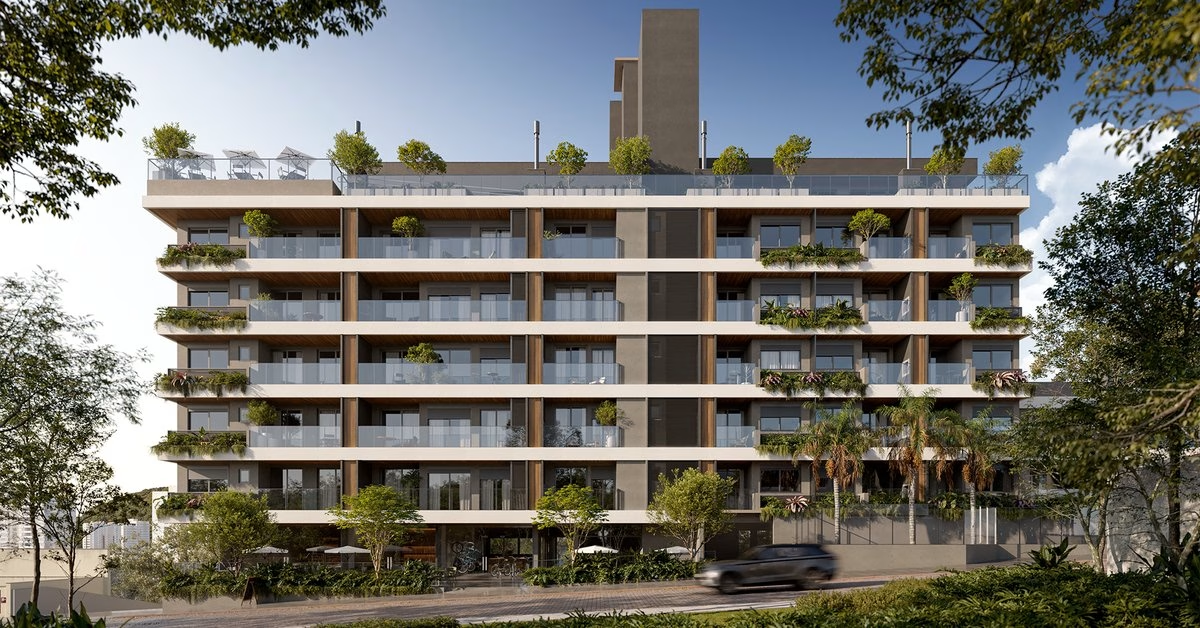
Parko, a development in Trindade that Regente Imóveis follows, is the case where the checklist comes off the paper. The differentiators below were confirmed by the operator. Items that depend on exact measurement, distance in meters, certification, or documentation appear as to confirm, because closed data requires technical verification.
- Stretcher-capable elevator. Confirmed. The exact cabin dimension, to attest compliance with NBR 14712 (1.20 m × 2.20 m), is to confirm.
- Pre-installation of oxygenation in 2-bedroom units. Confirmed. The standard followed in pre-installation is to confirm.
- Concierge with BLS. Confirmed. The certifying body is to confirm.
- Sabin Laboratory adjacent to the development. Confirmed. The exact distance in meters is to confirm.
- Proximity to HU-UFSC, CEPON, and Cardiology Institute. Confirmed. The exact walking distance to HU is to confirm.
- Patrimônio de Afetação with development registered. Confirmed.
- Turnkey delivery, furnished, decorated, and climate-controlled, making it possible for an elderly person to move immediately without weeks of construction. Confirmed.
The central point is not the name of the development. It is that each item on the technical checklist has a verifiable answer, not a generic promise.
Frequently Asked Questions
What Is a Multi-Generational Apartment?
A multi-generational apartment is designed to house more than one generation of the same family, typically grandparents, adult children, and grandchildren, in a single property or in adjacent units in the same development. Beyond shared space, the real concept implies adaptations that make the property safe and functional for people in different life stages: children who need space to play, adults in full professional activity, and elderly who may have reduced mobility or health needs. A property that merely wears the multi-generational label, without these technical adaptations, is just a large apartment.
What Is the Difference Between Multi-Generational and Accessible for People with Disabilities?
Accessibility for people with disabilities is a minimum legal requirement that every multifamily residential condominium must already comply with under ABNT NBR 9050. It includes an access ramp, handrails, doors with 0.80 m openings, and an elevator with cabin minimum for a wheelchair. A multi-generational apartment goes beyond: it considers the complete health cycle of an elderly person, which includes the possibility of hospital stretcher transport, connection to oxygen therapy services, rapid response to cardiac or neurological emergencies, and location near reference hospitals. Accessible design for disability solves the daily life. Multi-generational solves the emergency.
What Does an Elevator Need to Have to Serve an Elderly Person with Health Needs?
The standard residential elevator has a cabin approximately 0.90 m × 1.20 m, which fits a wheelchair but cannot transport an elderly person on a stretcher. A hospital stretcher has typical length around 2 m (exact measurement to confirm with manufacturer) and does not fit in a standard elevator. For stretcher transport, ABNT NBR 14712 defines minimum cabin dimension of 1.20 m wide by 2.20 m long, with door opening of 1.10 m. For a hospital bed, it increases to 1.50 m × 2.20 m. Before signing any contract, ask for the internal cabin dimension in meters and demand the number, not the generic answer that the property is accessible.
What Is an Oxygen Point and Why Does It Matter?
An oxygen point, or pre-installation of medical oxygen gas, is tubing embedded in the wall that lets you connect oxygen cylinders or a supply line without later construction. It is similar to a kitchen gas outlet, sized for medical use. It matters because common diseases in elderly, such as COPD, heart failure, and post-operative recovery from major surgeries, frequently require prolonged home oxygen therapy. Without pre-installation, installing later requires breaking walls, running tubing, and in many cases obtaining condominium approval. With pre-installation, the doctor prescribes, the supplier connects the equipment, and the elderly person is treated the same day.
Does a Condominium with a Doorman Already Handle a Cardiac Emergency?
No, and this is a critical distinction. A doorman without specific training can worsen a cardiac arrest by moving the patient incorrectly or by losing minutes before starting resuscitation. The BLS (Basic Life Support) protocol trains the professional to recognize a cardiopulmonary arrest, initiate CPR, and operate an AED while the ambulance does not arrive. The therapeutic window of a heart attack or stroke is minutes, and immediate CPR significantly increases survival chances. A concierge with BLS certification is a health asset of the condominium.
In Which Neighborhood of Florianópolis Does a Multi-Generational Property Make the Most Sense?
Trindade concentrates the densest health-care infrastructure in Florianópolis in a residential area. The neighborhood is home to HU-UFSC, a high-complexity hospital with ICU, surgery, and medical specialties, within the UFSC Campus. It is the only residential neighborhood in the city with a high-complexity university hospital integrated into the fabric of everyday living. The walking distance from a property in Trindade to HU may be shorter than the distance from other neighborhoods to the nearest emergency room. For families with elderly in oncology or cardiology care, CEPON and the Cardiology Institute are within accessible driving distance. Neighborhoods such as Jurerê Internacional and Campeche have a high-income profile, but require 30 to 50 minute drives to equivalent hospital infrastructure.
Does Multi-Generational Housing Save Real Money?
The numbers point that way, still with ranges to confirm. A family maintaining two separate homes in Florianópolis spends on average R$ 5,000 to R$ 8,000 per month in rent alone, or R$ 60,000 to R$ 96,000 per year without building wealth (figures to confirm). A family considering a private nursing home pays between R$ 5,000 and R$ 12,000 per month, reaching R$ 600,000 to R$ 1.44 million over ten years, also without building wealth. Multi-generational housing converts that operational cost into a transmissible real-estate asset. The aging of Brazil’s population, with the 60-and-over group rising from 8.7% in 2000 to 15.6% in 2023 per IBGE (range to confirm), tends to expand this demand.
Does It Make Sense for Someone Without a Dependent Elderly Person in the Family Today?
Yes, from two perspectives. The first is anticipation: buying the right property before need is cheaper and less stressful than buying in crisis, and the probability that one of the grandparents will show mobility or health limitations in five to ten years is high for someone in their 40s today. The second is market: properties with real multi-generational infrastructure, such as stretcher-capable elevator, concierge with BLS, and hospital location, have growing demand and limited supply in Florianópolis, which tends to sustain the asset value. Those who buy with a ten-year view rarely regret it, while those who buy in emergency usually pay more and have fewer options.
Conclusion
The term multi-generational became a label. What separates the label from real structure is a checklist of measurable, verifiable items: the elevator fits the stretcher, the unit has oxygen pre-installation, the team has BLS certification, the high-complexity hospital is close by, and the wealth is protected by Patrimônio de Afetação recorded.
For those who have built wealth with family in mind, this checklist is what separates buying peace of mind from buying a promise. The right decision is the one you make with the number in hand, before the crisis.
If you want to apply this checklist to a real case, Regente Imóveis conducts real-estate consulting for three-generation families in Florianópolis and follows Parko, in Trindade. Schedule a conversation to get to know Parko and evaluate, point by point, what actually works for your family.