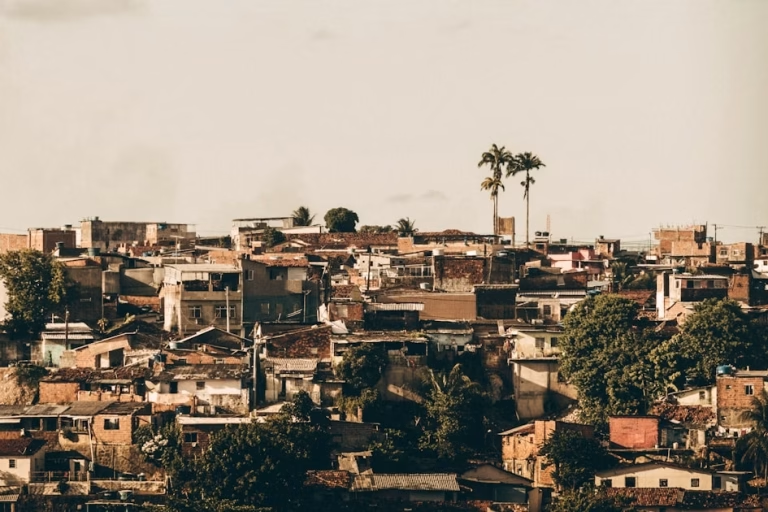
Ask someone from Florianópolis where to live. You’ll hear Jurere, Campeche, Lagoa, Ingleses. Downtown appears, if it appears at all, as a second choice.
That reputation is outdated. Downtown Florianópolis in 2026 is not the same as in 2015. A series of urban interventions — some completed, others still underway — is changing what it means to live there.
This guide documents what changed, what is still coming, and for which profile it makes sense.
What happened to Downtown in recent years
The change is not from one isolated intervention. It is from a set of projects converging in the same territory in a relatively short time frame.
Revitalization of Esteves Júnior — Jan Gehl Architects
The revitalization project of Esteves Júnior Street was developed with the participation of Jan Gehl Architects — the same firm that revitalized streets in New York, Copenhagen, and São Paulo. The project prioritizes pedestrians, cyclists, and mixed-use, reducing the prominence of cars on one of the busiest thoroughfares in Downtown.
For those who live within walking distance, this represents a change in the quality of daily urban experience — not just in the visual appearance of the street, but in flow, pedestrian safety, and the viability of living without depending on a private vehicle.
Marina Park — Downtown’s new green anchor
Marina Park is a project to revitalize the central waterfront of Florianópolis, with public green space, landscaping, and access to the water’s edge. For those living near Rio Branco Avenue, the park is 3 minutes on foot — an anchor for leisure and open space in the city center.
The rollout is happening gradually. The project represents a significant public investment in urban quality in the heart of the island — the kind that, historically, precedes significant property appreciation in the surrounding area.
Restoration of the Hercílio Luz Bridge
The Hercílio Luz Bridge — Florianópolis’s visual symbol — underwent structural restoration and reopened to pedestrian and cyclist traffic. For Downtown, this means a new connection between island and mainland that doesn’t depend on a car, plus a tourist and cultural asset that attracts activity to the region.
Revitalization of Felipe Schmidt
The historic pedestrian mall on Felipe Schmidt Street underwent reforms that restored the pavement and improved the circulation experience. It is the historic commercial axis of Downtown — and its revitalization directly impacts foot traffic and urban vitality in the region.
What is within 15 minutes on foot from Downtown
Living in Downtown Florianópolis — specifically along the Rio Branco Avenue / Waterfront axis — means having within 15 minutes on foot:
Green spaces and leisure:
– Marina Park (3 min on foot — in development)
– Waterfront North (8 min on foot)
– Praça XV de Novembro (5 min)
– Praça Pereira Oliveira (4 min)
Essential services:
– Supermarkets (3–6 min)
– Pharmacies (2–4 min)
– Hospitals and emergency care centers (Governor Celso Ramos Hospital, Regional Hospital — both less than 15 min)
– Banks and public services (concentrated in Downtown)
Dining and shopping:
– Dozens of restaurants, cafes, and bakeries within walking distance
– Public Market (5 min)
– Beira Mar Shopping (2 km / accessible by bike)
Transportation:
– Downtown Terminal (TICEN) — bus hub to all neighborhoods on the island and mainland
– Bikeways on Waterfront North
– Taxi and ride-share apps with minimal wait times
This concentration of services and quality public spaces is what makes Downtown qualitatively different from any peripheral neighborhood — regardless of property price.
The real cost of not having a car
Most housing cost analyses focus on the price per square meter and stop there. But there is a significant cost that rarely enters the calculation: the car.
For those living in peripheral neighborhoods of Florianópolis — Ingleses, Campeche, Ratones, Lagoa da Conceição — a car is not optional. It is survival infrastructure. Here is what that represents:
- Payment or opportunity cost of capital: R$ 600 to R$ 1,500/month in financing or opportunity cost
- Insurance: R$ 200 to R$ 600/month (Florianópolis has high theft rates)
- Vehicle tax, registration, maintenance: R$ 150 to R$ 300/month amortized
- Fuel: R$ 400 to R$ 800/month for intensive urban use
- Parking: R$ 100 to R$ 400/month depending on frequency of outings
- Depreciation: invisible, but real — 10 to 15% per year
Total: R$ 1,500 to R$ 3,600/month in mobility costs alone — not counting time lost in traffic.
Those living Downtown and forgoing a car have that amount available for other purposes: property payment, investments, quality of life, leisure. The more expensive Downtown property — compared to the cheaper peripheral property plus car — often has a lower total cost.
What is coming in the next few years
Beyond the interventions underway, there are confirmed or advanced-stage projects that tend to impact Downtown in the next few years:
- Expansion of bikeways in historic Downtown — part of the municipal active mobility policy
- New commercial and dining establishments on Waterfront North — the corridor is already a target for private investment
- Growth of the technology hub — technology companies and startups continue to concentrate in Florianópolis, and most of their professionals prefer to live close to work and services
Downtown Florianópolis is at an inflection — the kind that, when observed retrospectively, is usually described as “that moment when it would have been worth buying.”
For whom Downtown makes sense
Young technology, design, or consulting professional. Works remote or has an office Downtown. Wants urban quality, does not accept being dependent on a car. The compact, well-located apartment is the rational choice — not a compromise.
Digital nomad based in Florianópolis. Spends part of the year in the city, another part elsewhere. Wants a functional, well-located base that can be rented when away. Downtown delivers that.
Professional tired of hours in traffic. Already experienced living in a distant neighborhood. Knows the cost in time and money that represents. Wants to reverse the equation.
Investor seeking a high-liquidity rental property. Rental in Downtown Florianópolis — especially in a furnished, well-infrastructured property — has consistent demand. The concentration of professionals and business travelers Downtown keeps the market hot.
For whom Downtown does NOT make sense
Family with school-age children. Most reference private schools are outside Downtown — which imposes displacement regardless of how good the location is for the adult.
Someone who needs daily contact with nature. Florianópolis has beaches, trails, and forests in more distant neighborhoods. Those who won’t give up waking up to ocean or forest views will sacrifice central location.
Someone with logistics operations — who receives merchandise, has work vehicles, needs a large garage. Downtown was not planned for that.
Frequently asked questions about living in Downtown Florianópolis
Is Downtown safe to live in?
Downtown Florianópolis has crime rates comparable to downtown areas of similarly-sized Brazilian cities — neither a complete absence of problems nor the insecurity levels of metropolises like São Paulo or Rio. The perception of safety improves with the vitalization of public space — and the ongoing interventions tend to have that effect. As in any urban center, standard personal security precautions apply.
Isn’t traffic a problem?
Traffic is a problem for those passing through it by car. For those living Downtown and getting around on foot or by bike, traffic affects daily life little. In fact, it is one of the advantages of living Downtown: traffic is someone else’s problem.
Is there a supermarket nearby?
Yes. Downtown Florianópolis has supermarkets within 5 to 10 minutes on foot from practically any central address — plus smaller markets and farmers markets nearby.
How much does it cost to live Downtown?
Apartment rental in Downtown Florianópolis varies widely — from R$ 2,500/month for compact studios to R$ 8,000/month or more for larger units. For purchase, the square meter in the region ranges around R$ 12,000 to R$ 21,000/m² depending on the property standard and exact location. The market for new, compact properties Downtown is scarce — which sustains prices.
Is it worth buying in Downtown Florianópolis in 2026?
The combination of urban interventions underway, scarcity of quality new properties, and growing demand for central urban housing creates favorable conditions for those buying now. The timing of urban revitalization — buy during, not after — is historically the most favorable.
Want to know the only pre-launch in pre-registration at Downtown Florianópolis?
The Parkside Rio Branco is in the pre-launch phase — the price list will be revealed at a closed event for leads registered on May 28. There are no public prices released yet.
If you want to have access to the typologies, available floors, and conditions before the general public opening, the path is to pre-register now.